Seventy-two spirits, a 17th-century grimoire, and a modern technique that swaps the magic circle for the inner landscape of the mind. This is the story of Goetic pathworking, from the tradition’s roots to the claims people make about it today.
Close Your Eyes and Walk Toward the Demon
Okay, so picture this. You’re sitting in a dark room with a candle, looking at a strange seal drawn on a piece of paper. You close your eyes, and in your mind you walk down a stone staircase, through a doorway, into a landscape you’ve never seen. And waiting at the end of the path is one of the seventy-two spirits of the Ars Goetia, the most infamous demon catalog in Western magic.
That’s Goetic pathworking in a nutshell. It mashes up two very different traditions. One is the old Solomonic grimoires, all circles, triangles, and commanding spirits in the names of God. The other is a 20th-century visualization technique that grew out of the Golden Dawn and its offshoots.
So how did a book of “evil spirits” end up as a guided meditation? Let’s hop right into it, shall we?
What Is Pathworking?
“Pathworking” is basically guided, structured visualization, sometimes described as a kind of astral journey. The name comes from the Qabalistic Tree of Life: ten spheres (Sephiroth) connected by twenty-two paths. In Golden Dawn-style systems, each path has its own correspondences, like a Hebrew letter, a tarot trump, colors, and symbols. “Working” a path means traveling it in your imagination using those symbols as the scenery.
The technique is pretty young as occult practices go. The writer Alex Sumner points out that path-working “does not seem to have existed as an occult practice prior to the occult revival of the late nineteenth century.” It seems to have grown out of the clairvoyant work of the Stella Matutina, a Golden Dawn offshoot. According to Israel Regardie’s account, a lecture by J. W. Brodie-Innes (Frater Sub Spe) described re-reading the initiation rituals and then trying to “re-tread the Paths astrally”: picturing a giant pylon with the Hebrew letter Tau in its gate, then passing through it into a vision.
From there it spread through the Western Mystery Tradition:
- Dion Fortune (Violet Firth, 1890–1946), who trained in the Alpha et Omega, a Golden Dawn successor, founded the Fraternity (later Society) of the Inner Light. According to Sumner, she was fine with guided meditations “up to a point,” but wanted the leader to leave silent gaps so participants could find their own insights.
- W. E. Butler, one of Fortune’s students, founded the Servants of the Light in 1973. Dolores Ashcroft-Nowicki later took it over, and she wrote The Shining Paths, a whole book of pathworkings for the Tree of Life.
- The Aurum Solis used path-working as a fully guided meditation, where the leader tells participants what they experience.
Here’s the important thing: pathworking was originally about the Tree of Life, which means angels, god-forms, and the climb toward the divine. Pointing it at demons came later.
What Is the Ars Goetia?
The word comes from the Ancient Greek goēteia, meaning “charm,” “witchcraft,” or “jugglery.” It’s tied to goēs, a sorcerer. In medieval and Renaissance Europe, goetia meant the bad kind of magic, dealing with evil spirits, as opposed to theurgia (theurgy) and natural magic. Agrippa says flat out in his Three Books of Occult Philosophy that goetia is “abandoned and execrated by all laws.”
When occultists say “the Goetia” today, they usually mean the Ars Goetia, the first of five books in the Lemegeton Clavicula Salomonis, or Lesser Key of Solomon:
- Ars Goetia – the 72 spirits
- Ars Theurgia-Goetia – spirits of the compass points
- Ars Paulina – angels of the hours and the zodiac degrees
- Ars Almadel – contacting angels through a wax tablet
- Ars Notoria – prayers meant to boost memory and learning
Here’s a fun fact: the manuscripts never actually call it “the Lesser Key.” A. E. Waite may have coined that name in 1898. The Lemegeton itself was compiled in the mid-17th century out of material that’s centuries older.
The Roots: Solomon, Weyer, and the Grimoires
The legend goes way back. The Testament of Solomon, a Greek pseudepigraphal text usually dated to the early centuries CE, tells how King Solomon got a magic ring that let him bind demons, question them, and put them to work building the Temple. That image of Solomon as master of demons runs through the whole grimoire tradition. I went into the Testament on our Demonology in Medieval Europe (Ep 103) episode.
The most direct source for the Ars Goetia, though, is the physician Johann Weyer. In 1577 he published the Pseudomonarchia Daemonum (“False Monarchy of Demons”) as an appendix to his book De praestigiis daemonum. Here’s the wild part: Weyer was a skeptic of witch trials. He published the demon list to show how ridiculous it was. Instead, it became raw material for later magicians.
The Ars Goetia’s list doesn’t match Weyer’s exactly. It reorders the spirits, adds four (Vassago, Seere, Dantalion, and Andromalius), and drops one (Pruflas). That gets you to the famous seventy-two. Scholars think the compiler leaned more on Reginald Scot’s English translation of Weyer in The Discoverie of Witchcraft (1584) than on Weyer directly. There’s also material taken from Agrippa, the Heptameron attributed to Pietro d’Abano, and the Magical Calendar.
In one 17th-century version, copied by Dr. Thomas Rudd, each demon is paired with one of the 72 angels of the Shem HaMephorash to protect the magician and keep the demon in check. Stephen Skinner and David Rankine published that version in 2007 as The Goetia of Dr Rudd. Joseph H. Peterson’s 2001 Weiser edition of the Lesser Key of Solomon is widely treated as the standard scholarly text.
The Spirits Themselves
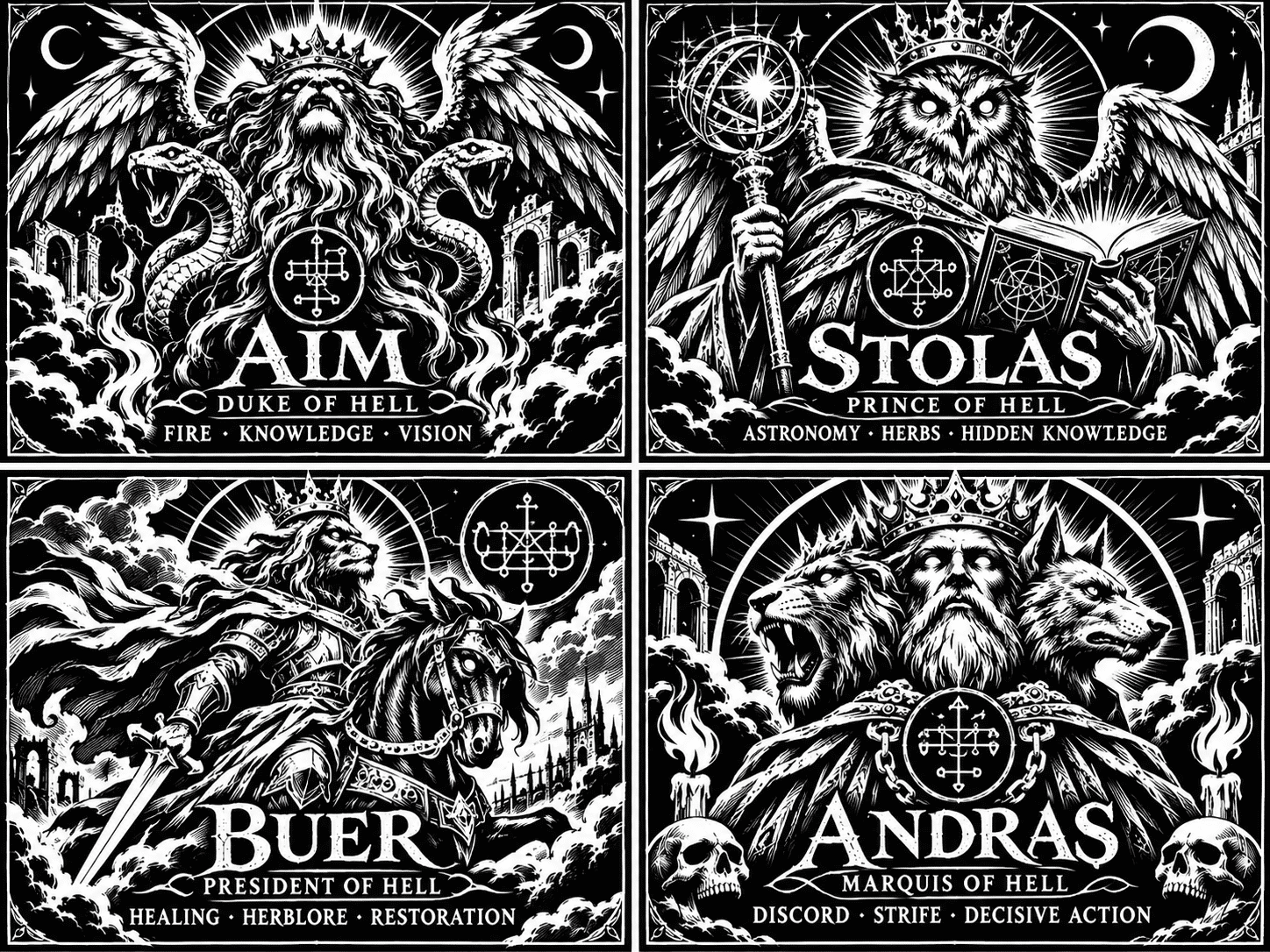
Each of the seventy-two gets a rank (king, duke, prince, marquis, president, earl/count, knight), a list of powers, a description of how it appears, and a seal, or sigil. King Bael comes first. King Paimon is number nine, which fans of Hereditary will recognize from our Hereditary and Paimon the Demon King (Ep 117) episode. The list ends with Count Andromalius, who recovers stolen goods.
The traditional method is pretty intense. The magician stands inside a protective circle, the spirit is supposed to appear in a triangle outside it, and the conjurations call on God’s names to command and bind the spirit. You don’t make friends with a Goetic spirit in this framework. You order it around under divine authority.
Crowley, Mathers, and the Brain
The big turning point came in 1904. Samuel Liddell MacGregor Mathers, a founder of the Golden Dawn, had prepared an English translation of the Goetia from manuscripts in the British Library. After their famous falling-out, Aleister Crowley published it under the title The Book of the Goetia of Solomon the King, and the title page credits the translation to “a dead hand.”
Crowley added extra invocations, including the “Preliminary Invocation” and some Enochian material, plus an essay called “The Initiated Interpretation of Ceremonial Magic.” And here’s the line everybody quotes:
“The spirits of the Goetia are portions of the human brain.”
He takes it further. A spirit’s seal, he says, is a way of “stimulating or regulating those particular spots (through the eye),” and the line “The Spirit Cimieries teaches logic” really means that “those portions of my brain which subserve the logical faculty may be stimulated and developed.”
What a lot of people miss is that Crowley doesn’t totally stop there. He writes that he is “not concerned to deny the objective reality of all ‘magical’ phenomena,” and then says “Unfortunately, we cannot stop there” before moving on to the Goetia’s more outrageous promises. So the “it’s all in your head” reading came from Crowley, but he was hedging. Still, that essay opened the door to treating the Goetia psychologically, and pathworking walks right through it.
If you want the full Crowley saga, check out our Life of Aleister Crowley (Ep 73) and Aleister Crowley with Coralyn (Ep 129) episodes.
How the Interpretations Changed
Over the 20th and 21st centuries, the Goetia split into a bunch of different reality tunnels:
1. Traditional evocation. The spirits are real, external beings. You use protection and divine names to call them up and bind them. This is the grimoire’s own framework, and some modern “traditionalists” work from historical editions like Peterson’s or the Rudd manuscript.
2. The psychological model. Following Crowley’s essay, the spirits are parts of the mind. A lot of modern practitioners borrow Carl Jung’s idea of the shadow, the disowned parts of the self, and describe Goetic work as a kind of shadow work: meeting your anger, lust, or fear as a “demon” so you can integrate it. Jung didn’t write about the Goetia himself, though. This is practitioners applying his ideas.
3. Crowley’s heirs, modernized. In 1992, Lon Milo DuQuette and Christopher S. Hyatt published Aleister Crowley’s Illustrated Goetia: Sexual Evocation, illustrated by David P. Wilson. It strips down the old procedures and includes chapters like “Goetia Evocation and Psychological Types.” According to a Spiral Nature review, the authors warn that Wilson’s sketches of the spirits aren’t “what you must see.” They’re “intended to serve only as springboards to your imagination,” because no two people have the same “visual-emotional ‘vocabulary.'” That’s basically the pathworking mindset already.
4. Chaos magic. Starting in the late 1970s, chaos magicians argued that belief itself is a tool, and that you can pick up a framework like the Goetia, use it, and drop it again. Under that approach, whether the spirits are “real” matters less than whether working with them gets results.
5. Demonolatry. In books like Modern Demonolatry (copyright 1997–2010), S. Connolly flips the whole relationship. Demons are honored, even worshipped, as divine or powerful beings instead of being bound and threatened. Connolly is careful to say that demonology is the study of demons, while demonolatry is the worship and practice.
6. Left-Hand Path and Qliphothic work. Asenath Mason, a Polish author and artist who founded the Temple of Ascending Flame in 2012, has written heavily on the Draconian Tradition and the Tree of Qliphoth, the “dark side” of the Tree of Life. Her book Tunnels of Set gives pathworkings (“guided ritual meditations”) for the 22 Qliphothic tunnels, and the publisher describes them as including demonic tunnel guardians. To be clear, that’s Qliphothic work and not the Ars Goetia’s 72 spirits specifically. It’s the same move, though: pathworking pointed at the dark side of the Tree.
Goetia Pathworking: What Practitioners Actually Do
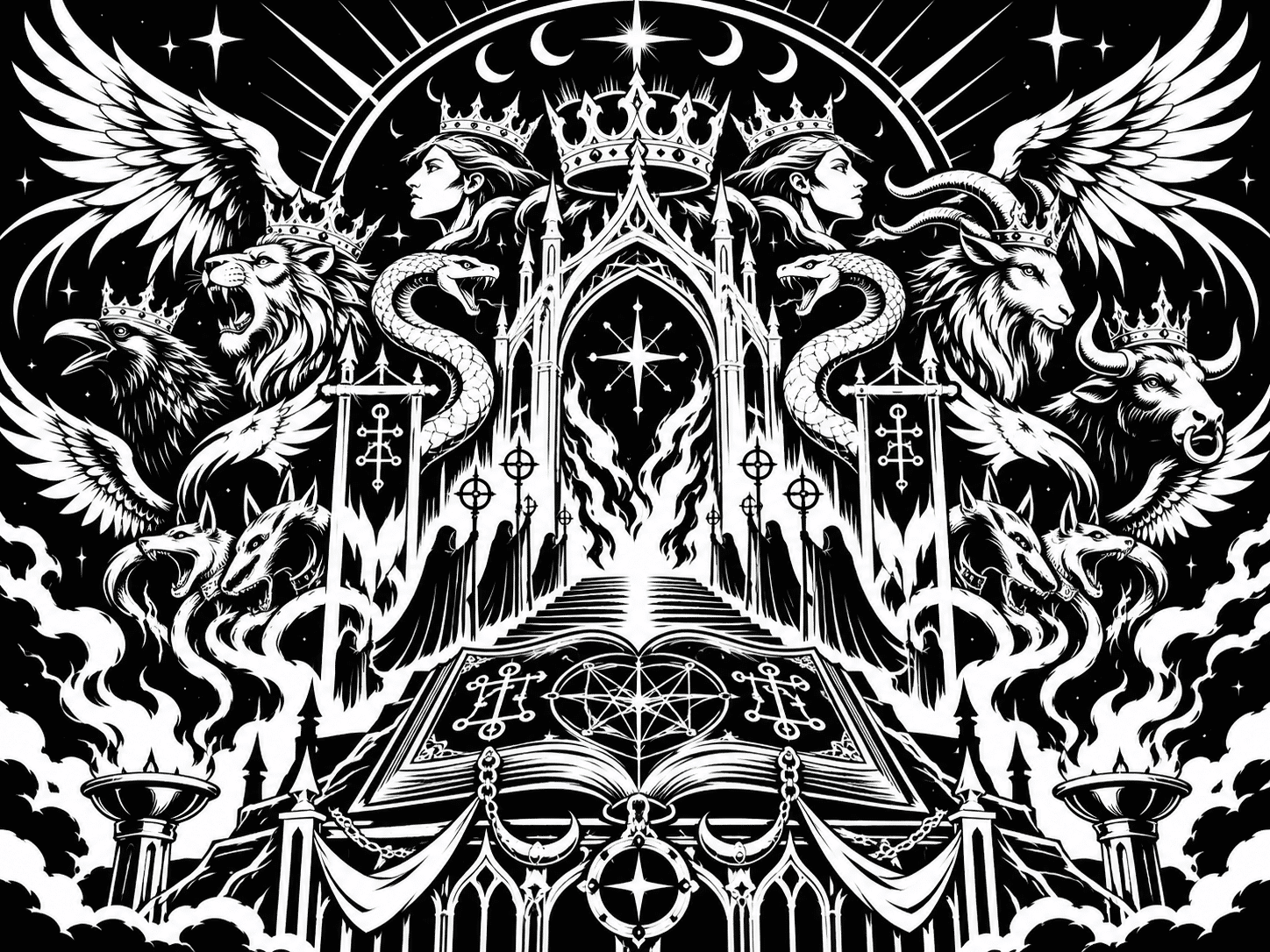
Pathworking books for the Goetia exist. One example is Corwin Hargrove’s Goetia Pathworking: Magickal Results from The 72 Demons (2019). Methods vary a lot, but the reported basics go something like this:
- Preparation. Relaxation, breathing, sometimes a banishing ritual like the Lesser Banishing Ritual of the Pentagram. DuQuette and Hyatt’s book includes the LBRP in its appendix.
- The seal. Gazing at the spirit’s sigil to focus attention on that one spirit. Hargrove’s book specifically says you “only need to look at the sigils in this book.”
- The journey. Visualizing a sequence of scenes (a path, a door, a landscape) that leads to where the spirit is. Hargrove’s version uses what he calls “Elemental Imagery.”
- The encounter. Talking with the spirit in the vision: asking questions, making a request, or just watching.
- Return and recording. Walking back out the same way, grounding, and writing down what happened.
The big selling point is accessibility. Hargrove’s marketing says no robes, no incense, no circle, “nothing to burn, collect, or make,” and that it’s “extremely safe and easy to learn.” That’s a big departure from the grimoire tradition, which treats this stuff as dangerous and very strict.
What Practitioners Claim to Experience
Everything here is a claim made by practitioners. None of it is verified:
- Vivid visions of the spirit, often in forms that differ from the grimoire’s descriptions. DuQuette and Hyatt say outright that each person’s imagery will be unique.
- Communication: words, impressions, symbols, or sigils that people say are “received” in trance. The Tunnels of Set materials talk about sigils “received directly” from tunnel guardians during astral travel.
- Changes in their lives, ranging from psychological insight and confronting fears to claimed real-world results like love, money, or influence, which are the kinds of powers the Goetia lists.
- Shared visions. Mason’s Temple says it ran multi-year group projects where participants compared what they experienced to see whether the imagery matched up.
Some people say the spirits feel independent and alive, and others say it feels like meeting parts of themselves. Honestly, that split is the Crowley debate all over again.
Cautions and Criticisms
It’s only fair to cover the pushback:
- Religious objections. In Christianity, Judaism, and Islam, calling on demons is forbidden or considered spiritually dangerous, whatever the method. Even the grimoire tradition called goetia the “unlawful” side of magic. Pathworking doesn’t get around that for believers. If anything, the “easy and safe” pitch is exactly what critics worry about.
- Traditionalist objections. A lot of grimoire purists argue that dropping the circle, the divine names, and the binding throws out the safety features the system was built on.
- Psychological cautions. Deep trance and imagery work can stir up intense emotions. Anyone with a history of dissociation, psychosis, or severe anxiety should be careful with altered-state practices in general, and it’s worth talking to a mental-health professional before trying them. A vision that “talks back” can feel really real.
- Skeptical view. From the outside, pathworking looks like guided imagery, plus expectation and suggestion. Its results can be explained as psychological effects with no spirits involved.
So What Is Goetic Pathworking, Really?
It’s a hybrid: a seventeenth-century demon list, built from a sixteenth-century skeptic’s catalog, built on an ancient legend about a king with a magic ring, now explored with a meditation technique invented by Victorian and Edwardian occultists. The Goetia went from “commanding evil spirits by the names of God,” to Crowley’s “portions of the human brain,” to shadow work, demonolatry, and guided journeys into the dark side of the Tree.
Whether the spirits are out there, in here, or nowhere at all, Goetic pathworking is a perfect example of how occult traditions don’t stay frozen. They keep getting reinterpreted, and this ineffable universe we call home keeps getting stranger.
Want to go deeper? Check out these episodes of Cryptic Chronicles: Demonology (Ep 85), Demonology in Medieval Europe (Ep 103), Demonology: The Renaissance (Ep 137), Demonology: The Enlightenment (Ep 160), Hereditary and Paimon the Demon King (Ep 117), The Life of Aleister Crowley (Ep 73), Aleister Crowley with Coralyn (Ep 129), and John Dee with Thomas Birmingham (Ep 84).
Until next time, stay curious, stay strange, and keep exploring the unknown.
Sources
- The Lesser Key of Solomon overview (Wikipedia): https://en.wikipedia.org/wiki/The_Lesser_Key_of_Solomon
- Crowley, “The Initiated Interpretation of Ceremonial Magic” (Hermetic Library): https://hermetic.com/crowley/goetia/the-initiated-interpretation-of-ceremonial-magic
- Mathers/Crowley Goetia, full text (Project Gutenberg): https://www.gutenberg.org/files/72679/72679-h/72679-h.htm
- Lemegeton / Goetia, ed. Joseph H. Peterson (Esoteric Archives): https://www.esotericarchives.com/solomon/goetia.htm
- Johann Weyer, Pseudomonarchia Daemonum (Esoteric Archives): https://www.esotericarchives.com/solomon/weyer.htm
- Testament of Solomon, trans. F. C. Conybeare (Sacred Texts): https://sacred-texts.com/chr/tos/index.htm
- Agrippa, Three Books of Occult Philosophy (Esoteric Archives): https://www.esotericarchives.com/agrippa/agrippa1.htm
- Alex Sumner, “Path-working on the Qabalistic Tree of Life” (Journal of the Western Mystery Tradition): http://www.jwmt.org/v1n3/pathworking.html
- “What Are Pathworkings?” (Llewellyn): https://www.llewellyn.com/journal/article/2850
- Dion Fortune (Wikipedia): https://en.wikipedia.org/wiki/Dion_Fortune
- Dolores Ashcroft-Nowicki, The Shining Paths (Thoth Publications): https://www.thoth.co.uk/books/the-shining-paths
- DuQuette & Hyatt, Aleister Crowley’s Illustrated Goetia (Google Books): https://books.google.com/books/about/Aleister_Crowley_s_Illustrated_Goetia.html?id=SyjhxSAKvHcC
- Review of Aleister Crowley’s Illustrated Goetia (Spiral Nature): https://www.spiralnature.com/reviews/aleister-crowleys-illustrated-goetia-duquette-hyatt/
- S. Connolly, Modern Demonolatry (PDF, demonolatry.org): https://demonolatry.org/wp-content/uploads/2019/10/ModernDemonolatry.pdf
- Asenath Mason, Tunnels of Set (Become A Living God): https://www.becomealivinggod.com/asenathmason/tunnelsofset/
- Corwin Hargrove, Goetia Pathworking (Goodreads): https://www.goodreads.com/author/show/15862140.Corwin_Hargrove

0 Comments