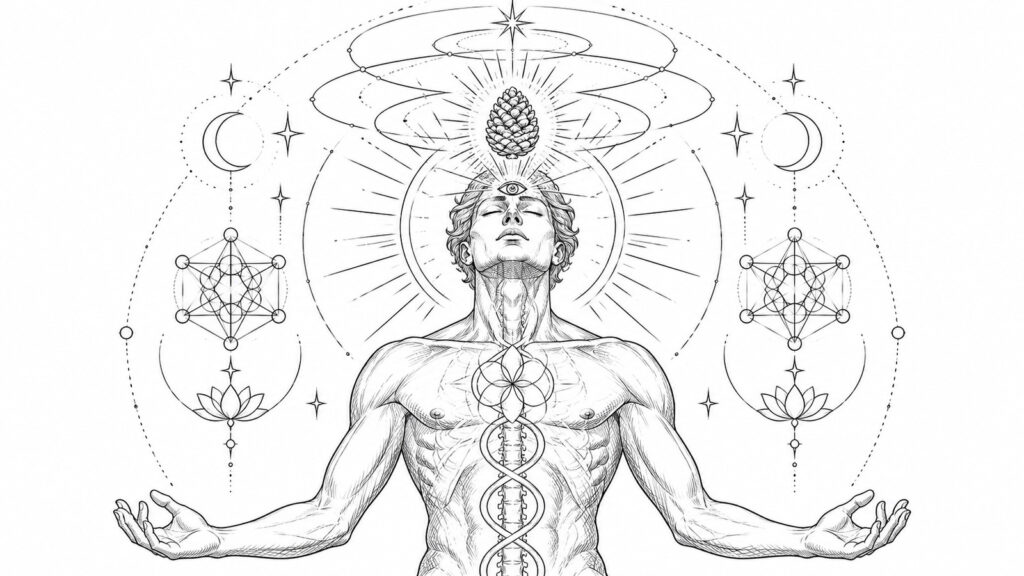
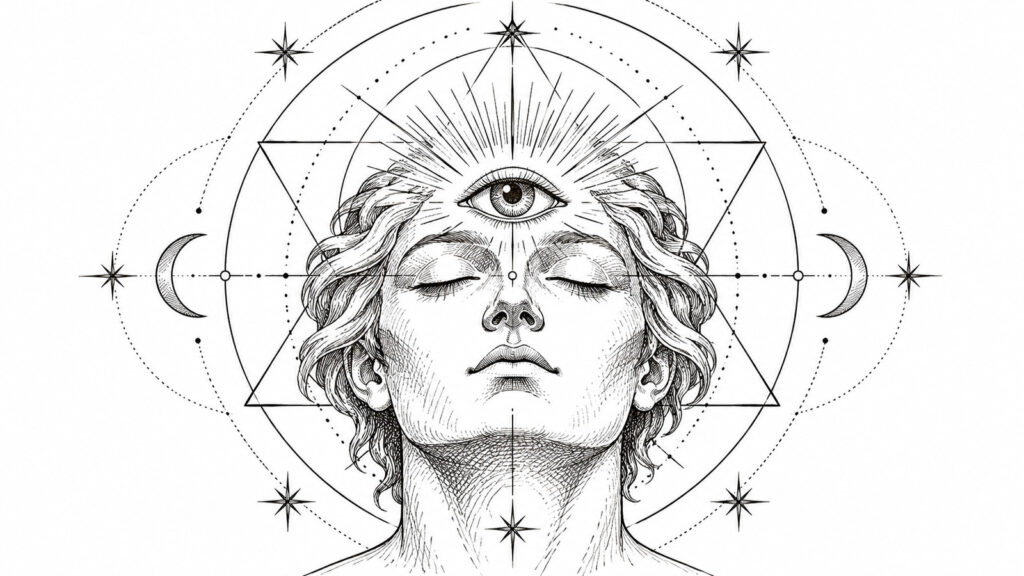
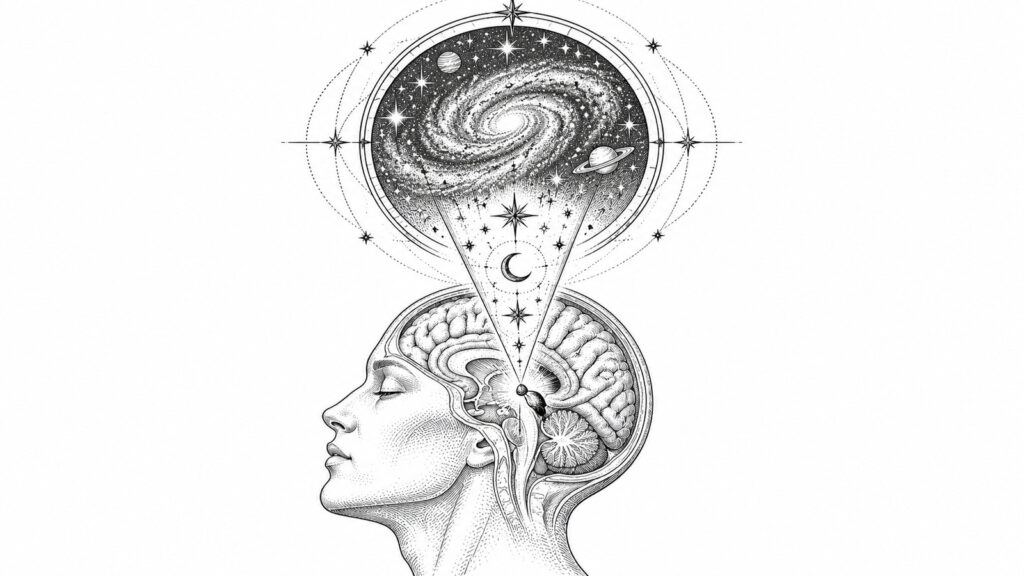
Spiritually, the pineal gland is called the third eye: a tiny pinecone-shaped gland in the middle of the brain that believers say is the doorway between physical sight and inner sight, and that Descartes called the seat of the soul.
The pineal gland is a pinecone-shaped speck of tissue sitting near the middle of your brain, and for a few hundred years now people have been calling it the seat of the soul. Philosophers, yogis and Theosophists all seem to be pointing at the same tiny spot behind your forehead, and believers say a very famous bronze pinecone in the Vatican is pointing there too.
The mainstream herd will tell you it’s a little hormone factory and leave it there. Fine. But there’s a whole second story running underneath that one, and it’s a good one. It covers where the lore came from, why believers say the gland can get “calcified,” what they do about it, and the abilities people say open up when it’s working. So let’s hop right into it, shall we?
What Is the Pineal Gland and What Does It Do?
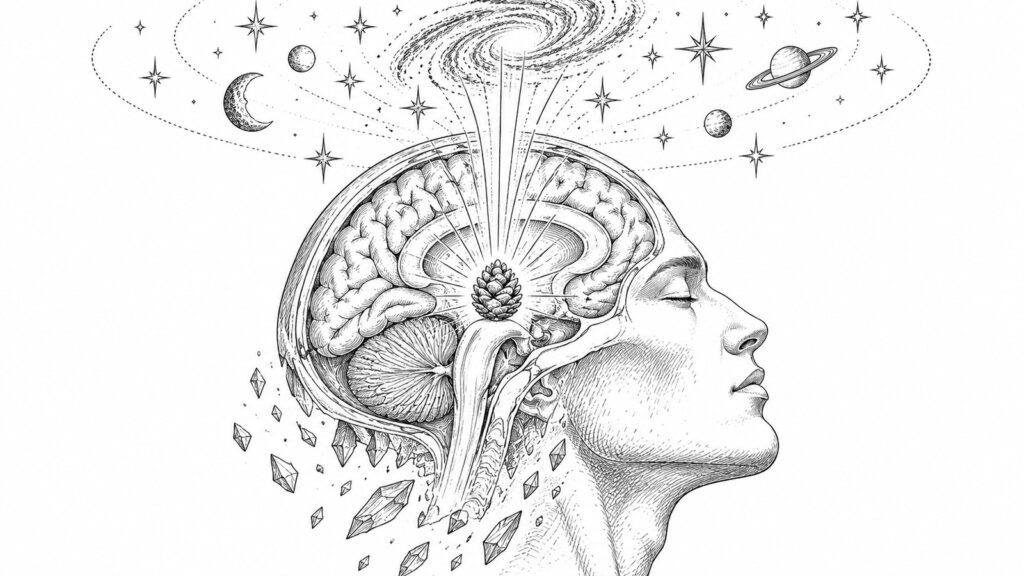
According to the StatPearls physiology entry from the National Library of Medicine, the pineal gland is a small, single, pinecone-shaped gland about 0.8 centimeters long and roughly a tenth of a gram in an adult. It sits behind the third ventricle, deep in the middle of the brain. The name comes from the Latin word for pinecone, which is a big part of this whole story.
What it does, as far as the textbooks go, is make melatonin. Light hits your eyes, the signal travels through the brain’s clock, and the pineal gland holds back. When it gets dark, the gland turns melatonin up. That’s the body’s day and night rhythm, run by something about the weight of a grain of rice.
Now here’s the part I love. Some animals have a pineal gland that is basically an eye. The tuatara, a lizard-like reptile from New Zealand, has a parietal eye on top of its head with a lens-like structure and a simple retina. Ivan Schwab and Gregory O’Connor describe it in a 2005 piece called “The lonely eye.” It doesn’t form pictures. It senses light. But it’s an eye, built from the same pineal complex, and it’s sitting right there on top of the skull.
Believers hear that and go, yeah, that’s the point. Humans carry the leftover. Hold that thought, because somebody wrote exactly that in 1888.
Why Did Descartes Call the Pineal Gland the Seat of the Soul?
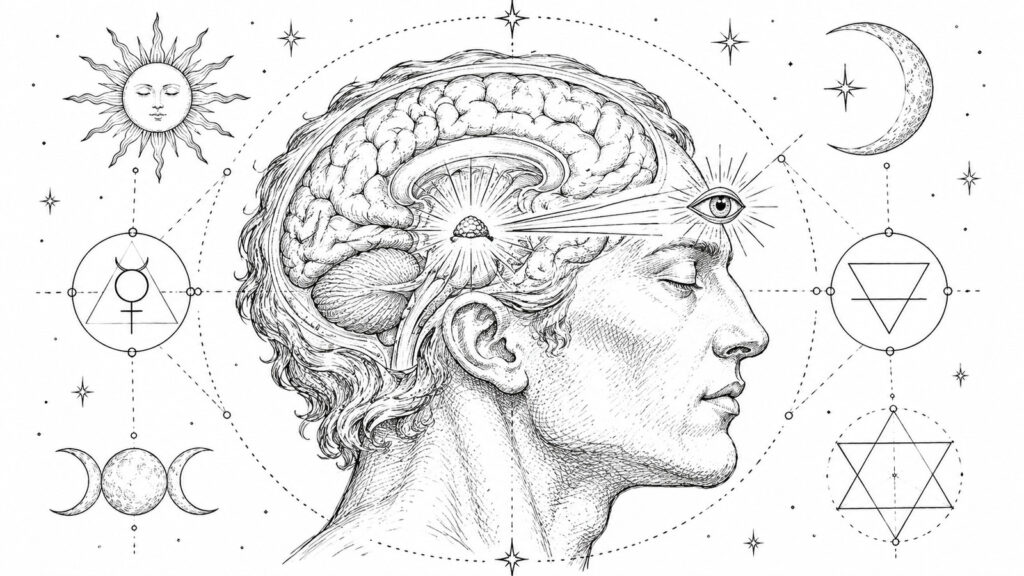
In 1649, Descartes argued that the soul acts most directly through the one unpaired gland in the middle of the brain, which he identified as the pineal gland.
The first big name is René Descartes. In his 1649 book The Passions of the Soul, he had a problem. He believed the soul and the body were two different kinds of thing, so where do they actually touch?
He looked through the brain and landed on one spot. In the translation linked in the sources below, he writes that the soul “exercises its functions” most directly in “a certain very small gland situated in the middle of the brain’s substance.” The next article in the book is titled “How We Know That This Gland Is the Principal Seat of the Soul.”
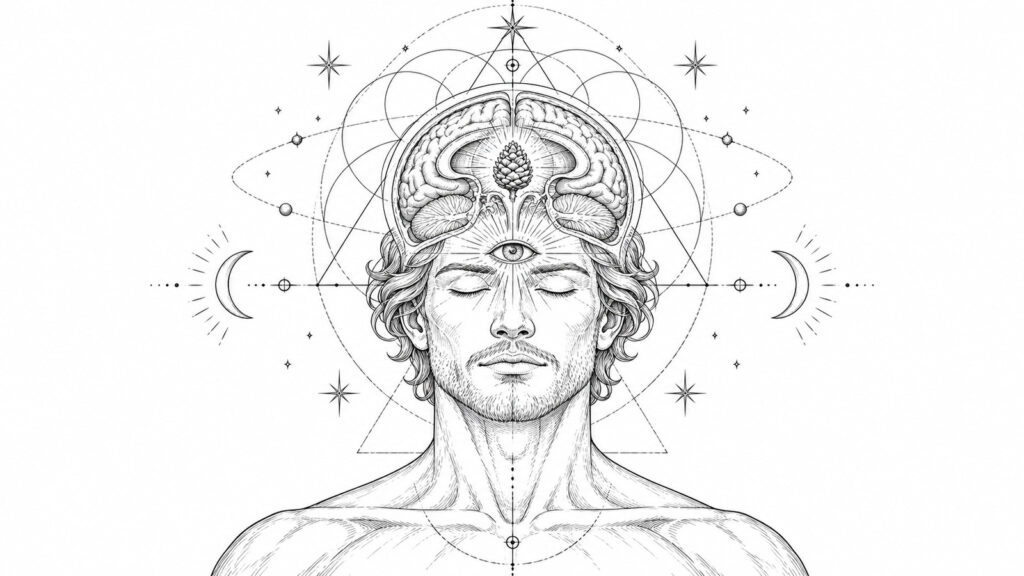
His reasoning is almost cute. Most of the brain comes in pairs, he says, like two eyes and two ears. But we only have one thought about a thing at a time. So somewhere the two images have to merge into one before they reach the soul, and he figured the one unpaired gland in the middle was the only candidate. Modern anatomy didn’t back him up on the details, and philosophers have been picking at that idea ever since. Still, a major thinker of the 1600s, no occultist at all, looked at the human head and pointed to this exact gland as the doorway for the soul. I think that’s wild, and it’s why every pineal lore article eventually comes back to him.
What Is Ajna, the Third Eye Chakra?
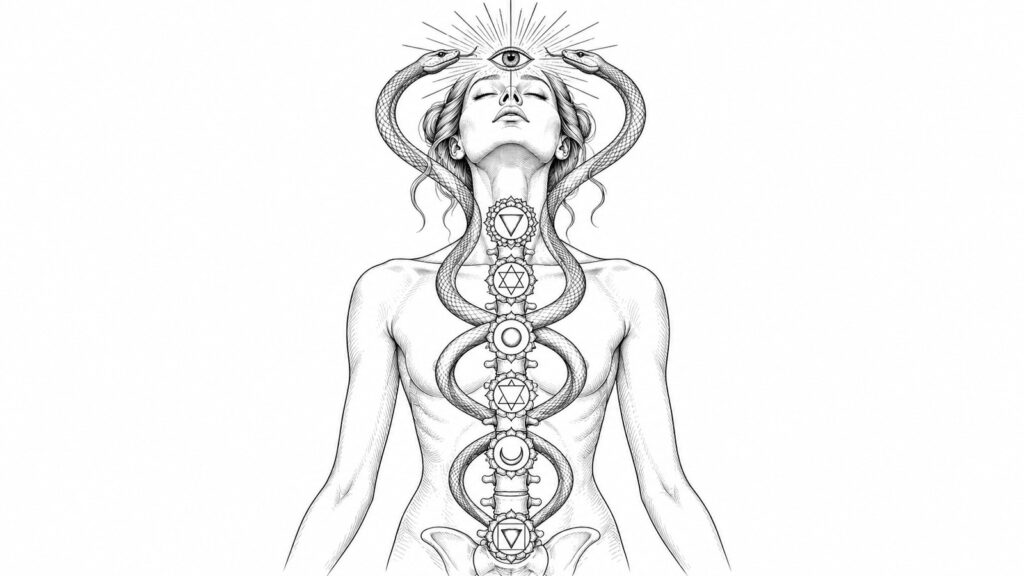
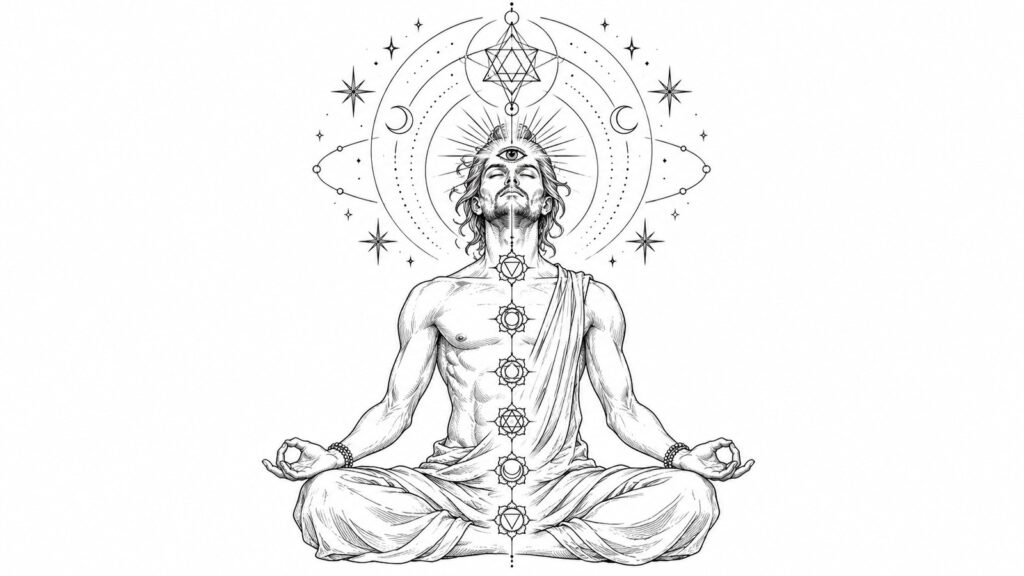
Ajna is the sixth of the seven main chakras, a two-petaled lotus between the brows that yogic tradition links to the third eye.
Long before Descartes, Indian yogic tradition already had a spot between the eyebrows that mattered. It’s called Ajna, the sixth of the seven main chakras. The Sanskrit word means “command.” In the Ṣaṭ-cakra-nirūpaṇa, a Tantric text that Sir John Woodroffe published in English as part of The Serpent Power in 1919 under the pen name Arthur Avalon, Ajna is a two-petaled lotus between the brows. The commentary says it gets the name because that’s where the guru’s command is received.
Shiva gets the famous third eye here too. He’s called Tri-bochana, “three-eyed,” and in the stories that eye can burn through illusion, and through a lot of other things as well.
A Taoist version of the idea turns up in inner alchemy. The upper dantian is also called the Niwan palace, the Crystal Palace, or the “square inch,” a spiritual center inside the head. Some modern writers match it to the pineal gland, though that match is a modern one and the classical sources don’t make it.
And here’s a little twist that most pineal articles skip. The Theosophist C. W. Leadbeater, in his 1927 book The Chakras, tied the sixth center, the brow, to the pituitary body, and the seventh, the crown, to the pineal gland. Then he says some people bend the seventh until it lines up with what he calls the “atrophied organ” known as the pineal gland, and for them it becomes a line of communication. So the idea that the pineal gland is the third eye is a blend of a few traditions that got stirred together in the West. That doesn’t bug me. A lot of lore is built like that, and it still points at the same spot.
What Did Blavatsky Say About the Pineal Gland?
In The Secret Doctrine (1888), Blavatsky said the human third eye was once a working organ and that the pineal gland is its leftover witness.
If there’s one person who put the pineal gland on the occult map in the modern West, it’s Helena Blavatsky. In The Secret Doctrine (1888), she says the human third eye was once a real, working organ. Her version of the distant past is that early humans saw through it, and that it faded as the two physical eyes developed.
Here’s the line everybody quotes. “The third eye is dead, and acts no longer; but it has left behind a witness to its existence. This witness is now the PINEAL GLAND.” (The Secret Doctrine, Vol. 2, p. 295.) She ties it straight to the “eye of Siva” in the Hindu tradition and to the old Cyclops stories.
She also leaned on the science of her day. She points to the lizard-like Hatteria, which is the tuatara from earlier, and she quotes Quain’s Anatomy on how the pineal develops. So she wasn’t just waving her hands. In the 1880s she saw that a reptile carries a light-sensing eye on top of its head, and she tied that to a human gland that looks like leftover equipment. I’d call that a pretty sharp catch for someone the mainstream still waves off.
Theosophy then handed the idea to everyone who came after. In 1956, a book called The Third Eye by “T. Lobsang Rampa” became a bestseller, with a story about a Tibetan monk having a hole drilled in his forehead to open his psychic sight. Honestly, it isn’t the best case to build anything on. The Daily Mail revealed in 1958 that the author was Cyril Hoskin, a plumber’s son from Devon who’d never been to Tibet, and Hoskin kept saying the spirit of a Tibetan lama had taken over his body. Weak source, sure. But the book put the words “third eye” in front of a huge audience, and the lore grew from there.
Is the Pineal Gland Linked to the Eye of Horus and the Vatican Pinecone?
Now to the symbols, where the lore gets a little more visual.
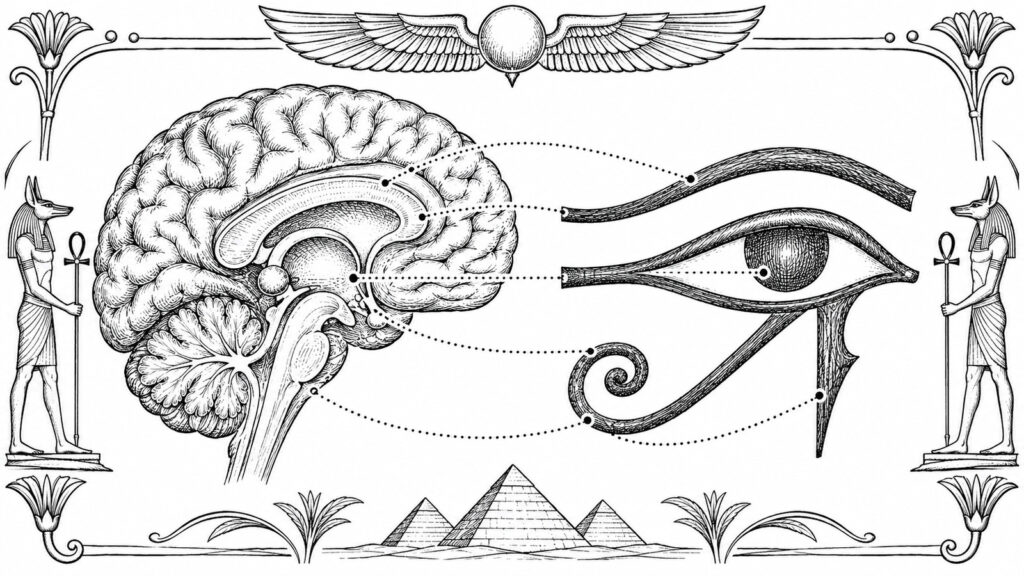
The Eye of Horus. The wedjat was an Egyptian symbol of protection and healing. In the myth, Horus’s eye is torn out in his fight with Set and restored. Egyptologists treat it as a symbol of wholeness. But believers lay the symbol over a side view of the brain, say the pieces of the eye line up with structures in the middle of the head, and point to the pineal gland. No Egyptian text says “this is the pineal gland.” Still, Karim ReFaey and colleagues published a 2019 paper in the journal Cureus that put the Eye of Horus on a sagittal image of the brain, and said each part of the eye appears to match the location of a particular sense. They call their idea “possible scientific speculation,” which I kind of love. It’s honest about being a reach, and somebody still went and did it.
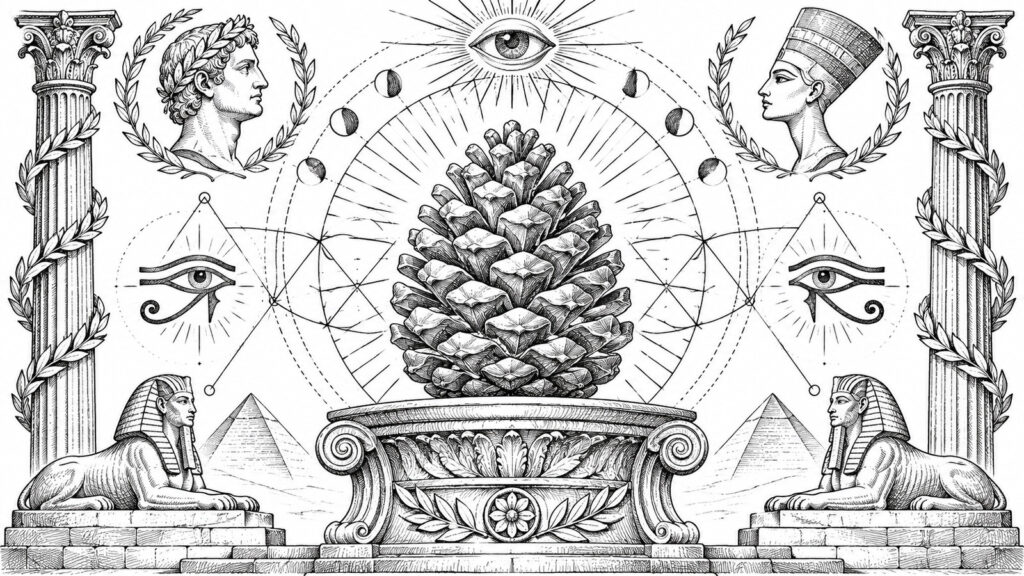
The Pigna. In the Vatican Museums there’s a bronze pinecone almost four meters tall, called the Pigna. According to the Vatican’s own description, it was made in the first or second century AD, it’s signed by a Roman bronze-caster named Publius Cincius Salvius, and it possibly decorated a monument in Rome’s Campus Martius. One scholar’s theory, reported by the Treccani encyclopedia, puts it on a fountain near the Serapeum, and some say the temple of Isis, which gets believers excited, because that’s an Egyptian cult in the middle of Rome. By the 1100s it stood in a fountain at the center of the courtyard in front of old St. Peter’s. Dante mentions it in the Inferno (Canto 31), saying the giant Nimrod‘s face looked long and thick like the pine cone of St. Peter’s in Rome. In 1608 it was moved up to the Belvedere, and today it stands in the courtyard that carries its name.
The Vatican says the Pigna has attracted wild legends over the years, including that it once held the ashes of the emperor Hadrian. The pineal gland isn’t on that list, and nothing in the official record says the pinecone stands for the gland. That part comes from esoteric writers.
One of the best known is Manly P. Hall. In The Secret Teachings of All Ages (1928), he calls the pineal body “the sacred eye of the ancients” and writes that “the pineal gland is the sacred pine cone in man–the eye single.” That phrase “eye single” echoes the Gospel of Matthew, in the King James wording: “The light of the body is the eye: if therefore thine eye be single, thy whole body shall be full of light.” Put those together and you can see why believers feel a thread running from a Roman bronze to a verse in the Bible to a gland in your skull. Are they stitching it together after the fact? Maybe. But a pinecone shows up in an awful lot of sacred places for a plain old tree seed.
How Do Believers Say You Decalcify the Pineal Gland?
Okay, this is the section most people click for. One plain-words line before we start: none of this is medical advice, it’s what believers practice and say, so check anything physical with a doctor.
Believers say you decalcify the pineal gland by cutting fluoride, eating cleaner, following natural light and dark cycles, and practicing meditation, trataka and humming breath, though no one has proven these dissolve calcification.
First, what is calcification?
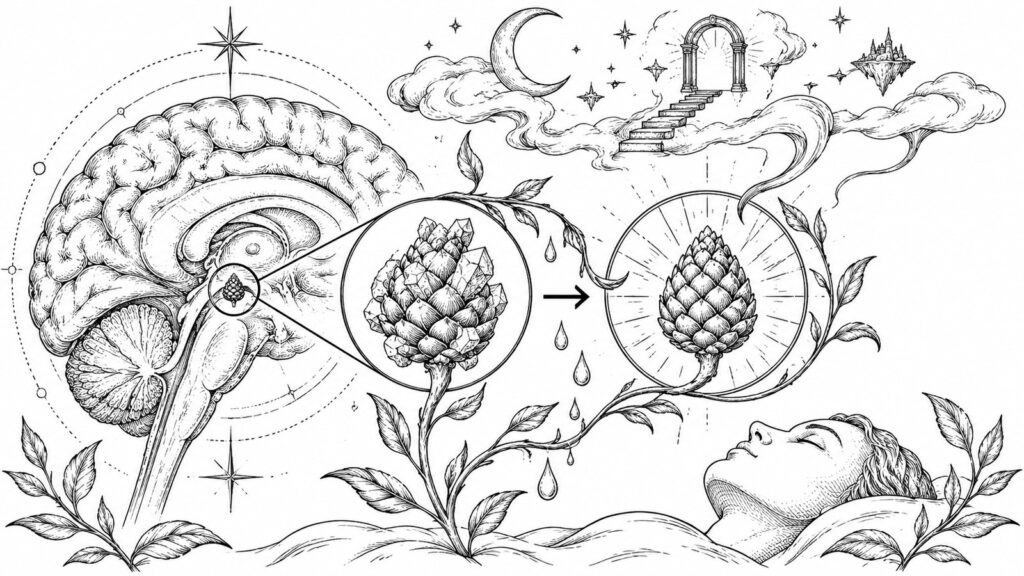
Over a lifetime, tiny mineral deposits build up in the pineal gland. Researchers call them corpora arenacea, or “brain sand.” That part isn’t lore. In a 2018 review in the journal Molecules, Dun-Xian Tan, Russel Reiter and colleagues wrote that the pineal “has the highest calcification rate among all organs and tissues of the human body,” and that calcification may limit how much melatonin the gland can make. They even suggested that “preservation of pineal health can be achieved by retarding its premature calcification or even rejuvenating the calcified gland.” That’s published researchers using the word “rejuvenating” about a calcified gland, which the (quote on quote) “experts” don’t toss around every day.
Believers take it a step further. If the gland is calcified, they say, the third eye is clogged, and your intuition goes quiet along with your melatonin. So the practices below are all about clearing it.
Fluoride
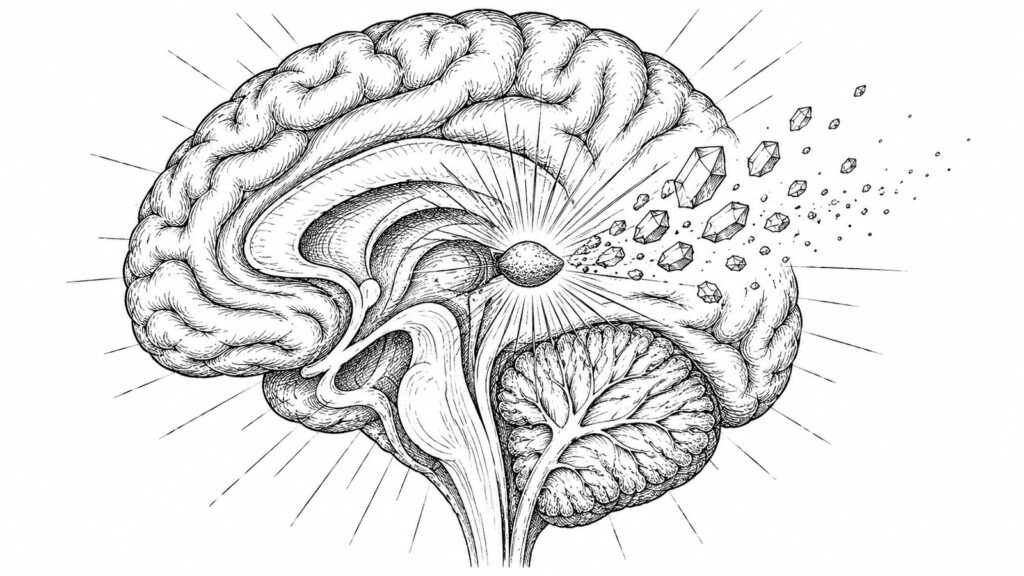
Fluoride is the biggest piece of the lore, and it has a real study behind it. In 2001, Jennifer Luke published a paper in Caries Research on pineal glands taken from 11 elderly cadavers, with a mean age of 82. The pineals averaged 297 milligrams of fluoride per kilogram of tissue, compared with 0.5 in muscle. Fluoride levels tracked with calcium levels in the gland, and she concluded the pineal readily accumulates fluoride, with a fluoride-to-calcium ratio higher than bone. Her earlier 1997 University of Surrey dissertation found that gerbils given high fluoride made less of a melatonin marker until sexual maturity, and the females reached puberty sooner.
That’s a small sample plus an animal study, and that’s all I’ll say about the limits. People who follow this lore take it seriously. So the first thing on every list is cutting fluoride. That usually means fluoride-free toothpaste and filtered water. The circles that talk about this say pitcher filters don’t remove it and point to reverse osmosis or distilled water instead. I can’t vouch for that part, but I can tell you it’s what you’ll see over and over.
Food
The diet part is where the lists get long. You’ll see apple cider vinegar, garlic, turmeric, tamarind, neem, chlorella, spirulina, iodine and boron over and over. People say to cut out processed food and sugar and to eat organic when you can. Honestly, nobody has shown any of these items dissolving a pineal deposit, so this is pure folk wisdom. But a cleaner diet is a pretty old idea in spiritual circles, going all the way back to teachers who said the purity of the body matters for the third eye. Blavatsky said so herself.
Light, dark, and sleep
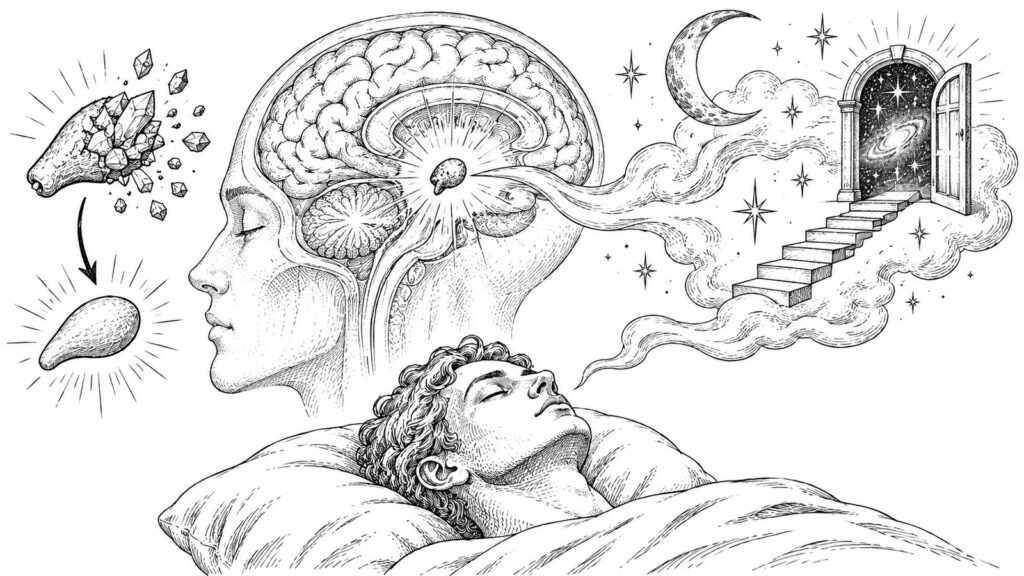
This one lines up nicely with real physiology. The pineal gland makes melatonin when it’s dark, and light shuts it down. So believers say to get out in the morning sun, dim the lights in the evening, put the phone down, and sleep in a room that’s truly pitch black. Every item on that list matches what the textbook says the gland does. Whether it clears anything out, I don’t know. It’s a lovely overlap between lore and lab, though.
Meditation, breath and sound
Then there’s the practice side, which is the oldest part. Go gently, though. Believers warn that pushing the third eye open too fast can backfire, and I covered that in Dangers of Premature Third Eye Activation.
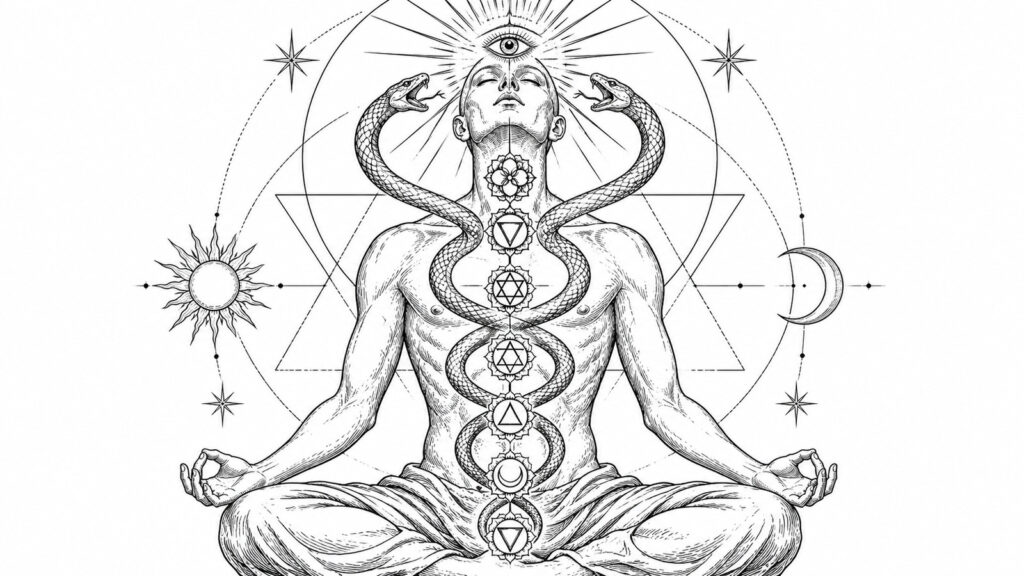
- Ajna meditation. Sit, close your eyes, and rest your attention at the point between the brows, or in the center of the head. This is the classic third eye practice.
- Trataka. The Hatha Yoga Pradipika, a fifteenth-century yoga text, describes gazing steadily at a small mark until the eyes fill with tears. Modern teachers usually swap in a candle flame at arm’s length and gently close the eyes afterward to watch the afterimage. People say it wakes up the area behind the forehead.
- Bhramari breath. The “humming bee” breath is a hatha yoga technique where you hum on the exhale and feel the vibration in your skull. A lot of people who follow the pineal lore swear by it.
- Chanting and tones. Chanting “Om” is the old version. There’s also a newer crowd that uses certain frequencies they say line up with the gland. That’s modern lore, not from the old yogic texts.
Sungazing
I’d skip this one, and I’ll tell you why in a second. In this lore, sungazing means looking at the low sun during the first or last hour of daylight, starting with a few seconds and building up. One well-known modern teacher was Hira Ratan Manek, whose protocol started at 10 seconds on day one and grew by about 10 more each day. The belief is that sunlight enters the eye, travels to the pineal, and fires it up.
Eye doctors warn about solar retinopathy, which is damage to the central retina from looking at the sun. The Royal Australian and New Zealand College of Ophthalmologists says it can be painless and can leave permanent vision loss, and a 1988 report in the British Journal of Ophthalmology documented cases after religious sun-gazing. Plenty of people in the lore just stand in the low morning light with their eyes closed and feel the warmth on their brow, and honestly, that sounds kind of lovely.
What Abilities Does the Third Eye Unlock, According to Believers?
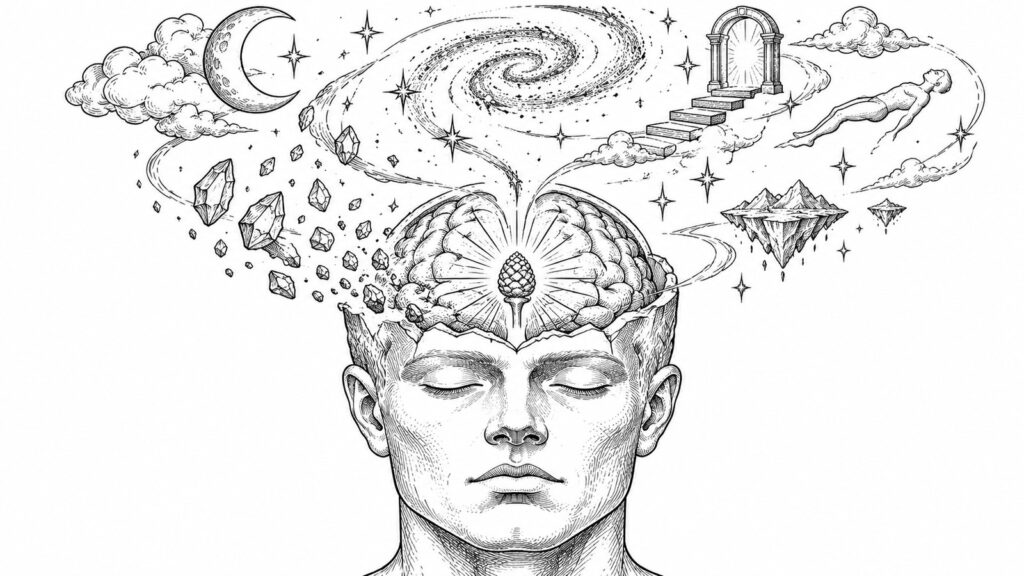
Believers link the third eye to intuition, clairvoyance, lucid dreaming and astral projection; these are lore, not established science.
So what do people say happens when the gland is humming? These are the abilities that come up again and again.
Intuition
This is the gentlest one, and probably the most common. A sharper gut sense. You know who’s calling before you look. You walk into a room and feel what happened there. Plenty of believers say it’s the first thing to show up, which makes sense, since it asks the least of you.
Clairvoyance and psychic sight
Clairvoyance means “clear seeing,” and that’s the headline power of the third eye. Reports include seeing auras around people, getting images in the mind’s eye that turn out to mean something, and what some describe as “knowing” a place without having been there. The Rampa book dramatized the same idea, with its auras and hidden motives.
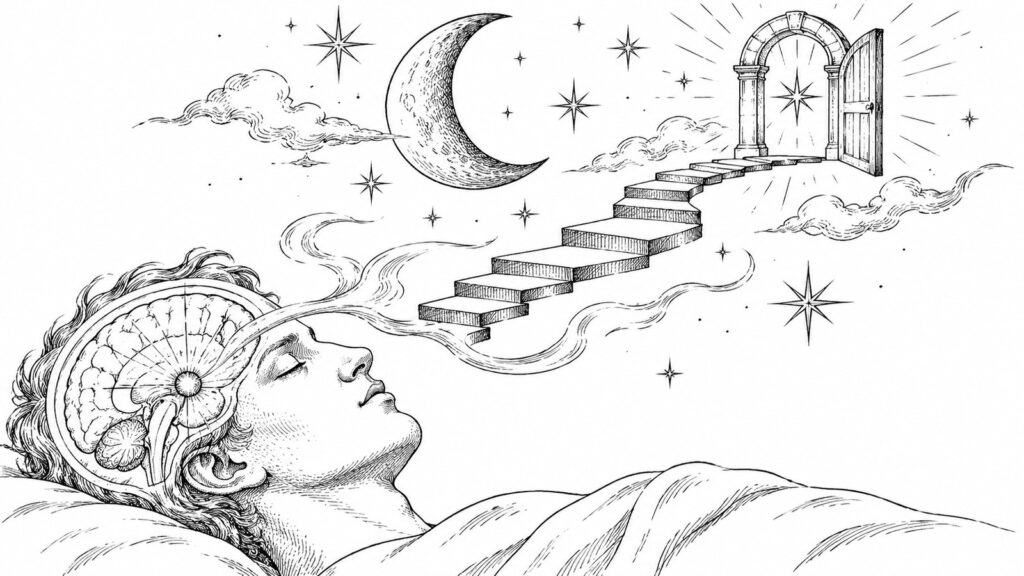
Lucid dreaming
People say a stronger pineal gland means more vivid, more memorable dreams, and eventually waking up inside them. That link is lore. Mainstream science hasn’t tied lucid dreaming to the pineal, but the idea isn’t totally random, since the gland helps keep your sleep clock. Lucid dreaming itself is real, and it’s been tested. Keith Hearne recorded the first deliberate eye signals from a lucid dreamer at Hull University on April 12, 1975. Then Stephen LaBerge and his colleagues at Stanford published verified lucid dreaming with pre-agreed eye signals in 1981, in Perceptual and Motor Skills. So the dream part is established. The pineal part is the believers’ addition.
Astral projection
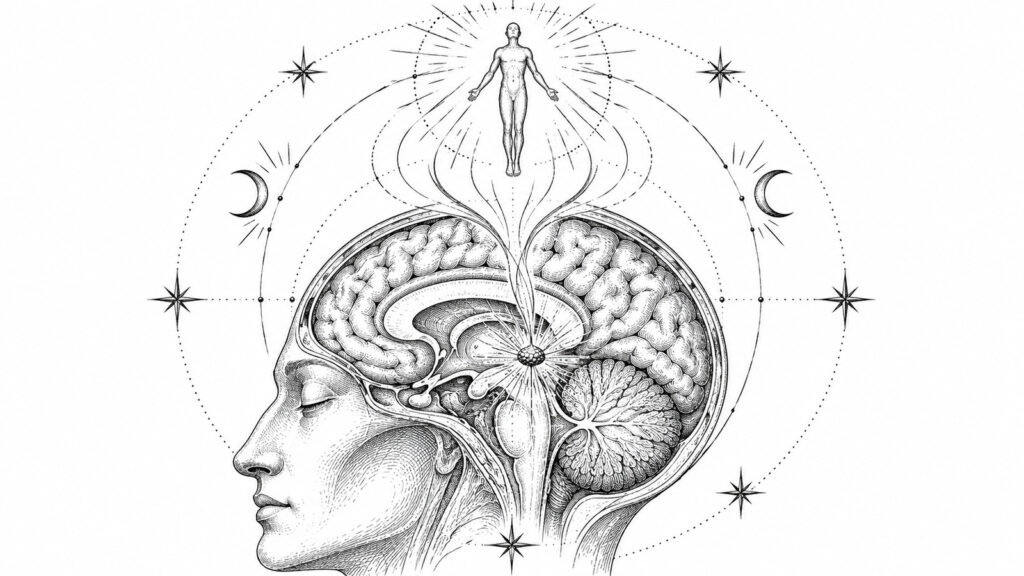
This is the one that makes the pineal crowd lean in. If the gland is a doorway, then maybe it’s the exit hatch for the astral body. Sylvan Muldoon, who wrote The Projection of the Astral Body with Hereward Carrington in 1929, described a cord running from the forehead of the body on the bed to the back of the head of the one floating above it. I covered his story, and a lot more, in our article on astral projection and dark entities. A cord at the forehead and a gland in the middle of the head. You don’t have to connect those two, but I can see why people do.
Other things people claim
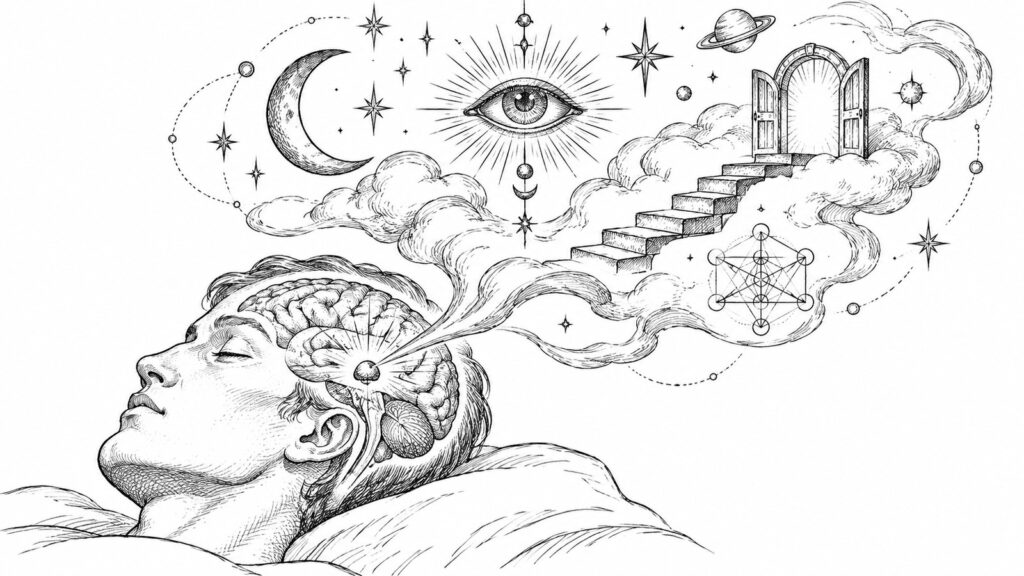
You’ll also see vivid inner imagery during meditation, a sense of being watched or “tuned in,” a feeling of light or pressure between the brows, and a deep calm that people struggle to put into words. Nobody can prove any of it, and people keep reporting it anyway.
So What Do You Think?
Here’s what keeps pulling me back to this. You can read the dry version of the pineal gland and it’s a tiny gland that keeps time. Then you read about a Roman bronze pinecone, a French philosopher, a Russian-born occultist, a lizard with a spare eye, and a published paper that says a calcified gland might be rejuvenated. And you start to wonder why so many separate traditions, over so many centuries, circled the same little spot in the middle of the head.
Is it coincidence, a symbol that grew legs, or something that really is there? I’m a seeker, so I don’t think a gland the size of a grain of rice got that much attention for nothing. What do you think? Let me know in the comments.
If you’d rather hear it, we dug into this very subject in Episode 1: Pineal Gland on the podcast. If you want more of this kind of thing, new episodes of Cryptic Chronicles come out every Tuesday. Join the newsletter at crypticchronicles.com, and if you want to go deeper, the Chronicler’s Vault on Patreon starts at $5 a month.
Pineal Gland FAQ
The pineal gland is a small, pinecone-shaped gland deep in the middle of the brain that makes melatonin. People call it the third eye because some animals, like the tuatara, have a pineal-based eye that senses light, and because writers like Helena Blavatsky said it was once a working organ of spiritual sight in humans.
Yes. In The Passions of the Soul (1649), Descartes argued that the soul acts most directly through a very small gland in the middle of the brain, which he identified as the pineal gland. He reasoned that something had to unite paired sensory images into a single thought.
Yes. Tiny mineral deposits build up in the pineal gland over time, and a 2018 review in Molecules called it the organ with the highest calcification rate in the human body. A 2001 study by Jennifer Luke also found the aged human pineal gland had high fluoride levels that tracked with its calcium.
The usual lore includes avoiding fluoride, eating a cleaner diet with foods like garlic, turmeric and tamarind, following natural light and dark cycles, and practicing meditation, trataka, and humming breath. None of this is medical advice, and no one has proven that these steps dissolve calcification.
Believers connect it to intuition, clairvoyance and psychic sight, lucid dreaming, and astral projection. The links come from esoteric traditions like Theosophy and yoga, and they’re considered lore, not established science.
The word pineal comes from the Latin for pinecone, because the gland is shaped like one. Esoteric writers such as Manly P. Hall linked that shape to ancient pinecone art, including the giant bronze Pigna at the Vatican. That connection comes from esoteric writers, and the Vatican doesn’t make it.
Sources
- René Descartes, The Passions of the Soul (1649), articles 31 and 32. Excerpt in translation (Stanford University PDF). See also Lisa Shapiro, “Descartes’s Pineal Gland Reconsidered”.
- National Library of Medicine, StatPearls, “Physiology, Pineal Gland”.
- “The lonely eye” (on the tuatara’s parietal eye), via PubMed Central.
- Ṣaṭ-cakra-nirūpaṇa, translated by Arthur Avalon (Sir John Woodroffe) in The Serpent Power (1919). Verse 32 commentary on Ajna.
- NeidanWiki, “Niwan (Muddy Pellet)”, on the Taoist upper dantian.
- C. W. Leadbeater, The Chakras (1927).
- H. P. Blavatsky, The Secret Doctrine, Vol. 2 (1888). Section on the third eye.
- David Bramwell, “The Tibetan lama who was really a plumber from Devon”, The Observer, May 17, 2020 (Guardian link).
- Karim ReFaey et al., “The Eye of Horus: The Connection Between Art, Medicine, and Mythology in Ancient Egypt”, Cureus (2019).
- Musei Vaticani, historical-artistic sheet on the Pigna (Italian), and Treccani, “Pina” (Enciclopedia Dantesca)) and “Cincius, Salvius P. L.”).
- Manly P. Hall, The Secret Teachings of All Ages (1928), “The Hiramic Legend”. The King James Bible, Matthew 6:22.
- Dun-Xian Tan, Bing Xu, Xinjia Zhou and Russel J. Reiter, “Pineal Calcification, Melatonin Production, Aging, Associated Health Consequences and Rejuvenation of the Pineal Gland”, Molecules (2018).
- Jennifer Luke, “Fluoride deposition in the aged human pineal gland”, Caries Research (2001), and “The effect of fluoride on the physiology of the pineal gland”, PhD dissertation, University of Surrey (1997).
- Hatha Yoga Pradipika 2.31 on trataka. Translation and commentary.
- Hira Ratan Manek’s sungazing protocol, as described by followers. Warnings: Royal Australian and New Zealand College of Ophthalmologists, “Solar Retinopathy” (public position statement, 2023), and “Solar retinopathy following religious rituals”, British Journal of Ophthalmology (1988).
- Keith Hearne’s first signaled lucid dream (1975), via keithhearne.com. Stephen LaBerge et al., “Lucid Dreaming Verified by Volitional Communication during REM Sleep”, Perceptual and Motor Skills (1981).
- Sylvan Muldoon and Hereward Carrington, The Projection of the Astral Body (1929), via the Psi Encyclopedia entry on Muldoon.

0 Comments