I noticed something unusual when I dug into the history of the Goetia, the most infamous demon book in Western magic, and here’s what I found. The man who first printed its demons was trying to make sure nobody could ever use them.
The short answer: Here’s the history of the Goetia in a nutshell. It’s the first book of the Lesser Key of Solomon, compiled anonymously in mid-1600s England, and most of its 72 demons come from Johann Weyer’s 1577 Pseudomonarchia Daemonum via Reginald Scot’s 1584 English translation. Those lists sit on medieval spirit catalogs and the old legend of Solomon’s demon-binding ring.
The copy most folks own today is Aleister Crowley‘s 1904 edition of his old teacher Samuel Liddell MacGregor Mathers’ translation. So that’s the textbook version, and it’s true as far as it goes. But follow the paper trail on the history of the Goetia and it gets weird fast, and then it gets weirder when you read what practitioners have been fighting about on forums for twenty-plus years. I went way down this rabbit hole. Grab a coffee.
1. What Does “Goetia” Actually Mean?
The word is a whole lot older than the book. Goetia comes from the Greek goēteia, sorcery, built from goēs, a sorcerer or wizard. And it was pretty much an insult from day one. According to the standard history, higher-class Greek theurgists used goēs to look down on what they saw as low, fraudulent magic, while their own “theurgy” was supposedly the respectable kind. (Funny how the respectable magic is always the kind the person talking happens to do.)
But “sorcerer” is the cleaned-up dictionary version. If you want to know what a goēs really was, you’ve got to go back to ancient Greece, to funerals and tombs and temples where the dead wouldn’t stay put.
2. Where Did the Word Goetia Come From in Ancient Greece?
This is where it starts getting creepy. Back in 1962 the classicist Walter Burkert wrote a paper titled “Goes: Zum griechischen ‘Schamanismus,'” digging into where the word comes from. It traces to the Greek goáō, to groan or bewail, and góos, the wailing lament people sang over the dead at old Greek funerals. And Burkert’s reading, as the practitioner and writer Frater Acher sums it up, is that the goēs wasn’t just some mourner. He was “the one conjuring the dead.” So the very oldest layer of this word sits right on the line between the living and the dead, which, I mean, tells you a lot.
And the old texts back it up. Honestly, a few of these gave me goosebumps.
A king called up by wailing. In 472 BC, Aeschylus put on The Persians in Athens. In one scene Persian elders mourn at the tomb of the dead King Darius, and his ghost rises out of it. Darius tells them they’ve stood by his tomb and “with shrill cries that summon the spirits of the dead, invoke me piteously.” In the Greek, those cries are psychagōgoi góoi, soul-leading laments. Same góos from Burkert’s etymology, used here to pull a ghost up out of the ground. And then Darius warns them, “Not easy is the path out of the tomb, for this reason above all, that the gods beneath the earth are readier to seize than to release.” Creepy as hell, and that’s a play from almost 2,500 years ago.
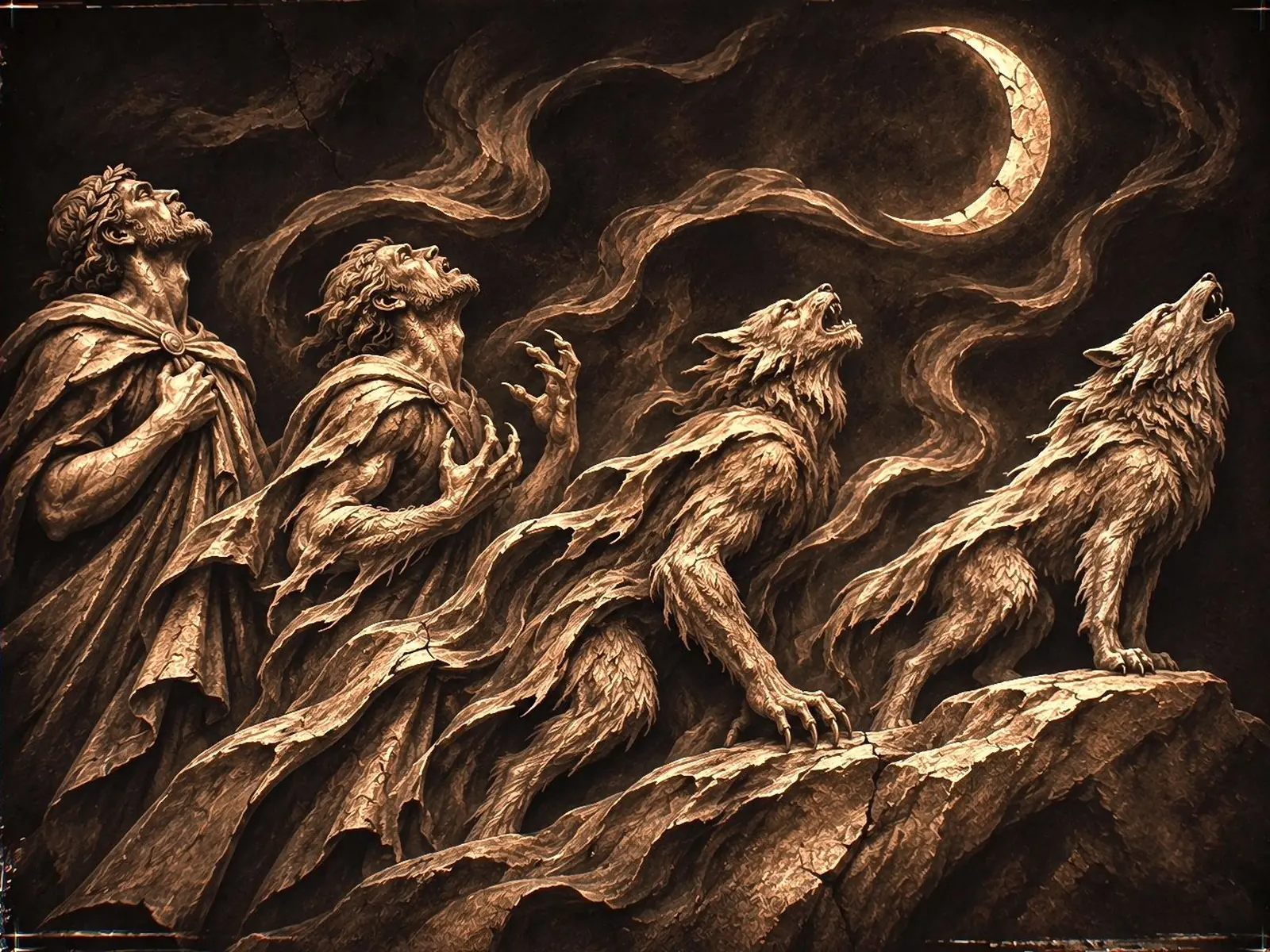
Werewolves and storm spells. Herodotus uses the word in two places I really love. Writing about a tribe called the Neuri, he says, “It may be that these people are wizards,” and the Greek word there is goētes. The Scythians and the Greeks living among them swore that once a year every one of the Neuri turned into a wolf for a few days and then changed back. Herodotus says the story doesn’t convince him, “but they tell it nonetheless, and swear to its truth.” Later, when a storm wrecked the Persian fleet in 480 BC, he says the Persian Magi “made offerings and cast spells upon the wind,” and the wind stopped on the fourth day. The Greek has them chanting with goēsi, a form of the same word. He hedges, sure, with “or perhaps it died down on its own.” But he still wrote it down.
Words as witchcraft. Around the end of the 400s BC, the orator Gorgias wrote his Encomium of Helen, a speech defending Helen of Troy, and in it he says that “there have been discovered arts twain of witchery and sorcery,” and that speech can work on the soul the same way. His Greek is goēteias de kai mageias dissai technai, goēteia and mageia sitting side by side. And according to Diogenes Laertius, the biographer Satyrus quoted Gorgias saying he’d personally been there when the philosopher Empedocles “performed magical feats.” Empedocles, for his part, promised a student in one of his poems, “Thou shalt bring back from Hades a dead man’s strength.” Which is a heck of a thing to put in a syllabus.
A god called a sorcerer. In Euripides’ Bacchae (405 BC), King Pentheus hears that a stranger has come to Thebes, “a sorcerer, a conjuror from the Lydian land.” The Greek is goēs epōdos. The stranger is actually the god Dionysus in disguise. Pentheus is basically the original mainstream skeptic, and let’s just say that play does not end well for him.
Plato’s spirit network. In the Symposium, the priestess Diotima says spirits, the daimones, are the go-betweens of gods and humans, and that through them pass “all divination and priestcraft concerning sacrifice and ritual and incantations, and all soothsaying and sorcery.” The word for sorcery there is goēteia. So in Plato’s own words, goēteia runs on spirits.
Over in the Republic he complains about begging priests at rich men’s doors selling “spells and enchantments that constrain the gods,” including katadesmoi, binding spells, to hurt an enemy. In the Laws he wants jail for people who claim “that they charm the souls of the dead” and who promise to persuade the gods by bewitching them, goēteuontes, with sacrifices, prayers and incantations. And yet a book later, Plato admits that with spells and bewitchment “it is neither easy to perceive what is the real truth, nor, if one does perceive it, is it easy to convince others.” Even Plato wasn’t totally sure, and he’s the guy who wanted them locked up.
A ghost hired out of a temple. This one’s my favorite. Pausanias, the Spartan general who beat the Persians at Plataea, later died in disgrace, and his ghost wouldn’t leave a Spartan temple. According to Plutarch, writing centuries later, an oracle told the Spartans to propitiate his soul. In Ogden’s translation, “So the evocators (psychagogoi) were sent for from Italy. They made a sacrifice and drew his ghost away from the temple.” Picture that. Sparta, of all places, sending overseas for professional ghost-handlers.
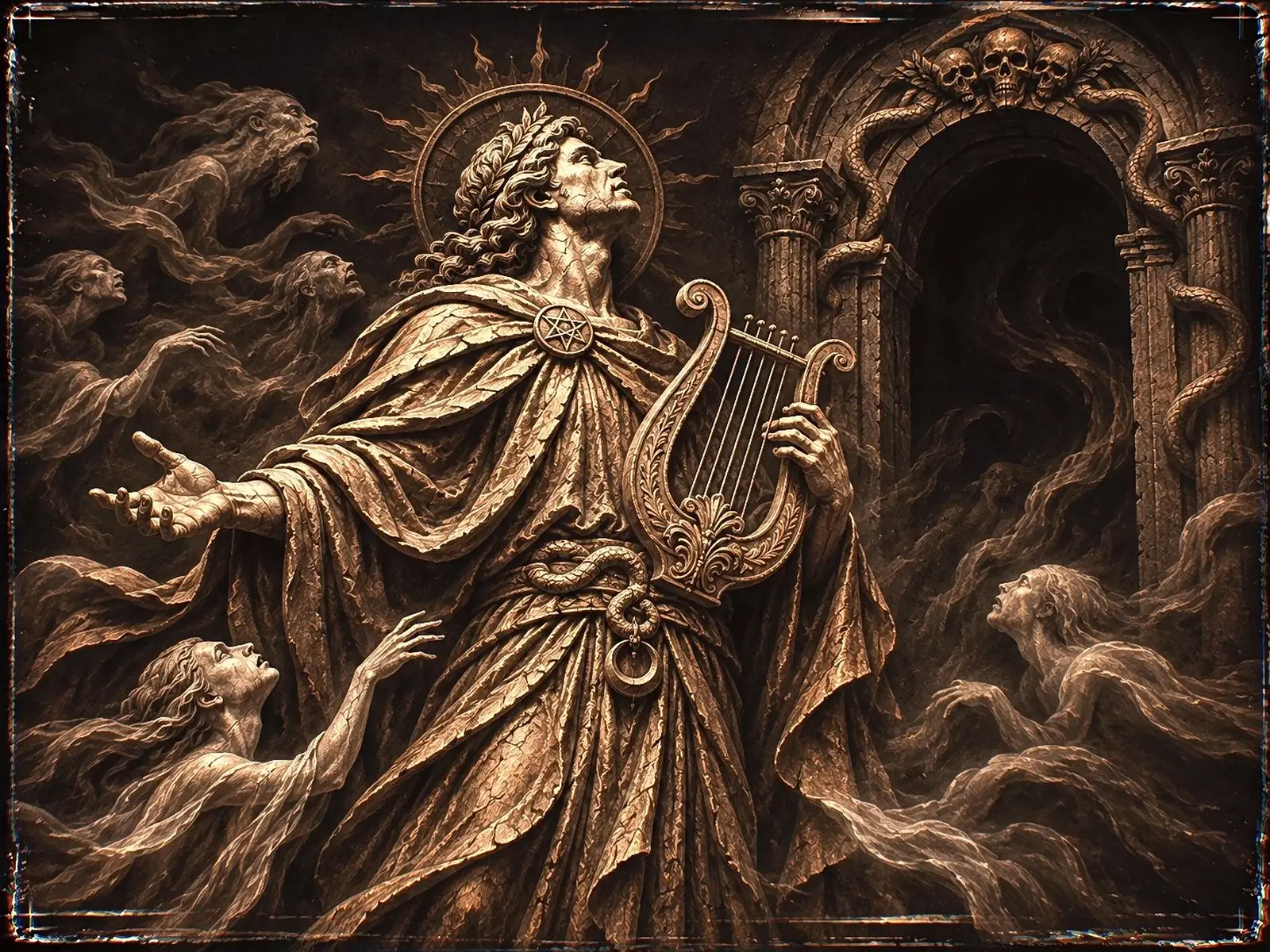
Orpheus, the wizard. So was the most famous singer in Greek myth ever called a goēs? Yep. In a fragment of Book 7 of his Geography, the geographer Strabo (writing around the turn of the first century AD) says Orpheus the Ciconian lived at a village called Pimpleia near Mount Olympus, and calls him “a wizard who at first collected money from his music, together with his soothsaying and his celebration of the orgies connected with the mystic initiatory rites.” The Greek is andra goēta, a goēs-man. According to Strabo, Orpheus then gathered followers and power until people suspected a plot and killed him.
He’s not the only one tying Orpheus to spellcraft, either. In Euripides’ satyr play Cyclops, a cowardly satyr brags that he knows “an incantation of Orpheus so wonderful” that the burning stake will walk up to the Cyclops’ skull all by itself. And those begging priests from Plato’s Republic, the ones selling binding spells, carry “a bushel of books of Musaeus and Orpheus” to run their rites. The man who walked into the underworld to bring a dead woman back, remembered as a goēs. That fits the word’s roots almost too well.
So that’s the ancient picture. Funeral wailing that raises a king, a wizard-singer who walked into Hades, wolf-men, storms talked down by Magi, spells sold door to door, and specialists you call when a ghost won’t leave. Over time, though, goēs turned into a word for a cheat. In Acher’s summary of Burkert, the organized oracles of the city-states took over from the individual shamans, and the voices of the dead got pushed out to the edges.
Modern practitioners take that idea really seriously. The late Jake Stratton-Kent, who described himself as a “very late Late Pagan,” built a whole three-volume Encyclopaedia Goetica around it. His publisher describes the second volume, Geosophia, as tracing magic “from the Greeks to the grimoires, laying bare the necromantic and chthonic roots of goetic ritual.” In his telling, Jason, Medea, the sibyls and the road down to Hades are all sitting underneath the grimoires, like a basement nobody mentions.
By the Renaissance the insult had stuck for good. Heinrich Cornelius Agrippa, the most famous occultist of his day, wrote in his Three Books of Occult Philosophy that “Goetia is unfortunate, by the commerces of unclean spirits made up of the rites of wicked curiosities, unlawful charms, and deprecations, and is abandoned and execrated by all laws.”
Keep Agrippa in the back of your mind, because his student ends up being the most important person in this whole story. But first, the Greeks weren’t the beginning. Not even close.
3. Does the Goetia Go Back Even Further Than Greece?
The Greek word is old, but the ideas packed inside the Goetia are older. Naming a spirit, binding it, trapping it in a container, forcing it to obey a higher power… all of that shows up in the ancient Near East long before anybody in Athens wailed over a tomb. Now, I’m not going to tell you there’s a straight paper trail from Babylon to a 1600s English manuscript. There isn’t one, and anyone who says there is is selling something. But the family resemblance is spooky, and the Goetia itself keeps pointing back to Babylon.
Mesopotamia: the nameless demons. The Sumerians, and later the Akkadians, Assyrians and Babylonians, had a whole class of demons called udug (in Akkadian, utukku). They were born in the underworld and got blamed mostly for disease, and the texts for driving out the evil udug are called the Udug Hul incantations, which cast the exorcist as the healer. The detail that stopped me cold, though, is this one. According to the Assyriologist Gina Konstantopoulos, “the udug is defined by what it is not: the demon is nameless and formless.” One Old Babylonian incantation, from roughly 1830 to 1531 BC, calls it “the one who, from the beginning, was not called by name… the one who never appeared with a form.” The descriptions give it a dark shadow, an absence of light, poison and a deafening voice.
Flip that around and you’ve got the Goetia. Every one of its 72 spirits has a name, a rank, a shape and a seal, and the magician’s whole power comes from knowing them. So in a way the entire history of demon magic is people trying to give the nameless thing a name, so they can finally handle it.
Burning the witch in effigy. The Akkadian Maqlû (“Burning”) series is a huge anti-witchcraft ritual. In its mature form, probably from the early first millennium BC, it runs to eight tablets of nearly a hundred incantations plus a ritual tablet. They performed it over one night in the month of Abu, July or August, when spirits were traveling to and from the netherworld. Figurines of the sorcerer got burned, drowned in black liquid, and crushed face down while the tablets were recited. One incantation calls on the fire god, “burn, set alight, incinerate my witch!” An exorcist even wrote to the Assyrian king Esarhaddon about it. Professionals doing magic for kings, timed to the nights the dead were on the move, which should sound pretty familiar after the Greek stuff.
A demon against a demon. Out of everything I found in Mesopotamia, this is the closest thing to Goetic thinking, and I kind of love it. Lamashtu, called the daughter of the sky god Anu, was blamed for miscarriages and the deaths of infants. Pazuzu, a demonic figure from Babylonian and Assyrian culture in the first millennium BC, was a dangerous wind-demon in his own right, but he was also believed to be able to force Lamashtu back to the underworld. So pregnant women wore amulets with Pazuzu’s head on them, and his image hung in homes to protect babies. Ritual texts from Uruk even say a woman could be given a bronze Pazuzu amulet to keep Lamashtu from causing a miscarriage. And one surviving Lamashtu amulet calls her by her many names and then commands, “you must not approach (this) person.”
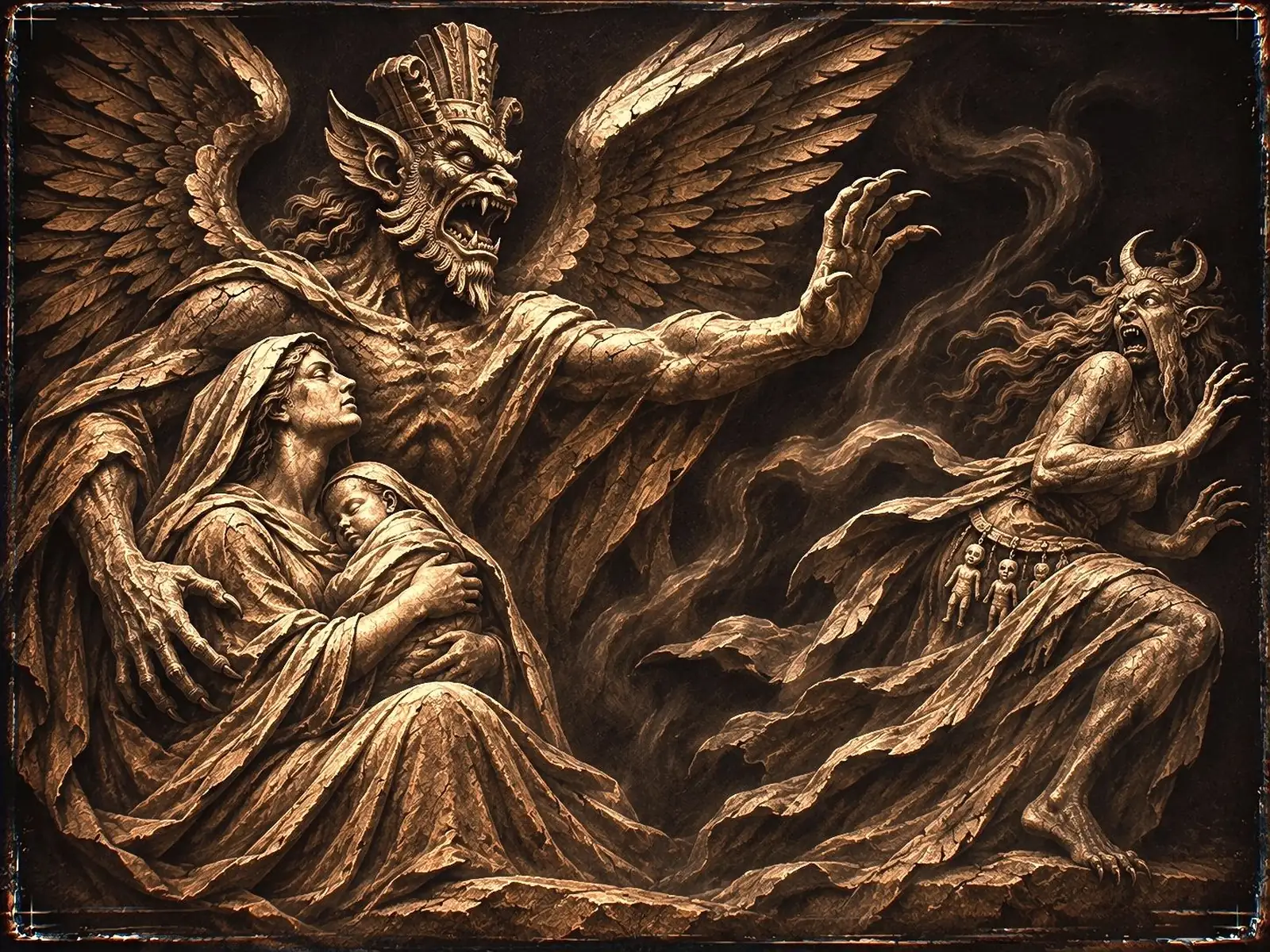
So you’ve got a frightening spirit, called on by name and image, hired to do a job and keep a worse spirit away. That’s the Goetic bargain, more than two thousand years before the Goetia was compiled. (And yes, it’s the same Pazuzu who possesses Regan in The Exorcist. Hollywood made him the villain. The Babylonians mostly used him as a bodyguard.)
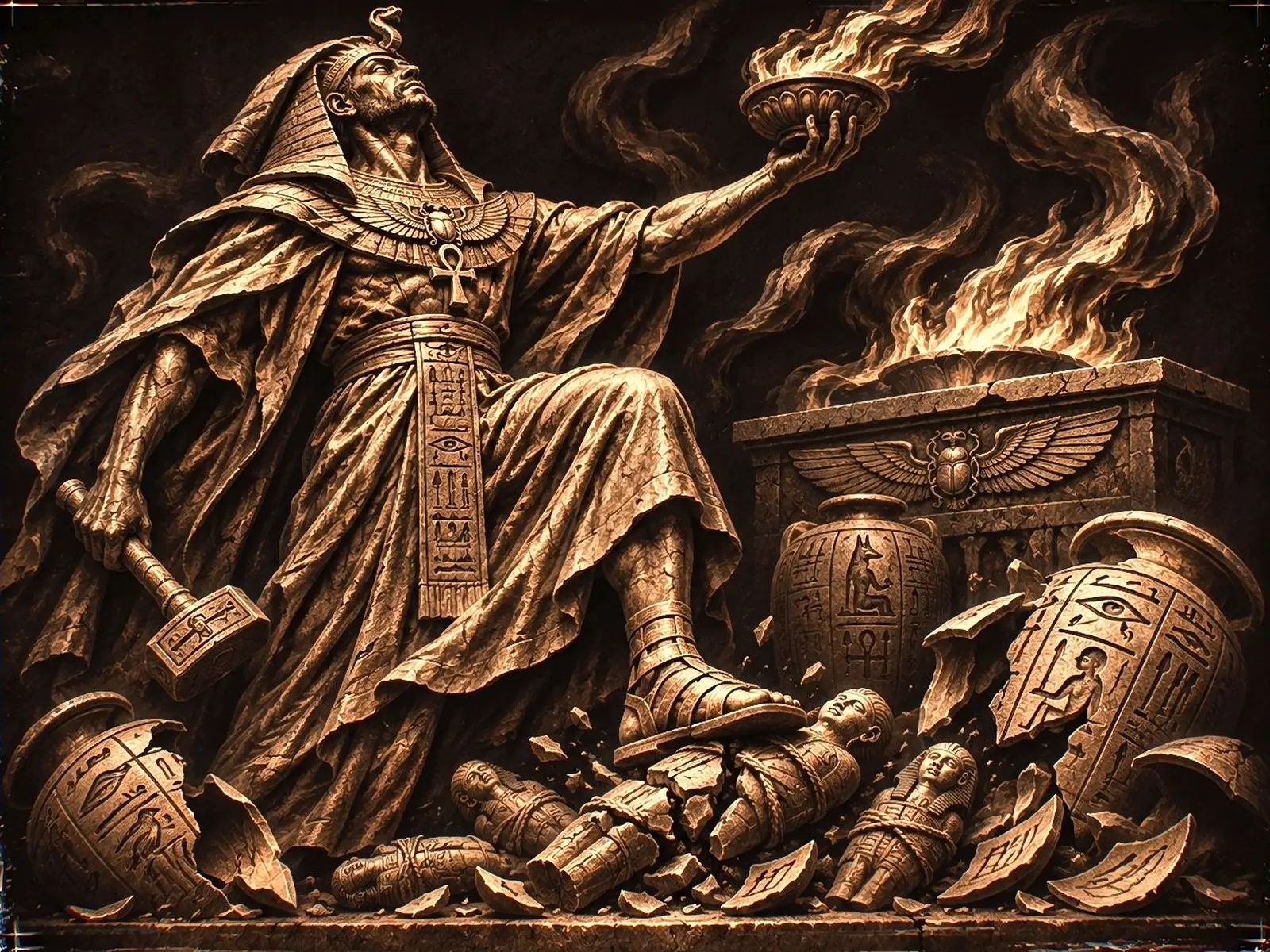
Egypt: breaking the names. The ancient Egyptians had execration rituals for wiping out enemies, human or otherwise. They wrote the enemies’ names on figurines of bound captives, on bowls, or on blocks of clay or stone, then broke the objects and buried them. The Berlin and Brussels groups of these texts date to roughly the 20th to 18th centuries BC, and archaeologists have found more than 1,000 execration deposits at sites from Giza and Saqqara down to Nubia. One recorded rite told the operator to “spit on him four times … trample on him with the left foot … smite him with a spear … place him on the fire.” Binding, naming and wrecking a spirit by working on an image of it. When the Goetia pulls out its “chains” and curses for a spirit that won’t behave, it’s swimming in that same old current.
Egypt also hands the Goetia something directly. The Preliminary Invocation that opens Crowley’s 1904 edition (more on that below) comes from the Greek Magical Papyri, a body of spells from Greco-Roman Egypt dating from the 100s BC to the 400s AD. According to the scholar Hans Dieter Betz, even Greek gods like Zeus, Hermes and Aphrodite show up in those papyri as demonic or even dangerous figures, all mixed in with Jewish and Egyptian beliefs. The line between god and demon was already getting blurry there.
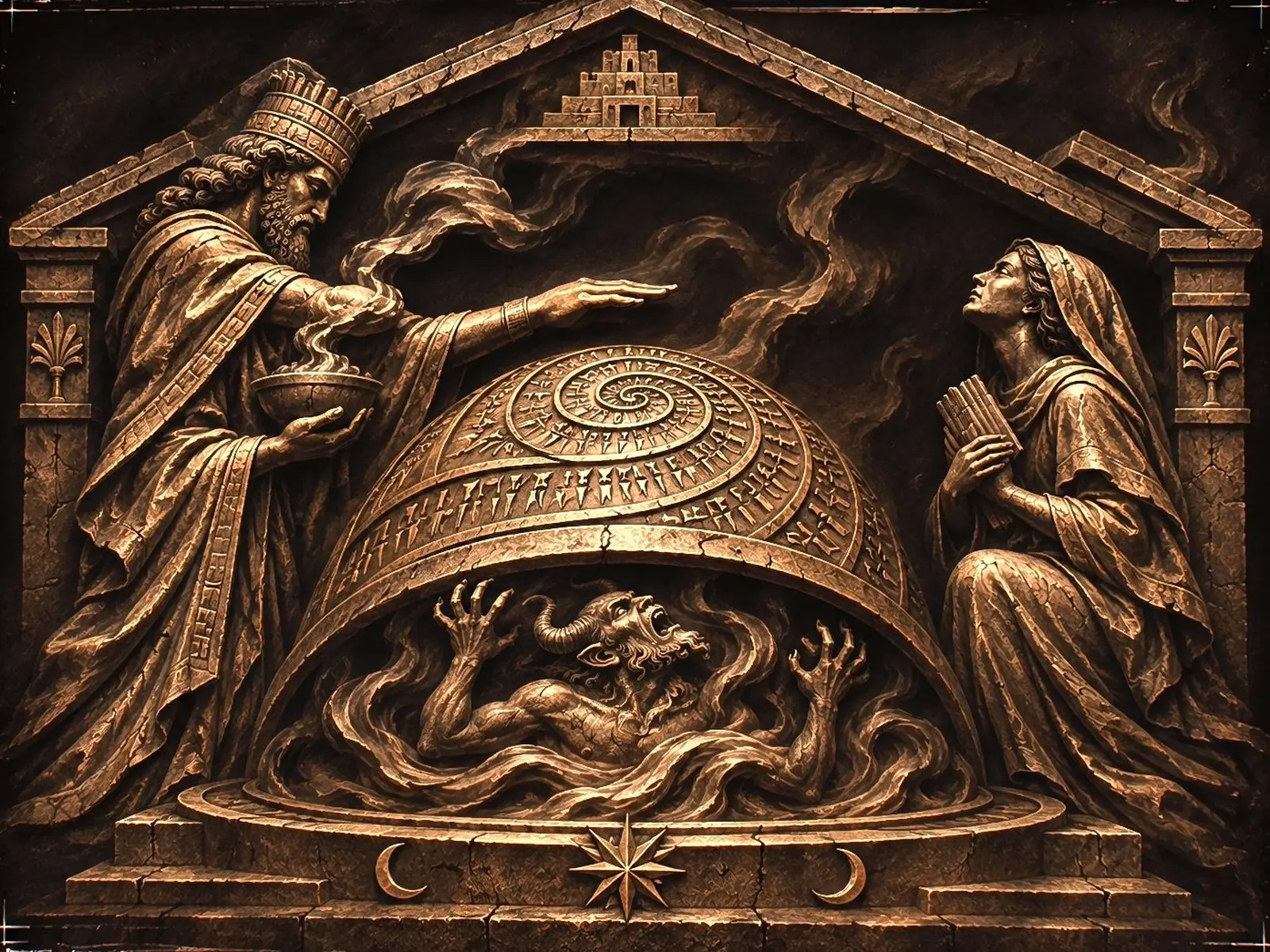
Babylon: demons trapped in bowls. Okay, this is the one that made the hair on my arms stand up. Under the Sasanian Persian Empire (226 to 636 AD), Jewish families in Babylonia, especially in the settlement at Nippur, buried incantation bowls in their homes. Almost every house excavated in the Jewish settlement at Nippur had them. Most are written in Jewish Babylonian Aramaic, spiraling from the rim to the center, against things like the evil eye and Lilith. Scholar John Charles Arnold describes how they were supposed to work: “When placed upside down under each corner of a house, demons would follow the inscribed charms that spiraled from the outer rim inward, only to be caught in the center.” About 2,000 have been registered as archaeological finds, and there may be tens of thousands more sitting in private hands.
Demons sealed inside a vessel and buried in Babylon. Now go look at the Goetia’s own origin story, where Solomon shuts the 72 kings in a brass vessel and throws it into a deep lake in Babylon, and the Babylonians break it open hoping for treasure. Whoever wrote that may never have laid eyes on an incantation bowl. But the image of a demon trapped in a container in Babylon was very real, and very, very old.
4. Where Does King Solomon Come In?
Which brings us to the name on the cover. Every version of the Goetia claims to come from Solomon, the wise king of Israel, and while the book isn’t ancient, the Solomon-binds-demons legend genuinely is.
The oldest solid reference I found is from the Jewish historian Josephus in the first century. In his Antiquities of the Jews, he writes that God enabled Solomon “to learn that skill which expels demons,” and that Solomon left behind incantations and exorcisms that still worked in Josephus’s own day.
Then he tells a story that honestly gives me chills. He says he personally saw a man named Eleazar free possessed people “in the presence of Vespasian, and his sons, and his captains, and the whole multitude of his soldiers.” Eleazar put a ring holding a root “of one of those sorts mentioned by Solomon” to the man’s nose and drew the demon out through his nostrils. And to prove it was really gone, he set a cup or basin of water a little way off and commanded the demon to knock it over on the way out. According to Josephus, it did.
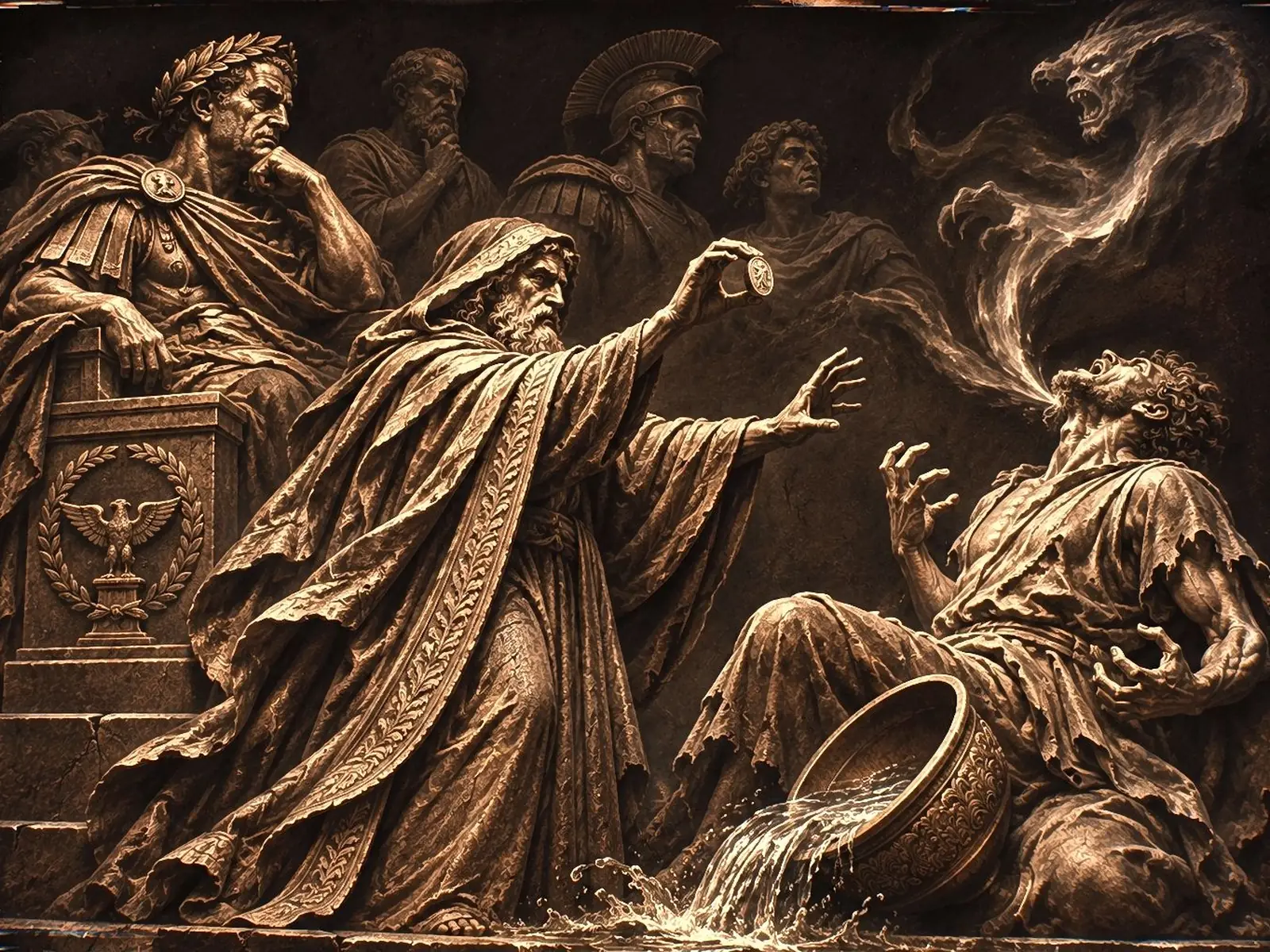
A ring, Solomon’s name, and a demon forced to obey, in a Roman army camp almost two thousand years ago. That’s pretty much the Goetia’s whole DNA right there.
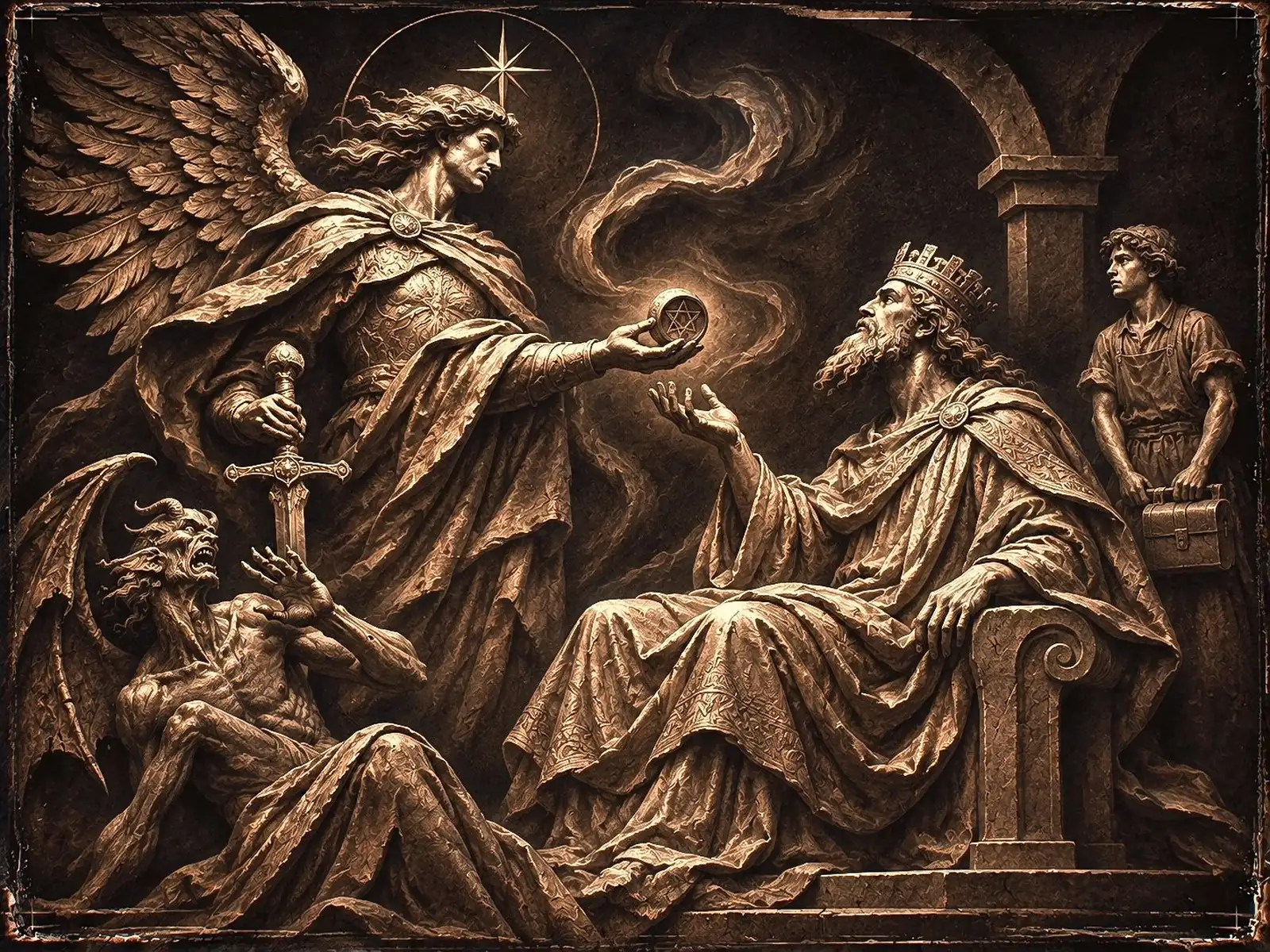
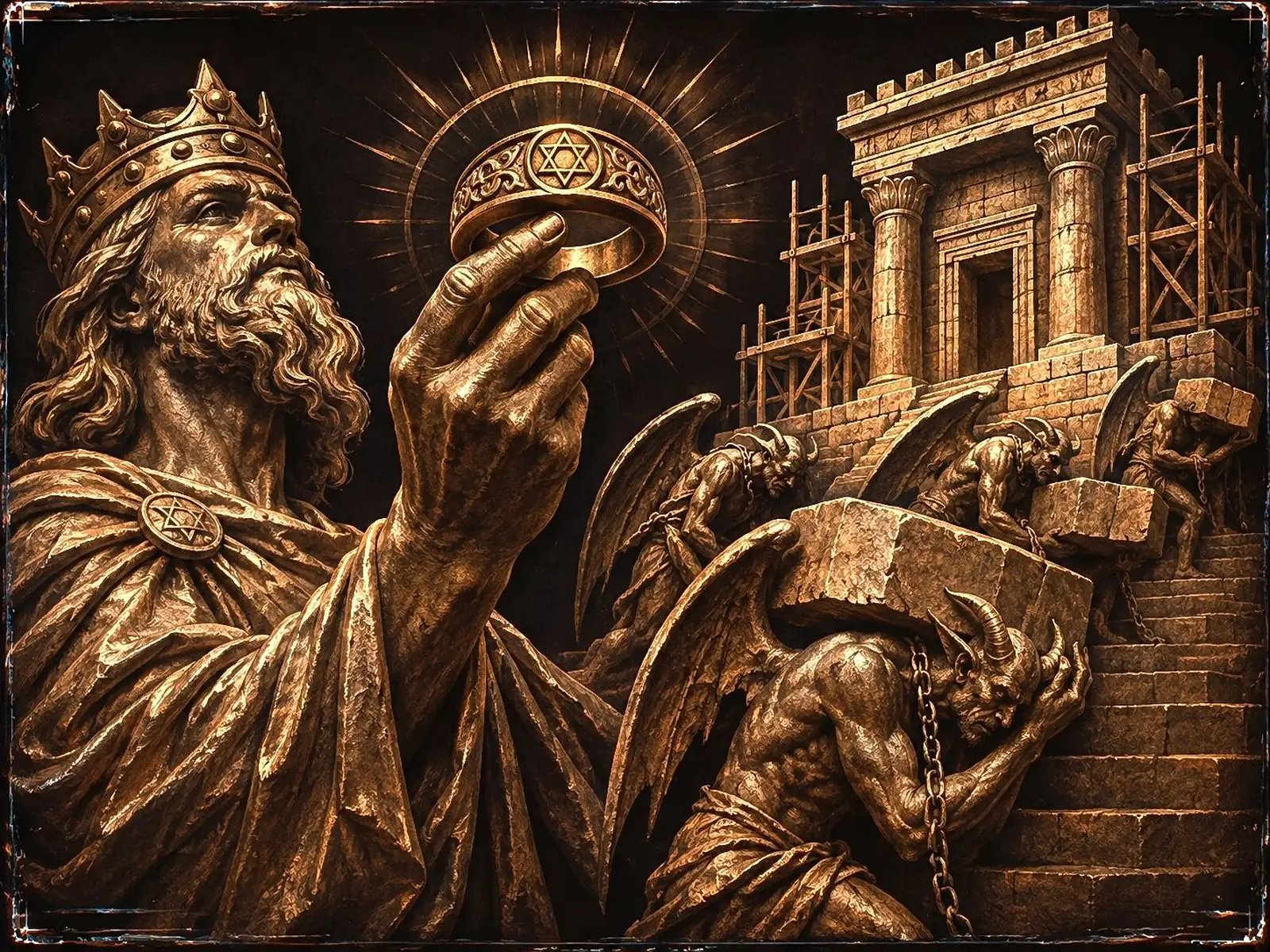
Then there’s the Testament of Solomon, a Greek text that scholars date anywhere from the first century AD to the Middle Ages. A demon named Ornias is draining a young worker Solomon likes, sucking the life out of him through his right thumb. Solomon prays, and the archangel Michael hands him a magic ring. With it Solomon binds Ornias, then Beelzebul, the prince of demons, and then he puts the whole infernal workforce to work building the Temple. Demon after demon has to cough up its name, what it does, and what thwarts it, which is basically the format of a Goetia entry written centuries earlier.
And the Testament goes way further than most people realize. A few scenes read like a rough draft of the Goetia.
Asmodeus shows up, and he’s furious. When Solomon calls him, the demon Asmodeus arrives bound and glares at him: “And who art thou?” He claims he was “born an angel’s seed by a daughter of man.” Solomon has him flogged until he gives up his name and his job, then asks which angel defeats him. “By Raphael,” the demon answers, adding that the liver and gall of a fish smoked over tamarisk ashes put him to flight. That’s straight out of the Book of Tobit, where Raphael uses a fish against Asmodeus. And it matters, because Asmodeus walks right into the Goetia as Asmoday, spirit number 32, “a great king, strong & powerfull,” with three heads (bull, man and ram), belching fire and riding an infernal dragon. Same demon, many centuries of paperwork later.
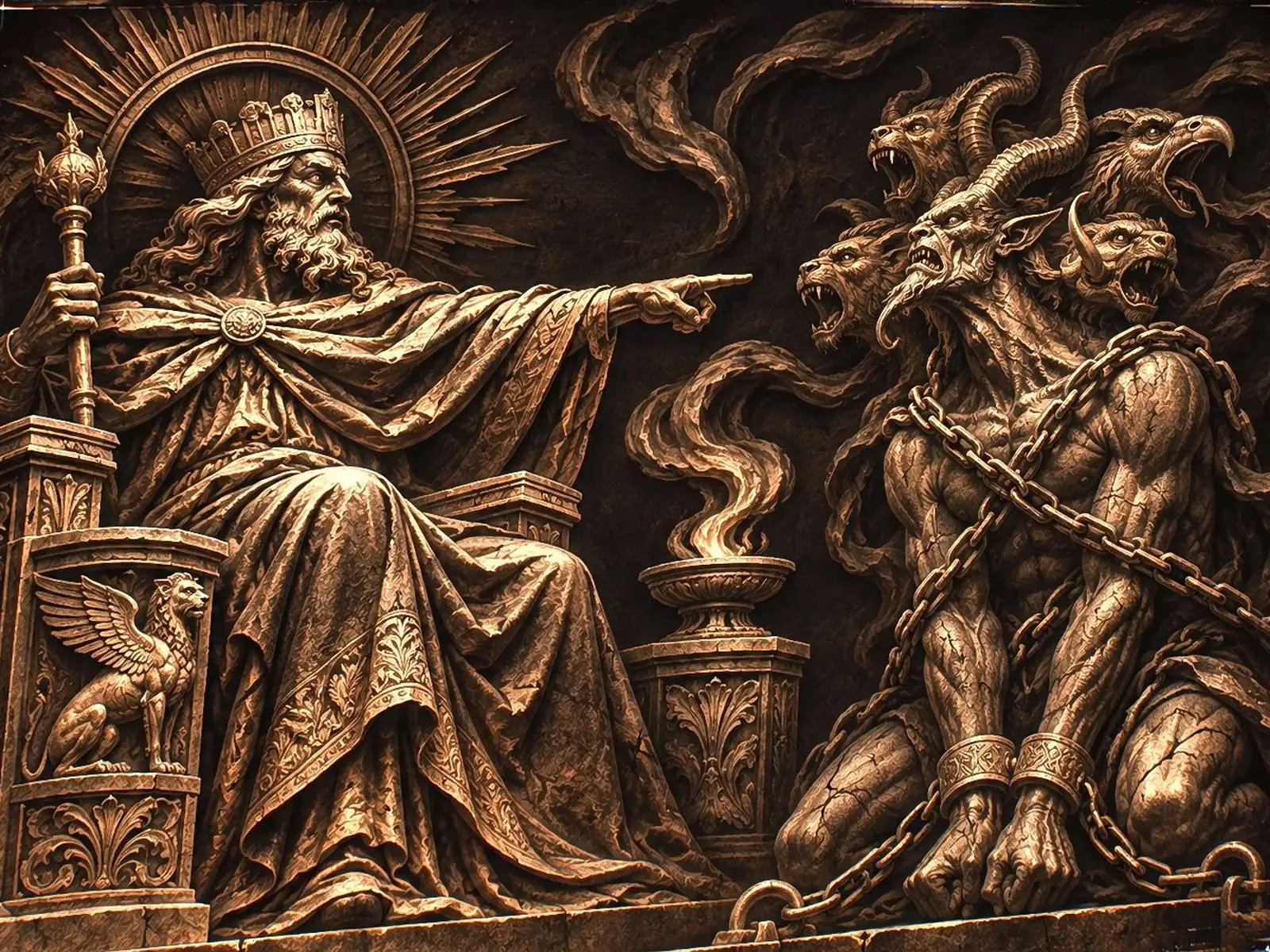
A demon in a bottle. Near the end, Solomon sends a servant into Arabia with a leather flask and his signet ring to catch a wind-demon named Ephippas. The servant holds the ring at the mouth of the flask, the demon blows into it, and the servant ties it shut and seals it. Back in the Temple, the flask “stood up and walked around some seven steps and then fell on its mouth and did homage” to the king. A spirit sealed in a container with a ring… there’s that brass vessel again.
The demons predict their own jailbreak. This is the part that made me stop reading for a minute. One spirit tells Solomon his kingdom will be broken, that the Temple will be torn apart by “the King of the Persians and Medes and Chaldaeans,” and that “all the jars, in which thou dost shut us up, shall be broken by the hands of men. And then we shall go forth in great power hither and thither, and be disseminated all over the world.” That’s the Goetia’s Babylon story, jars smashed open and spirits flying out, sitting in a text that’s centuries older.
And they want to be worshipped. Asmodeus taunts Solomon that his “tyranny over us” won’t last, and that then “we shall again have free range over mankind, so as that they shall revere us as if we were gods.” Hang onto that line. It matters a lot once we get to the demons-as-old-gods question.
Solomon falls. The Testament ends with Solomon himself undone. He falls for a foreign woman, crushes five locusts “in the name of the god Moloch,” and gets pushed into building temples to Baal, Rapha and Moloch. “My spirit was darkened,” he says, “and I became the sport of idols and demons.” The text says he wrote the book as a warning. And that echoes the Bible, too. First Kings 11:5 says “Solomon went after Ashtoreth the goddess of the Zidonians,” the same goddess whose name turns into the Goetic duke Astaroth. So the demon-master ends up serving the very gods later tradition would call demons. You honestly can’t write irony like that.
The Talmud’s version is just as wild. In Gittin 68a–b, Solomon needs the shamir, a creature that cuts stone, so he can build the Temple without iron tools. To find it, he sends his man Benayahu with “a chain onto which a sacred name of God was carved, and a ring onto which a sacred name of God was carved” to capture Ashmedai, king of the demons. Ashmedai gets caught. But later he talks Solomon into taking off the chain and handing over the ring, and he swallows the ring, grows until “one wing in the heaven and one wing on the earth,” and throws Solomon four hundred parasangs away. Then Ashmedai sits on Solomon’s throne. Every grimoire after that is basically trying to teach the same lesson. The second you hand the spirit your protection, you’ve lost.
One honest caveat, and then I’ll move on. Wikipedia’s article on the Seal of Solomon notes that a demon-commanding ring was already a thing in the first century (that’s Josephus’s Eleazar), but that tying Solomon’s name to “such a ring” is likely medieval, despite the Testament. Wherever the ring really came from, it’s been on Solomon’s finger in people’s imaginations for a very long time.
Islam carries the story forward too. According to Islamic tradition, God gave Solomon the power to speak to animals and jinn and to command the devils with the help of a staff or a ring. And here’s a detail I didn’t see coming. According to Wikipedia’s summary, Solomon’s battle with the demons “plays an important role in Sufistic interpretations of Islam as the internal struggle of the self against demonic urges.” So centuries before Jung, mystics were already reading Solomon’s demons as something inside us. The Quran itself says the jinn worked for Solomon, building “elevated chambers, statues, bowls like reservoirs,” and that among the devils were “every builder and diver” and “others bound together in shackles.”
Bound together in shackles. Keep that picture handy, because it comes back later in a brass bottle in Babylon.
5. What Demon Lists Existed Before the Goetia?
So how do you get from a king with a ring to a numbered catalog of 72 demons? This is the part most “history of the Goetia” pages skip, and it’s where the real lineage lives.
Spirit catalogs were floating around medieval Europe for centuries. According to Joseph Peterson, the scholar behind esotericarchives.com, Michael Scot (who died in 1236) already listed about twenty demons in his Liber introductorius, and some of them show up in later texts. In 1508 the abbot Johannes Trithemius listed a book of spirit “offices” in his catalog of necromantic books. So the core text was already out there, and already condemned, before Weyer was even born.
Then there are three manuscripts that I think are the real heart of the story.
The Livre des Esperitz (Book of Spirits). A French manuscript from the 15th or 16th century. It lists 47 spirits with their looks, jobs and legions, and 30 of them are nearly identical to spirits in the Ars Goetia. Bael’s in there too, spelled “Beal,” but he only commands six legions instead of sixty-six. Somebody got promoted.
The Munich Manual. A Latin necromancer’s handbook from the 1400s, Bavarian State Library manuscript CLM 849, with more than forty illustrations of magic circles and a list of eleven demons that partly matches the Goetia. Historian Richard Kieckhefer published it as Forbidden Rites in 1998.
The Book of the Office of Spirits. This is the big one, and the original has never been found. What survives are copies and cousins, including a 1583 manuscript tied to an Englishman named John Porter, and a manuscript at the Folger Shakespeare Library that Daniel Harms and Joseph Peterson published in 2015 as The Book of Oberon. The Folger version lists “the three devils” (Lucifer, Ba’el and Satan), four kings of the air, and eighty-two demons. And then, out of nowhere, it shifts over to Oberyon, king of the fairies, his wife Mycob, and their seven daughters. Fairies and demons in the same spirit catalog. I love that so much.
So by the time anybody wrote “Goetia” on a title page, these spirits had been passed hand to hand, copied, garbled and renamed for at least two hundred years.
6. How Did a Witch-Hunt Skeptic End Up Saving the Demons?
Remember Agrippa’s student? This is where he comes in, and it’s the twist that made me sit back in my chair.
Johann Weyer was a Dutch physician who’d lived with Agrippa as a student from about age 14. He grew up to be one of the first people to publish a full attack on witch trials. In De praestigiis daemonum (1563) he argued that most accused “witches” were suffering from melancholy, a kind of mental illness, and that the crime itself was basically impossible. Peterson notes that Sigmund Freud later counted it among the ten most significant books of all time.
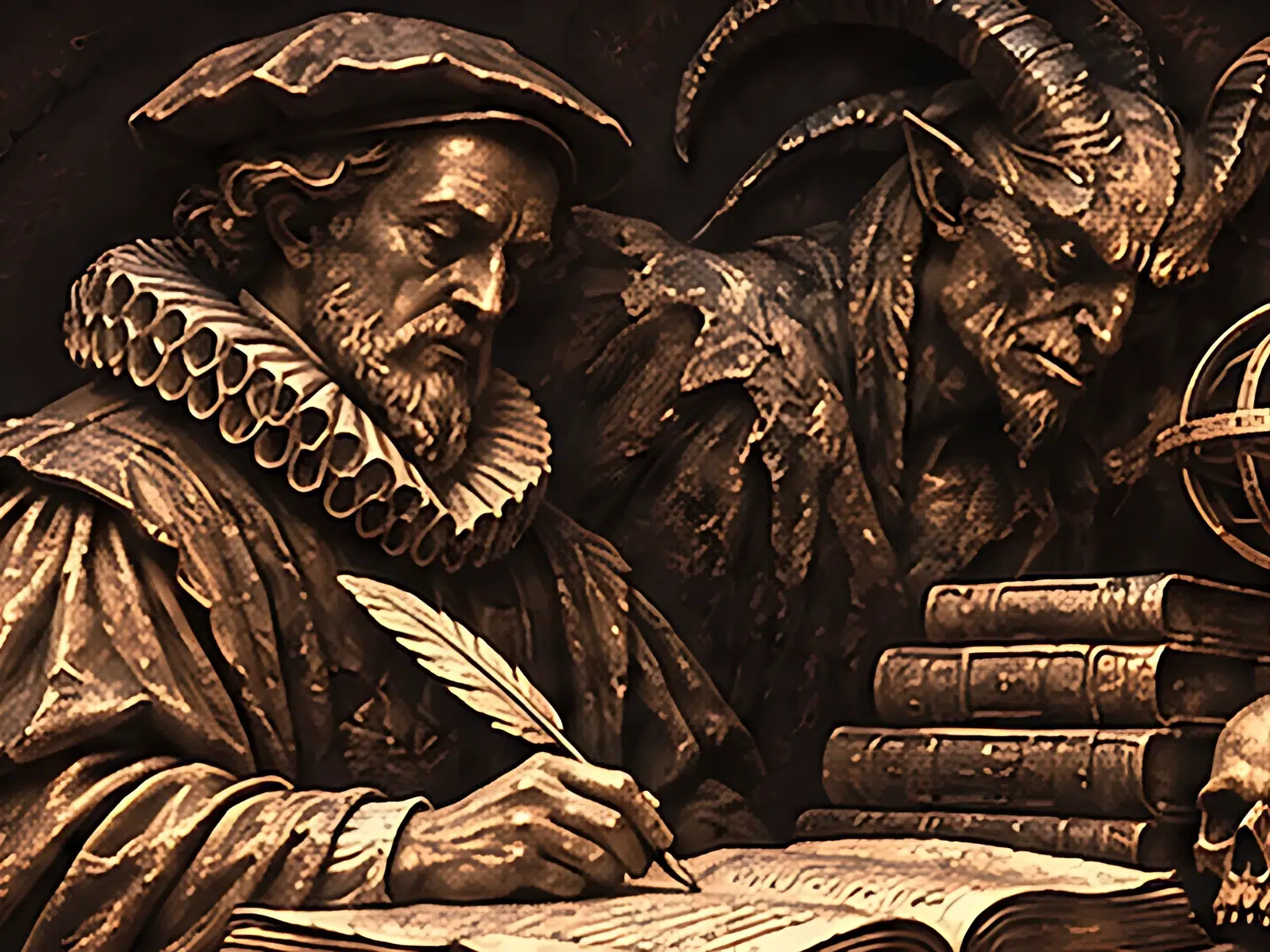
Then, in the 1577 edition, Weyer did something wild. He tacked on an appendix listing the demons from a magician’s manuscript he’d gotten hold of, a book called Liber officiorum spirituum, “the book of the offices of spirits.” He gave it a mocking title, Pseudomonarchia Daemonum, “The False Monarchy of Demons,” and his whole point was to drag the magicians’ “deceptions, vanity, tricks, impostures” out into daylight.
And he sabotaged it on purpose. In his note to the reader, in Peterson’s translation, he writes, “But lest anyone who is mildly curious, may dare to rashly imitate this proof of folly; I have omitted passages from this study, in order to render the whole work unusable.”
Let that one land for a second. The most famous demon list in history was published by a guy who deliberately broke it. Peterson thinks one of the things Weyer cut was which direction each spirit is called from, which is why the later Goetia doesn’t have them, and a lot of those directions turned up again centuries later in the Folger manuscript.
Weyer even argued with the Solomon connection. In his entry on the spirit Gaap, he says the necromancers claimed Solomon made their art, “Which is false: for it was rather Cham, the sonne of Noah, who after the floud began first to invocate wicked spirits.” In Weyer’s version, Ham called up the spirit Bileth and “made an art in his name, and a booke.” So even the man who published the list thought the real origin went back to the generation after the Flood. Pretty wild, right?
Oh, and Weyer listed 69 spirits, not 72. File that away.
Seven years later, in 1584, the Englishman Reginald Scot put an English translation of Weyer’s demon list (Peterson credits it to Abraham Fleming) into The Discoverie of Witchcraft. And Scot was a skeptic too. He thought witch prosecutions were irrational and un-Christian. King James VI of Scotland, the future James I of England, called Scot’s opinions “damnable” in his 1597 Daemonologie, and popular belief holds that copies of Scot’s book were burned when James took the English throne in 1603. Shakespeare, meanwhile, borrowed from it for the witches in Macbeth.
Here’s the official line, and I’ll only say it once. Scholars see the Ars Goetia as a 17th-century patchwork built mostly from Scot’s English version of Weyer, plus bits of Agrippa and the Heptameron. Wikipedia even points out that one spirit, Pruflas, goes missing in both the Goetia and an edition of Weyer’s list cited in Scot’s book, which is how they know the Goetia came after Weyer and not the other way around.
Fine. But think about what that actually means. Two men who wrote books to keep people from being burned as witches are the reason the demon names survived at all. If you’d told Weyer his appendix would turn into a working spellbook for four centuries, I’m pretty sure he’d have dropped his quill.
7. How Was the Lesser Key of Solomon Actually Put Together?
Somewhere in mid-1600s England, an unknown compiler took Scot’s demon list and wrapped it in a full ritual system, with circles, triangles, the brass vessel, the seals, conjurations, curses, and a “license to depart.” Then they bundled it with four other books on angels and spirits (the Theurgia-Goetia, Ars Paulina, Ars Almadel and Ars Notoria) and called the whole thing Lemegeton Clavicula Salomonis, the Little Key of Solomon.
Peterson’s notes on the manuscripts turn up some super weird details.
The book is named after a book that may not exist. The title “Lemegeton” seems to come from one line in the Ars Notoria, where “Solomon also saith in his Treatise Lemegeton.” A French scholar, Julien Véronèse, called that treatise “unidentified, perhaps fictitious.” So the most famous grimoire in the West might be named after a phantom.
“Lesser Key” isn’t in the manuscripts either. They say “little key.” A. E. Waite used “Lesser Key” in 1898 and may have coined it.
The 72 were rounded up on purpose. Weyer had 69. The Goetia adds Vassago, Seere, Dantalion and Andromalius and drops Pruflas, landing on 72. Peterson thinks it was for the number’s significance, making the demons a kind of shadow version of the 72 angels of the Shem HaMephorash, the 72-fold name of God. A later manuscript linked to a “Dr. Rudd” pairs each demon with one of those 72 angels to keep it in line.
The seals are newer than the names. Peterson says the sigils don’t appear in any earlier Office of Spirits manuscript he knows of. So the faces everybody tattoos today may be the youngest layer of the whole thing.
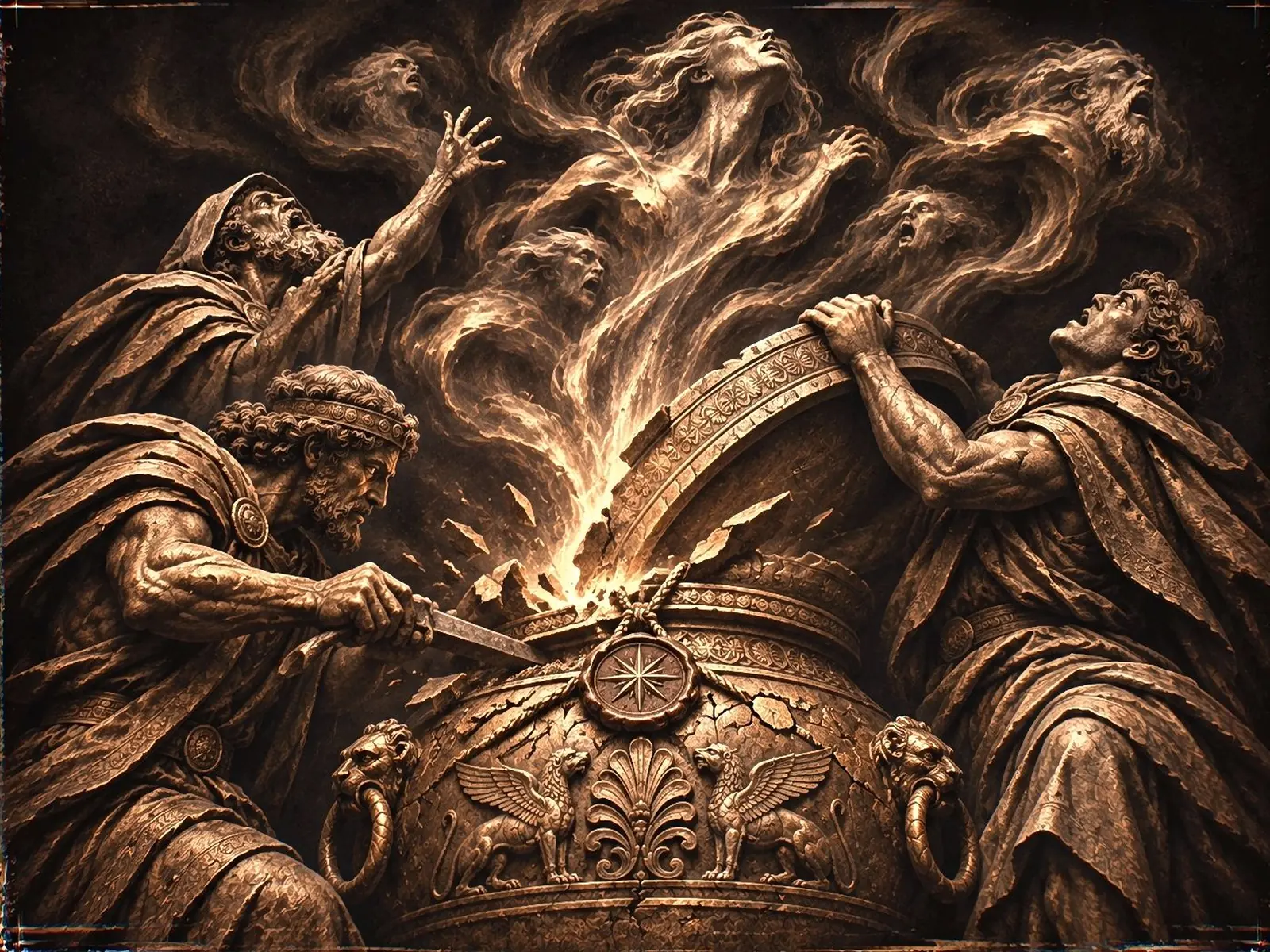
The vessel changed metal. The Goetia says Solomon shut the 72 kings and their legions in a vessel of brass and threw it into a deep lake in Babylon. The Babylonians, thinking it held treasure, broke it open, and out flew the spirits. All except Belial, who “entered into a certaine Image” and gave answers to people who sacrificed to it as a god. But Weyer’s Latin clearly says in vase vitreo, a glass vessel. Peterson puts the switch to “brass” down to Scot’s translator or a bad copy. Somewhere along the line, in somebody’s translation, the bottle turned to brass.
The key manuscripts sit in the British Library today, including Sloane MS 3825 (Peterson calls it the most accurate when checked against the source texts), Sloane 2731, Sloane 3648, and Harley 6483, dated 1712 to 1713 and titled “Liber malorum Spirituum, seu Goetia.”
8. Timeline: The History of the Goetia at a Glance
That’s a lot of centuries to keep straight, so here’s the whole run in one place.
| When | What happened | Why it matters |
|---|---|---|
| c. 20th–18th c. BC | Egyptian execration texts (Berlin and Brussels groups) | Enemies’ names written on figurines and pots, then smashed and buried |
| c. 1830–1531 BC | Old Babylonian incantation against the nameless udug | Demon exorcism centuries before Greece |
| early 1st millennium BC | Akkadian Maqlû “Burning” ritual in its mature form | Night-long anti-witchcraft rite timed to when spirits travel |
| 8th–7th c. BC | Pazuzu appears in art and texts | A demon called on to drive off a worse demon |
| 472 BC to c. 350 BC | Aeschylus’ Persians raises Darius’s ghost with “soul-leading laments”; Herodotus, Gorgias, Euripides and Plato use goēs and goēteia | The word Goetia is born among ghost-raisers, spell-sellers and wolf-men |
| c. 1st c. BC to 1st c. AD | Strabo calls Orpheus andra goēta, a wizard | Even the great singer of the underworld was a goēs |
| 100s BC to 400s AD | Greek Magical Papyri, incl. the future “Bornless” rite | Greco-Egyptian spells, later bolted onto the 1904 Goetia |
| c. 93–94 AD | Josephus describes Eleazar exorcising with a ring and Solomon’s incantations before Vespasian | Earliest solid Solomon-ring-demon story |
| 1st c. to Middle Ages | Testament of Solomon written in Greek | Solomon binds named demons with Michael’s ring to build the Temple |
| 226–636 AD | Jewish Aramaic incantation bowls buried in Babylonian homes | Demons trapped in vessels in Babylon |
| before 1236 | Michael Scot lists about twenty demons | Some names survive into later catalogs |
| 1400s | Munich Manual (CLM 849) | Necromancer’s handbook with a partial Goetia-like list |
| 1400s–1500s | Livre des Esperitz | 30 of 47 spirits nearly match the Goetia |
| 1508 | Trithemius catalogs a book of spirit offices | The source text was already circulating |
| 1577 | Weyer’s Pseudomonarchia Daemonum | 69 demons, deliberately made “unusable” |
| 1583 | John Porter’s Office of Spirits | English cousin of Weyer’s source |
| 1584 | Scot’s Discoverie of Witchcraft | English translation the Goetia leans on |
| mid-1600s | Lemegeton compiled; the date 1641 appears in its text | The Goetia as we know it is born |
| 1712–1713 | Harley 6483, the “Dr. Rudd” version | Demons paired with 72 angels |
| 1818 / 1863 | Dictionnaire Infernal; 1863 edition illustrated by Louis Le Breton | The demon faces most people picture |
| 1898 | A. E. Waite uses “Lesser Key” | The famous title may start here |
| 1904 | Mathers’ translation published by Crowley at Boleskine | The edition that made the Goetia famous |
| 1992 | DuQuette and Hyatt’s Aleister Crowley’s Illustrated Goetia | Opens the door to imaginative, psychological Goetia work |
| 1999 | Newcomb’s Conjuring the Goetia Spirits | A modern “simple advanced key” |
| 2001 | Joseph Peterson’s critical edition | Called the standard scholarly text |
| 2019 | Hargrove’s Goetia Pathworking | Goetia without the circle |
| 2022 | Jason Miller’s Consorting with Spirits | Spirit work as relationship, not just command |
9. What Really Happened Between Crowley and Mathers in 1904?
If you own a copy of the Goetia, there’s a good chance it’s this one. And its title page is a burn.
Mathers, one of the heads of the Hermetic Order of the Golden Dawn, had translated the Goetia. The book’s own prefatory note says he worked from “numerous MSS. in Hebrew, Latin, French and English.” Crowley had been his student and at one point wrote that “Mathers was my only link with the Secret Chiefs.” Then the Golden Dawn tore itself apart, Mathers was expelled in April 1900, and teacher and student turned into bitter enemies. Crowley later cast Mathers as a villain in his 1917 novel Moonchild.
So in 1904, under an imprint at his house at Boleskine on Loch Ness, Crowley published The Book of the Goetia of Solomon the King, “Translated into the English Tongue by a Dead Hand.” The prefatory note identifies the translator only by Mathers’ Golden Dawn initials, D.D.C.F., and says he had “succumbed unhappily to the assaults of the Four Great Princes (acting notably under Martial influences).” In normal people talk, the book says the demons got him, so somebody else had to finish the job. Crowley adds in a footnote that the original translator did such a good job that editing it “proved practically a sinecure.” Mathers was very much alive, by the way. He died in Paris in 1918.
Crowley also slipped in some things that were never in the Lemegeton.
The “Preliminary Invocation.” “Thee I invoke, the Bornless one.” It’s one of the most quoted pieces of modern magic, and it isn’t Solomonic at all. It comes from a Greco-Egyptian papyrus in the Greek Magical Papyri, PGM V. 96–172, the “Stele of Jeu the Hieroglyphist,” first published in England by Charles Wycliffe Goodwin in 1852. And its original purpose was exorcism. So the prayer that opens the world’s most famous demon-summoning book was written to drive spirits out. You can’t make this stuff up.
Enochian conjurations, in the “Angelic” language from John Dee and Edward Kelley‘s work, which Crowley transliterated himself.
An essay with a famous line. In “The Initiated Interpretation of Ceremonial Magic,” Crowley writes, “The spirits of the Goetia are portions of the human brain.” That line gets quoted everywhere as proof he thought it was all psychology. But a page earlier he wrote, “I am not concerned to deny the objective reality of all ‘magical’ phenomena.” So which was it? Honestly, Crowley being Crowley, probably both.
Peterson also notes that Mathers “substantially rewrites and shortens” one of the conjurations, and his changes don’t match any other manuscript. So the Goetia most people think of as ancient carries Mathers’ edits, Crowley’s add-ons, and a 2,000-year-old Egyptian exorcism bolted onto the front. Then a Chicago publisher, L. W. de Laurence, lifted the whole thing in 1916, an edition Wikipedia describes as a plagiarism of the Mathers/Crowley text.
10. Were the Goetic Demons Once Gods?
Remember Asmodeus bragging that people would “revere us as if we were gods”? This is the question the forums fight about more than any other, and the textbooks barely touch it.
Start with the Bible, because that’s where the demotion begins. Deuteronomy 32:17 says Israel “sacrificed unto devils, not to God; to gods whom they knew not.” Psalm 106:37 says they “sacrificed their sons and their daughters unto devils.” And Paul says it outright in 1 Corinthians 10:20: “the things which the Gentiles sacrifice, they sacrifice to devils, and not to God.” So in that worldview the gods of your neighbors aren’t fake at all. They’re real, and they’re demons. Scholars cited on Wikipedia say Paul’s line gave a theological basis for turning goddesses like Astarte into demons, and once you buy that logic, every conquered god becomes a candidate for hell’s org chart.
The Goetia even remembers it on its own pages. At the end of its Babylon story, Belial slips into an image and gets worshipped “as a God.” The book itself remembers a demon being treated as a god, which I find kind of fascinating.
So here’s what I could actually trace, going from the solid cases down to the forum claims.
| Goetic spirit | Older figure | How solid is the link? |
|---|---|---|
| Bael (#1), “a king ruling in the East” | Baal, the Canaanite title tied to the storm and fertility god Hadad, “rider of the clouds” | Strong on the name. Collin de Plancy wondered if they were the same |
| Astaroth (#29), a duke who rides an “Infernall like dragon” | Astarte, the Phoenician goddess the Bible calls Ashtoreth, the Northwest Semitic counterpart of Ishtar | Very strong. Scholars trace the goddess turning into a male demon |
| Asmoday (#32), “a great king, strong & powerfull” | Asmodeus/Ashmedai of Tobit, the Talmud and the Testament, probably from the Persian aēšma-daēva, the demon of wrath | Very strong. Same demon, traced back to Zoroastrian Persia |
| Amon (#7), a marquis who appears as a wolf with a serpent’s tail | The god Amun of Siwa Oasis, or the Punic god Baal Hammon of Carthage | Plausible. Wikipedia gives both possible sources |
| Belial (#68), “Created next after Lucifer” | A Hebrew word for “wickedness” or “worthlessness,” personified as a demon in the Dead Sea Scrolls | Strong, but he started as a word, not a god |
| Beelzebub (not one of the 72, but Solomon’s demon prince in the Testament) | Baal-zebub, “the god of Ekron,” whom King Ahaziah consults in 2 Kings 1 | Very strong. A Philistine god turned prince of demons |
| Ipos (#22) and Haures (#64, also spelled Flauros) | Anubis and Horus, according to forum posters | Forum claim only. I couldn’t find a scholarly source for either |
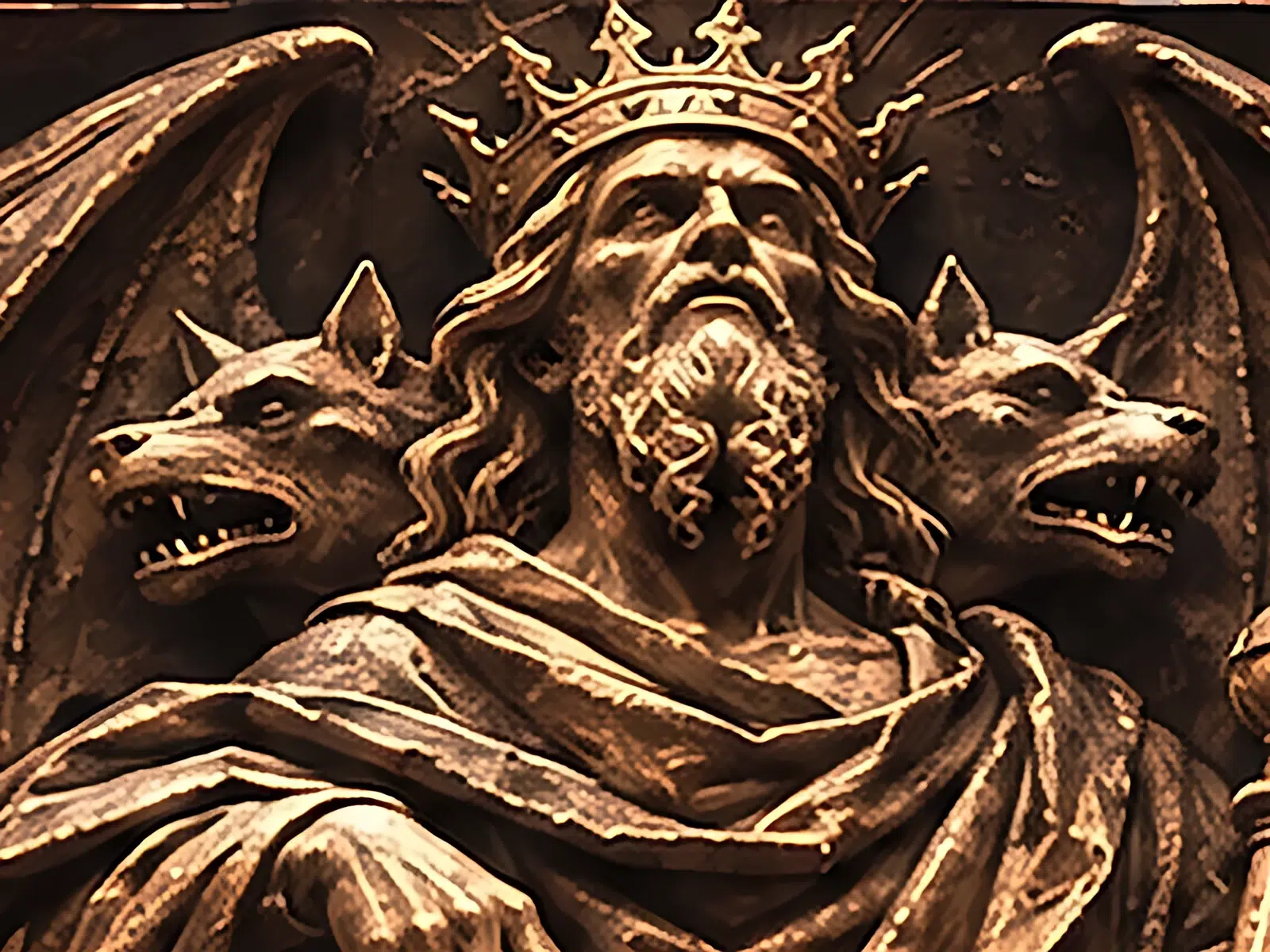
The Bael-to-Beelzebub family is the clearest example of how the demotion works. Baal was a title, “lord,” and the Hebrew Bible shows prophets like Elijah fighting his cult. In 2 Kings, King Ahaziah falls through a lattice and sends messengers to “inquire of Baal-zebub, the god of Ekron, whether I shall recover.” Elijah condemns him to die for asking the wrong god. Centuries later, that same god of Ekron is Beelzebul in the Testament of Solomon, the prince of demons, who tells Solomon he used to be the highest-ranking angel in heaven. And the Goetia’s first king, Bael, carries the old title right at the top of the list.
Astaroth is even wilder. Astarte was worshipped from the Bronze Age through classical antiquity, from Ugarit and the Phoenician coast outward, and the Bible’s own Solomon “went after” her. Her Hebrew plural form, Ashtaroth, referring to multiple statues, got carried straight into early Greek and Latin Bibles, where it was less obvious it had been a feminine plural. By the time she reaches the Goetia, the goddess who may be Jeremiah’s “Queen of Heaven” has turned into a male duke on a dragon who, in the Goetia’s words (spelling modernized), “will declare willingly how the spirits fell, if desired, and the reason of his own fall.” Read that line again with her history in mind. It hits different. (And hold that thought, because one modern magician says she never stopped being a she. We’ll get to him.)
The Persian thread matters too. If Asmodeus really does come from the Zoroastrian aēšma, then the Goetia is carrying a Persian demon of wrath that passed through Jewish, Christian and Islamic stories before it ever landed in an English grimoire. And in one later tale summarized on Wikipedia, a demon, either Asmodeus or Sakhr, gets hold of Solomon’s ring and rules in his place for forty days.
Practitioners take all of this a lot further. A WizardForums thread says flat out that “some of the demons are bastardized pagan gods (ex. Ashtaroth = Astarte, IPOs = Anubis, Haures – Horus, etc).” A poster on r/DemonolatryPractices pushes back a little: “While people like Connolly will say all the demons used to be gods, I don’t think that’s true for every single instance.” (That’s S. Connolly, a well-known demonolatry author.) Another r/DemonolatryPractices thread describes the Goetic demons and grimoire spirits as “a general collection of the names of pre-Christian gods, supernatural figures” and more. And the author Carroll Runyon argued in The Book of Solomon’s Magick (1996) that the demons came from Mesopotamian mythology.
Not everybody’s buying it. On the Become A Living God forum in 2020, one member wrote that the Goetia spirits are “for the most part ‘fairly’ new” and that people “try and cement their history by tying them to the pagan Gods, despite there not being really any historical presence of them ever being such, besides maybe 1 or 2.” Another member in that same thread waved off the whole history debate in one line: “The Goetia’s been the industrial standard of ceremonial evocation in Western magic for a few centuries now because it works.”
My take? The names prove at least a handful of old gods ended up in the catalog, and the Bible hands you the exact theology that put them there. Whether something deeper is going on, whether the old powers kept answering under new names, nobody can prove from paperwork, which is exactly why people are still arguing about it. And a part of me really wants to say the old gods never left. I just can’t back that up with a manuscript.
11. Are the Goetic Spirits Inside Us or Out There?
So if some of these spirits used to be gods, what are they now? This is where the Goetia gets personal. Ask ten magicians what a Goetic spirit is and you’ll get at least three answers: an outside being, a piece of your own mind, or both at once. And honestly, the “both” answer has the deepest roots.
Crowley started the argument, and hedged it. I already mentioned his famous line, “The spirits of the Goetia are portions of the human brain.” He even explains that “The Spirit Cimieries teaches logic” really means “those portions of my brain which subserve the logical faculty may be stimulated and developed.” But he also said he was “not concerned to deny the objective reality of all ‘magical’ phenomena.” Read the whole essay and you get a guy who thought the spirits worked through the brain, without promising they were only the brain.
Jung gave it a map. Carl Jung coined the term “collective unconscious” for a layer of the mind that isn’t personal at all. In his words, “primordial images” or “archetypes” “belong to the basic stock of the unconscious psyche and cannot be explained as personal acquisitions. Together they make up that psychic stratum which has been called the collective unconscious.” So in Jung’s model there’s something inside you that’s bigger than you, shared by every human, and it shows up as images and figures that seem to have a life of their own. (I did a whole episode on the shadow back in Episode 31, if you want to go deeper.)
And then there’s the shadow. Jung’s shadow is the unconscious part of the personality that doesn’t match who we think we are, so we shove it away and project it onto other people. According to the Wikipedia summary, it can be personified as archetypes tied to the collective unconscious, like the trickster. Jung warned that “a man who is possessed by his shadow is always standing in his own light and falling into his own traps.” And his fix, using Dr. Jekyll and Mr. Hyde as the example, is this: “it must be Jekyll, the conscious personality, who integrates the shadow … and not vice versa. Otherwise the conscious becomes the slave of the autonomous shadow.”
Now hold that up next to the Goetia. A spirit shows up in a terrifying form, roars, lies, or won’t speak clearly. The magician, standing in a circle built on divine names, commands it to take “a fair and humane shape” and answer truthfully. Paimon “roareth at his first comming, and his speech is such as the Magician cannot well understand, unless he compelleth him” (spelling partly modernized). Swap a few words and that’s Jekyll staying in charge of Hyde. To be fair, Jung never wrote about the Goetia that I could find. This is practitioners, and me, running with his ideas.
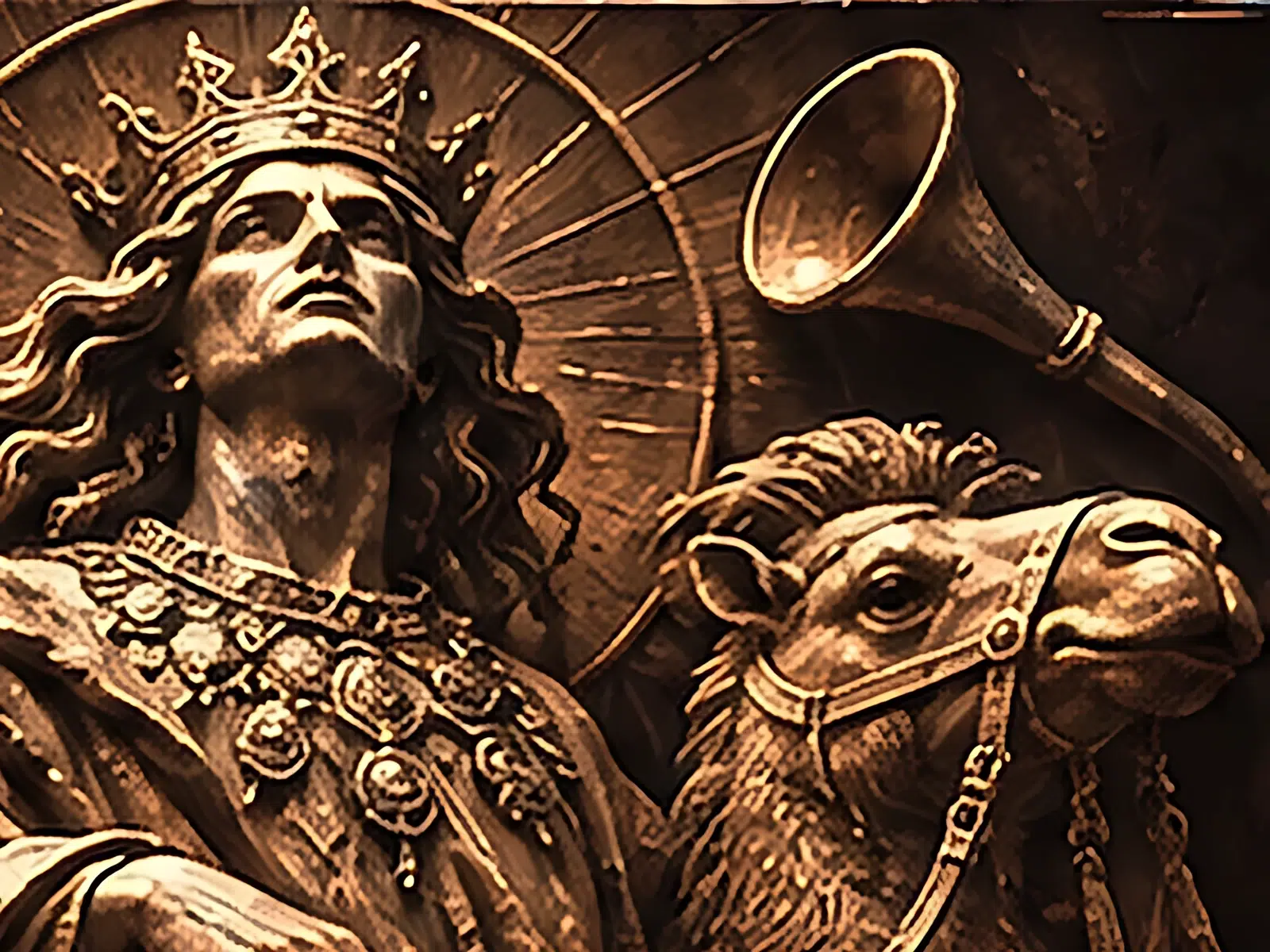
DuQuette’s famous line. Lon Milo DuQuette, one of the best-known modern Goetia practitioners, co-wrote Aleister Crowley’s Illustrated Goetia (1992) with Christopher S. Hyatt and wrote a memoir called My Life With the Spirits (1999). He sums up the whole debate in a line he later used as the subtitle of his 2010 book Low Magick: “It’s all in your head … you just have no idea how big your head is.”
In Low Magick he asks readers not to forget the second half of what he calls his “outrageous statement.” I love that, because it lets the spirit be inside you and bigger than anything you’d call “you.” In the Illustrated Goetia, DuQuette and Hyatt even warn that David P. Wilson’s drawings of the spirits aren’t “what you must see.” According to a Spiral Nature review, the pictures are “intended to serve only as springboards to your imagination,” because everybody’s “visual-emotional ‘vocabulary'” is different.
The mystics got there first. Think back to the Sufi reading of Solomon, where his battle with the demons becomes “the internal struggle of the self against demonic urges.” That idea is centuries older than Jung. Or the Babylonian udug, “the one who, from the beginning, was not called by name.” Whether you think of a demon as a being or as a buried piece of yourself, the oldest move in the book is the same one. You give it a name and a face, so you can deal with it.
So where do I land? I don’t think “it’s psychological” and “it’s real” cancel each other out. If the collective unconscious is shared by every human who ever lived, then something living there is “within us” and “outside us” at the same time. Thousands of years of people meeting the same kinds of figures under different names starts to look less like coincidence and more like a place we all keep visiting. Or, I mean, a place that keeps visiting us.
12. Why Would a Mystic Walk Into the Dark on Purpose?
And that leads to an angle most history-of-the-Goetia pages never touch, which honestly matters a lot to me. For some mystics, going into the dark has nothing to do with evil. It’s about wholeness.
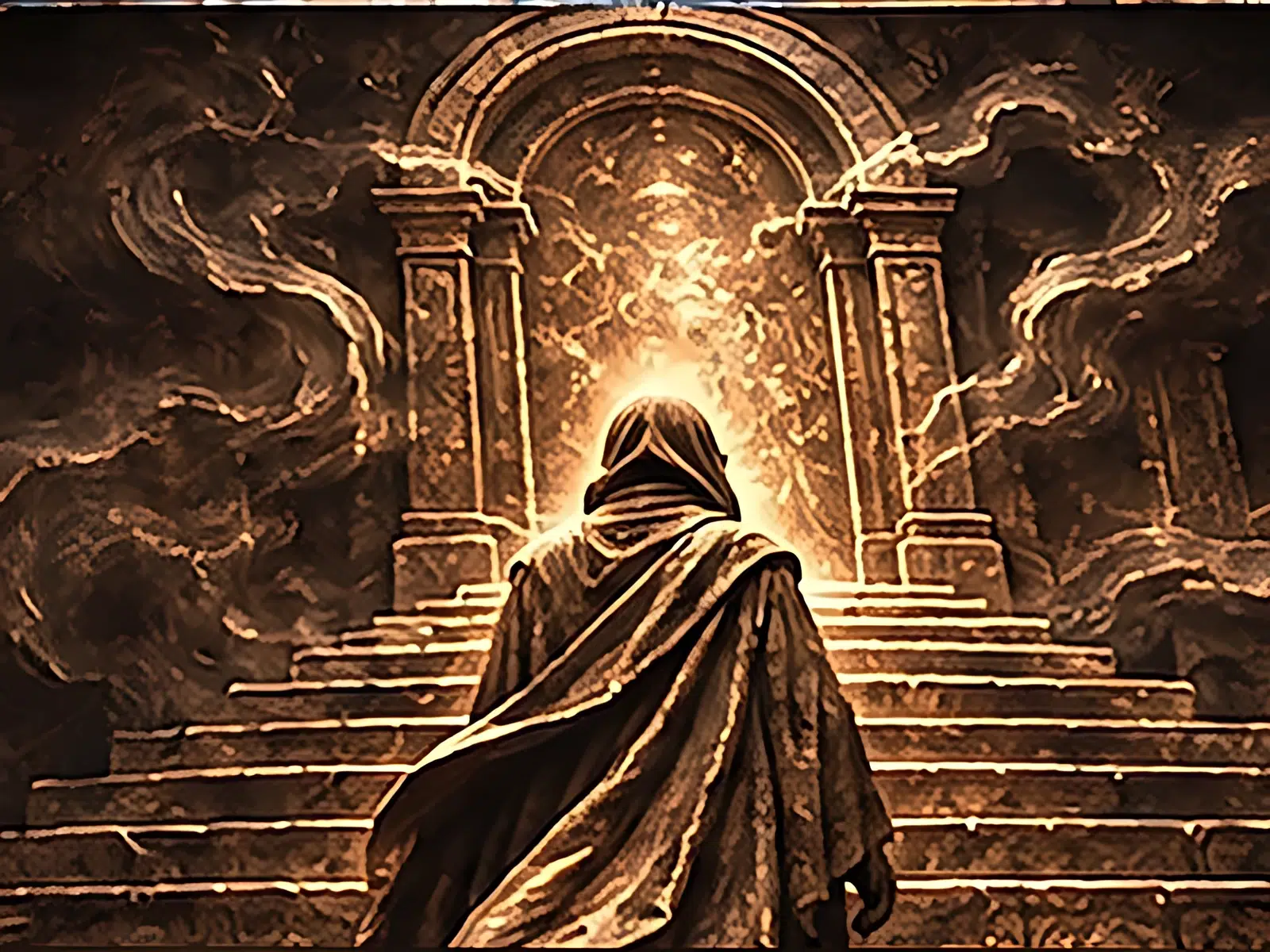
Jung put it in one of his most quoted lines, from Alchemical Studies: “One does not become enlightened by imagining figures of light, but by making the darkness conscious.” The passage goes on, “The latter procedure, however, is disagreeable and therefore not popular.” In plain words, you don’t get whole by pretending the scary parts of you aren’t there. You get whole by facing them, which is about as unpopular as it sounds.
The Goetia was built by believers. This one surprises people. The grimoire is soaked in God. The magician commands each spirit “by all the holy and most glorious Names of the most holy and true God,” calling out names like Adonai, El, Elohim, Zebaoth and Tetragrammaton (spelling modernized from the manuscript). The circle around the magician is lettered with Hebrew divine and angelic names, and the magician wears Solomon’s ring, engraved with the name Tetragrammaton on the inside and Michael on the outside. The whole system assumes a person of faith walking into the darkest room in the house while holding the light.
And the spirits themselves talk like fallen beings more than cartoon monsters. Belial says he “fell first” among the worthier and wiser angels. Astaroth will tell you the reason of his own fall. It’s the Christian story of rebellion and fall, told from the other side of the table.
So what about a Christian doing Goetic work? That’s the image I keep coming back to, and to me it’s the heart of this whole section. A believer going deep into the Goetia, without switching sides, to face what their tradition taught them to fear, and coming out more whole. It’s the same logic as Jung’s shadow work and the same logic as the Sufi reading of Solomon. And honestly it’s the oldest version of the Solomon story, too. The king who knew God best was also the one who sat across from the demons and made them talk.
The Testament adds a warning, though, and I’m not going to skip it. Solomon ends that book as “the sport of idols and demons,” and says he wrote it so readers would learn from his fall. Engaging the dark for wholeness and getting swallowed by it are two very different things, and every tradition that walks this road says so.
Jason Augustus Newcomb’s book. One modern book I’d point you to here is Jason Augustus Newcomb’s Conjuring the Goetia Spirits, subtitled A Simple Advanced Key, first published by Smite! Press in 1999. Newcomb later recorded it himself as an audiobook (released in 2016 by New Hermetics Audio Press), which the listing says includes “a lot of new material that was only released in an ultra-rare private second edition,” including “some very powerful techniques for opening up the inner planes more effectively.” That phrase, opening up the inner planes, says a lot about where modern Goetic work has gone. The spirits get approached on the inside, in the inner worlds, as much as out there in the triangle.
And here’s the twist that makes Newcomb perfect for this part of the story. He’s a Thelemite who writes about Goetia, Enochian magic and Hermetics, and in 2008 he also published How the Teachings of Jesus Could Change America. One longtime member of WizardForums was so thrown by that pairing that he started a whole thread about it in 2025 and said he was “perplexed.” Another member’s answer was that all of Newcomb’s work, “Thelma, Enochian, Goetia, folk Jesus,” aims to give people a way to improve their lives through spiritual activity. On Newcomb’s own site, the new limited edition of the Goetia book promises “three different approaches to goetic work,” which he calls “battle-tested.” The original late-’90s run was only about two hundred staple-bound copies, and he says he’s seen one sell for over $75 on eBay. (Kind of wish I’d grabbed one.)
That same instinct shows up all over the forums. In a 2018 r/occult thread titled “Goetia shadow work?”, one commenter wrote that there’s an interpretation where the Goetic spirits are “parts of your own psyche,” the unacknowledged, submerged side of yourself. Another described evoking the spirit and then calling on “The Creator, surrounding and going into to transform and redeem it.” That isn’t devil worship by any stretch. It’s somebody walking straight into their own darkness with their light in hand, and coming out the other side more whole.
13. Do the Goetic Spirits Actually Follow the Rules?
Which raises a question every Goetia newbie eventually asks. If these things have their own will, do they actually stay where they’re told?
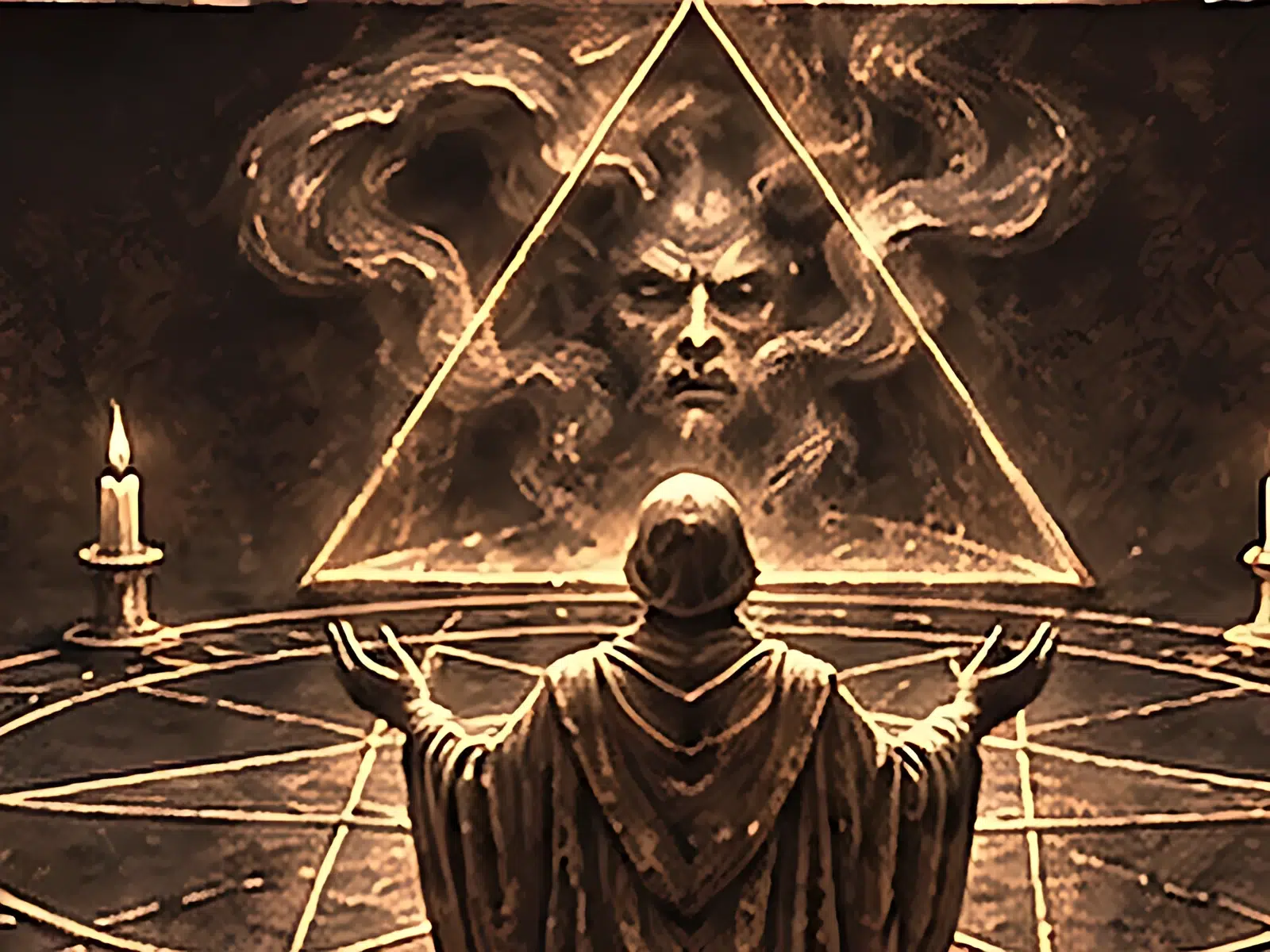
On paper, the Goetia is all rules. The magician stands inside the circle. The spirit’s supposed to appear outside it, in the triangle. Get those wrong and, according to the book, you’re in trouble. And the old text is packed with warnings that make it sound like the spirits are just waiting for an excuse.
- Beleth, “a mighty king and terrable,” rides a pale horse with trumpets playing before him and is “very furious at his first apperance.” The magician has to stretch a hazel stick toward the south and east, “making a Triangle without the Circle,” and command him into it “by the vertue of the Bonds & chaines of spirits.” And yet the magician also “must receive him courteously, because he is a great king & doe homage to him.” Threats and good manners in the same breath.
- Flauros (Haures) gives true answers about past, present and future, “but unless he be commanded into a Triangle, he will Lye in all those things and deceive or beguile the Exorcist.”
- Astaroth comes as “an unbeautifull angel” riding an infernal dragon with a viper in his right hand, and “you must not lett him come to neare you least he doe you damage by his stinking Breath.” The magician holds Solomon’s ring up to his face for protection.
- And when it’s over, the magician gives a formal “licence to depart,” telling the spirit to go back “unto thy proper place without doeing any Injury or danger to any man or beast.”
(Spelling in those quotes is from the Sloane 3825 manuscript, lightly modernized.)
Jason Miller’s story. Jason Miller is a modern sorcerer, the man behind Strategic Sorcery, and the author of Consorting with Spirits: Your Guide to Working with Invisible Allies (Weiser Books, 2022), with a foreword by Mat Auryn. He also co-hosts The Circle Is podCAST with actress and author Rachel True. And there’s a story in Consorting with Spirits that I’ve never been able to shake.
As I remember it from the book, Miller was calling Astaroth, the spirit whose name comes from the goddess Astarte. And the spirit didn’t stay where the rules said it should. It came inside the circle, right up to him, talking in a frightening voice. Miller reminded it that it was supposed to stay in its place. And the spirit laughed. Then it dropped the scary voice and the scary form, took on a gentler one, and stepped back outside the circle, like it was saying fine, we’ll play it your way.
That gets under my skin every time. And Miller’s said plenty in public that fits it. In a long interview with religious-studies scholar Dr. Angela Puca, he said, “I have communicated with Astaroth God knows how many times since I was a young man. I’ve never been stank out of the room with a noxious odour that I needed a ring to make her stop, as is described in the books.”
Notice the pronoun. The Goetia calls Astaroth a duke, but Miller says her. Readers on r/DemonolatryPractices noticed it too. One wrote that in Consorting with Spirits, Miller describes a Goetic spirit “traditionally always… portrayed as male” that “presented exclusively female to him” and even told him to use a feminized form of its name. That’s Astarte, the goddess, peeking out from behind the demon’s mask. The book itself includes Miller’s own friendly conjuration of Astaroth, which readers on that same subreddit say they’ve adapted for other spirits.
He’s pretty blunt about the grimoire descriptions, too. In that same interview he pointed out that the Goetia’s spirit entries match across Weyer and the other texts because “they literally just copied from one book to the other. So ultimately, it boils down to one person who decided that this is what Astaroth does.” Which, if you read section 6, is exactly what the paper trail shows.
And he doesn’t think the biggest name is always the right call. In the Puca interview he explains it with coffee: “if you have the CEO of Starbucks on speed dial and you want a coffee, do you speed dial the CEO of Starbucks or do you talk to the barista at the Starbucks?” He goes right on to poke fun at people with “this sort of weird Pokémon idea like, ‘Well, I’m going to call upon Astaroth because she has, you know, 150 hit points, whereas this other lower Vassago only has 20,'” and says “it doesn’t really work like that.” I laughed out loud at that one. Pretty much every Goetia forum in existence, called out in one sentence.
So what actually matters to him? According to a Musing Mystical review of Consorting with Spirits, Miller writes that “it’s the relationship that really matters, not whether the spirit is in the correct column for the planet or whether the description in the book fits your needs.” And on his Strategic Sorcery blog, explaining why the book teaches both friendly and forceful conjuring, he wrote that “some spirits treat the forceful constraint as a sort of test and won’t deal with anyone who doesn’t show strength.” So the chains might be less of a cage and more of a test, a way of showing you belong in the room.
Put that next to the circle story and it clicks. The circle didn’t stop the spirit. The spirit chose to honor the circle once it was reminded. The way I read it, for Miller the rules work more like etiquette than a cage. The spirit plays along because it’s agreed to, and it could probably stop agreeing.
And that lines up eerily well with the old texts. The Goetia tells you to threaten Beleth with chains and bow to him as a king at the same time. The Testament‘s Ephippas, sealed in a flask, still “stood up and walked around some seven steps” and bowed to Solomon on his own. In the Talmud, Ashmedai is chained with God’s name and still talks Solomon out of his ring. Over and over, the stories hint at the same thing. The bindings are real, but they work because both sides recognize them, kind of like a treaty. Push a spirit past what it agreed to, or hand over your protection, and the “formality” stops being a formality real quick.
I’ll be honest, that scares me way more than a demon that just obeys. It means you’re dealing with something that has its own will and its own sense of humor, and it’s choosing to be polite.
14. How Is Goetic Pathworking Different From Traditional Goetic Evocation?
That relationship idea is also why the modern scene split in two. People say “working with the Goetia” about two practices that are almost opposites. I went deep into pathworking in a separate article, but here’s how they stack up side by side. (This is history and comparison, not a how-to.)
Traditional evocation is the grimoire’s own method. The Lemegeton compiler, drawing on older texts like the Heptameron, built it around a protective circle lettered with divine names, a triangle outside it where the spirit is meant to appear, the spirit’s seal worn as a lamen, Solomon’s ring, Solomon’s hexagram and pentagram, a brass vessel, and a long chain of conjurations, constraints and curses for a spirit that won’t come. The spirit is treated as a real outside being, commanded “by all the holy and most glorious Names” of God to appear “before this Circle, in a fair and humane shape,” answer truthfully, and leave when licensed.
Pathworking comes from a totally different family tree. The writer Alex Sumner points out that path-working “does not seem to have existed as an occult practice prior to the occult revival of the late nineteenth century.” It grew out of the Golden Dawn offshoot the Stella Matutina, where members tried to “re-tread the Paths astrally” on the Qabalistic Tree of Life, and it spread through Dion Fortune, W. E. Butler’s Servants of the Light (founded 1973), and Dolores Ashcroft-Nowicki’s The Shining Paths. It was built for the Tree of Life, which means angels and the climb toward the divine. Pointing it at the Goetia’s 72 came a lot later.
| Traditional Goetic evocation | Goetic pathworking | |
|---|---|---|
| Where it comes from | 1600s Lemegeton, built on Weyer, Scot, the Heptameron and the Solomon legend | Golden Dawn and Stella Matutina visualization, late 1800s on |
| Where the spirit appears | Outside you, in a triangle beyond the circle | Inside a guided vision or inner landscape |
| How you relate to it | Command and constrain it by divine names, with threats if needed | Meet it, talk with it, observe it |
| Protection | Circle, divine names, Solomon’s ring, seals, a formal license to depart | Usually a banishing or grounding practice; varies by author |
| What it looks like | The grimoire’s fixed descriptions, like Bael’s cat, toad and man heads | Personal imagery; DuQuette and Hyatt call drawings “springboards to your imagination” |
| Tools | Many, and the grimoire is strict about them | Very few. One modern book, Corwin Hargrove’s Goetia Pathworking (2019), says you “only need to look at the sigils” |
| What the spirit “is” | A real, outside being | Ranges from a real being met in the inner planes to a part of the psyche |
| Biggest criticism | Dangerous, confrontational, and forbidden by most religions | Purists say dropping the circle and names throws out the safety features |
The big difference is direction. Evocation drags the spirit out into the room, and pathworking sends you in to meet it. Hargrove’s marketing calls his method “extremely safe and easy to learn,” with “nothing to burn, collect, or make.” Traditionalists hear that and wince, because the old system treats every single one of its tools as a safety device.
What gets me, though, is that both camps report the same kind of thing. Grimoire purists talk about spirits with their own personalities. Pathworkers report visions that surprise them, talk back, and don’t match the book, and DuQuette and Hyatt say outright that each person’s imagery will be different. Which drops us right back into the last few sections. If a spirit can show up in your inner landscape and in a triangle on the floor, maybe “in here” and “out there” were never as separate as we think.
15. What Pieces of the Goetia’s History Are Still Missing?
When I lined up what the scholars say next to what the forums say, a few gaps just would not close.
- The original Book of the Office of Spirits has never been found. Wikipedia says flatly that the original work, “if it is a single work,” hasn’t been located.
- What exactly did Weyer cut? He admits he removed passages. Peterson rebuilt some of them, like the spirits’ compass directions, from the Folger manuscript, but nobody knows the full list.
- Was there a lost Trithemius text? Wikipedia’s summary says the Rudd version may come from a now-lost work by Trithemius, who taught Agrippa, who taught Weyer. Teacher to student to student, with a book in the middle that’s just gone.
- Where did the seals come from? They aren’t in the earlier lists Peterson knows of. Other catalogs, like one in a Florence manuscript with sigils for 100 demons, look similar.
- Is there an older non-European version? Way back in 2005, the very first post in a Forteana forum thread on the Goetia’s origins asked whether there were copies in Arabic. Weyer himself claimed an Arabic origin for a different part of the Lemegeton, the Ars Almadel. As far as I could find, no Arabic ancestor of the Goetia’s demon list is known.
- Is “goetia” really necromancy at the root? Burkert’s lament-for-the-dead reading and Stratton-Kent’s Greek underworld theory say yes. The grimoires themselves mostly talk about Solomon instead.
A quick checklist for spotting Goetia myths
Next time you see a video or a post about the history of the Goetia, run it past this:
- Does it say King Solomon actually wrote it? No surviving manuscript is older than the 1600s.
- Does it say Crowley wrote or translated it? He edited and published Mathers’ translation.
- Does it call the Preliminary Invocation part of the original? It came from an Egyptian papyrus and was added in 1904.
- Does it treat the seals as ancient? They’re the youngest layer we can trace.
- Does it skip Weyer and Scot entirely? Then it skipped the best part.
- Does it claim every demon was once a god? A few clearly were. The rest is still up for grabs.
So What Is the Goetia, Really?
Here’s what keeps rattling around my head. A pregnant woman in Babylon wears a demon’s face to keep a worse demon away. A Jewish family in Nippur buries a bowl to catch whatever comes through the door. A Roman general watches a basin of water tip over by itself. A Greek word for wailing over the dead turns into a curse word. A doctor publishes a demon list so people will stop burning witches, and breaks it on purpose so nobody can use it. Somebody in 1600s England fixes it anyway, rounds the demons up to 72, swaps the glass bottle for brass, and names the whole thing after a book that might never have existed. Then a feuding magician publishes it with an ancient exorcism on page one and his old teacher credited as a “dead hand.”
The mainstream herd will tell you that’s a story about plagiarism and paperwork. Maybe. But these same names have been copied, hidden, banned, burned and rebuilt for something like 500 years, and people still swear something answers when they call. That’s a whole lot of effort for a list that supposedly doesn’t do anything.
So what do you think? Are the Goetic spirits old gods wearing new crowns, pieces of our own buried shadow, a Renaissance invention, or something that was there long before anybody wrote it down? Let me know in the comments.
Frequently Asked Questions
Who wrote the Goetia?
Nobody knows. The Ars Goetia was compiled anonymously in England in the mid-1600s, mostly from Reginald Scot’s 1584 English translation of Johann Weyer’s 1577 demon list, plus material from Agrippa and the Heptameron. It’s attributed to King Solomon, but no manuscript is older than the 17th century.
How old is the Goetia?
The book dates to the mid-1600s, and its demon names appear in 15th-century manuscripts. The Solomon legend reaches back to Josephus, the word goēteia to Herodotus and Plato, and demon-binding ideas like naming, trapping and commanding spirits to ancient Mesopotamia and Egypt.
Did Aleister Crowley translate the Goetia?
No. S. L. MacGregor Mathers did the translation. Crowley edited and published it in 1904 after the two fell out, crediting the translator as “a dead hand.” Crowley added the Preliminary Invocation, Enochian conjurations and an introductory essay.
Why are there 72 demons in the Goetia?
Weyer’s 1577 list had only 69. The Goetia’s compiler added four and dropped one to reach 72. Scholar Joseph Peterson suggests it mirrors the 72 angels of the Shem HaMephorash, the 72-fold name of God.
Are the Goetia demons based on pagan gods?
Some clearly are. Bael echoes the Canaanite god Baal, Astaroth comes from the goddess Astarte, and Asmoday is Asmodeus from the Book of Tobit. Practitioners on forums argue many more were demoted gods, while others say only one or two have real ancient roots.
Keep Exploring the Weird
If you like this kind of rabbit hole, join the free newsletter at crypticchronicles.com, one email a week with the strangest story on my mind and the newest episode. And if you want the full extended episodes, the Chroniclers Vault on Patreon starts at five bucks. Either way, thanks for reading.
Sources
- Goetia (magic), Wikipedia: https://en.wikipedia.org/wiki/Goetia_(magic)
- The Lesser Key of Solomon, Wikipedia: https://en.wikipedia.org/wiki/The_Lesser_Key_of_Solomon
- Peterson, Joseph H., ed. Lemegeton Clavicula Salomonis, introduction and manuscript notes, Esoteric Archives: https://www.esotericarchives.com/solomon/lemegeton.htm
- Peterson, Joseph H., ed. Lemegeton Part 1: Goetia, transcribed from Sloane MS 3825 with notes, Esoteric Archives: https://www.esotericarchives.com/solomon/goetia.htm
- Weyer, Johann. Pseudomonarchia Daemonum (1577), Latin text with Scot’s translation and Peterson’s notes, Esoteric Archives: https://www.esotericarchives.com/solomon/weyer.htm
- Pseudomonarchia Daemonum, Wikipedia: https://en.wikipedia.org/wiki/Pseudomonarchia_Daemonum
- Johann Weyer, Wikipedia: https://en.wikipedia.org/wiki/Johann_Weyer
- The Discoverie of Witchcraft, Wikipedia: https://en.wikipedia.org/wiki/The_Discoverie_of_Witchcraft
- Liber Officiorum Spirituum, Wikipedia: https://en.wikipedia.org/wiki/Liber_Officiorum_Spirituum
- Livre des Esperitz, Wikipedia: https://en.wikipedia.org/wiki/Livre_des_Esperitz
- Munich Manual of Demonic Magic, Wikipedia: https://en.wikipedia.org/wiki/Munich_Manual_of_Demonic_Magic
- Josephus, Antiquities of the Jews, Book VIII, ch. 2.5 (Whiston translation), Wikisource: https://en.wikisource.org/wiki/The_Antiquities_of_the_Jews/Book_VIII
- Testament of Solomon, Wikipedia: https://en.wikipedia.org/wiki/Testament_of_Solomon
- Seal of Solomon, Wikipedia: https://en.wikipedia.org/wiki/Seal_of_Solomon
- Quran 34:12–13 and 38:37–38 (Sahih International): https://quran.com/34/12-13 and https://quran.com/38/37-38
- Grimoire (incl. Owen Davies, Grimoires: A History of Magic Books, 2009), Wikipedia: https://en.wikipedia.org/wiki/Grimoire
- Shem HaMephorash, Wikipedia: https://en.wikipedia.org/wiki/Shem_HaMephorash
- The Book of the Goetia of Solomon the King (Mathers/Crowley, 1904), scanned edition, Wikisource: https://en.wikisource.org/wiki/Page:The_Book_of_the_Goetia_(Mathers-Crowley,_1904).djvu/7
- Samuel Liddell MacGregor Mathers, Wikipedia: https://en.wikipedia.org/wiki/Samuel_Liddell_MacGregor_Mathers
- Bornless Ritual (PGM V. 96–172), Wikipedia: https://en.wikipedia.org/wiki/Bornless_Ritual
- Aeschylus, Persians 681–688 (Smyth translation and Greek text), Perseus: https://www.perseus.tufts.edu/hopper/text?doc=Perseus:text:1999.01.0012:card=681 and https://www.perseus.tufts.edu/hopper/text?doc=Perseus:text:1999.01.0011:card=681
- Herodotus, Histories 4.105 (the Neuri) and 7.191 (the Magi and the wind), Godley translation and Greek text, Perseus: https://www.perseus.tufts.edu/hopper/text?doc=Perseus:text:1999.01.0126:book=4:chapter=105 and https://www.perseus.tufts.edu/hopper/text?doc=Perseus:text:1999.01.0125:book=7:chapter=191
- Gorgias, Encomium of Helen 10 (LaRue Van Hook translation, 1913), Wikisource: https://en.wikisource.org/wiki/The_Encomium_on_Helen,by_Gorgias(LaRue_Van_Hook_translation)
- Gorgias, Encomium of Helen, Greek text (open-access edition), JSTOR: https://www.jstor.org/content/oa_chapter_edited/j.ctv36cj70n.6
- Diogenes Laertius, Lives of the Eminent Philosophers 8.58–59 (Empedocles; Hicks translation), Wikisource: https://en.wikisource.org/wiki/Lives_of_the_Eminent_Philosophers/Book_VIII
- Euripides, Bacchae 233–234 (Buckley translation and Greek text), Perseus: https://www.perseus.tufts.edu/hopper/text?doc=Perseus:text:1999.01.0092:card=215 and https://www.perseus.tufts.edu/hopper/text?doc=Perseus:text:1999.01.0091:card=215
- Plato, Symposium 202e–203a (Lamb translation and Greek), Perseus: https://www.perseus.tufts.edu/hopper/text?doc=Perseus:text:1999.01.0174:section=202e and https://www.perseus.tufts.edu/hopper/text?doc=Perseus:text:1999.01.0173:section=203a
- Plato, Republic 2.364b–c (Shorey translation and Greek), Perseus: https://www.perseus.tufts.edu/hopper/text?doc=Perseus:text:1999.01.0168:book=2:section=364b and https://www.perseus.tufts.edu/hopper/text?doc=Perseus:text:1999.01.0167:book=2:section=364c
- Plato, Laws 10.909b and 11.933a (Bury translation and Greek), Perseus: https://www.perseus.tufts.edu/hopper/text?doc=Perseus:text:1999.01.0166:book=10:section=909b and https://www.perseus.tufts.edu/hopper/text?doc=Perseus:text:1999.01.0166:book=11:section=933a
- Ogden, Daniel. “The Ancient Greek Oracles of the Dead,” Acta Classica 44 (2001), quoting and translating Plutarch, Moralia 560e–f, on Pausanias’s ghost: https://www.casa-kvsa.org.za/legacy/2001/AC44-11-Ogden.pdf
- Burkert, Walter. “Goes. Zum griechischen ‘Schamanismus,'” Rheinisches Museum für Philologie, 1962: https://journals.ub.uni-koeln.de/index.php/rhm/en/article/view/9554
- Frater Acher, “Goêteia,” Theomagica: https://theomagica.com/goeteia
- Jake Stratton-Kent author page, Scarlet Imprint: https://scarletimprint.com/jake-stratton-kent
- Geosophia: The Argo of Magic, Scarlet Imprint: https://scarletimprint.com/publications/p/geosophia
- Bael (demon), Wikipedia: https://en.wikipedia.org/wiki/Bael_(demon)
- Astaroth, Wikipedia: https://en.wikipedia.org/wiki/Astaroth
- Asmodeus, Wikipedia: https://en.wikipedia.org/wiki/Asmodeus
- Belial, Wikipedia: https://en.wikipedia.org/wiki/Belial
- Dictionnaire Infernal, Wikipedia: https://en.wikipedia.org/wiki/Dictionnaire_Infernal
- “History of the Goetia and modern accounts of Goetic experience,” Become A Living God forum, June 2020: https://forum.becomealivinggod.com/t/history-of-the-goetia-and-modern-accounts-of-goetic-experience/116634
- “The Origins Of The Goetia,” Forteana Forums, Dec. 2005: https://forums.forteana.org/index.php?threads/the-origins-of-the-goetia.24514/
- “Are demonized pagan gods of the Goetia their own being or apart of the original deity,” WizardForums: https://wizardforums.com/threads/are-demonized-pagan-gods-of-the-goetia-their-own-being-or-apart-of-the-original-deity.18770/
- “Origins of Ars Goetia?” r/DemonolatryPractices: https://www.reddit.com/r/DemonolatryPractices/comments/1paw0c3/origins_of_ars_goetia/
- “Goetian entities and official ancient gods,” r/DemonolatryPractices: https://www.reddit.com/r/DemonolatryPractices/comments/186y5at/goetian_entities_and_official_ancient_gods/
- “Are goetic demons gods? What are their true origins?” r/occult: https://www.reddit.com/r/occult/comments/16ub17n/are_goetic_demons_gods_what_are_their_true_origins/
- Strabo, Geography 7, fragment 18 (Orpheus as a wizard), H. L. Jones Loeb translation, LacusCurtius: https://penelope.uchicago.edu/Thayer/E/Roman/Texts/Strabo/7Fragments*.html ; Greek text (ἄνδρα γόητα), Loeb Classical Library: https://www.loebclassics.com/view/strabo-geography/1917/pb_LCL182.339.xml
- Euripides, Cyclops (the “incantation of Orpheus,” c. line 646; English translation and Greek text), Perseus: https://www.perseus.tufts.edu/hopper/text?doc=Perseus:text:1999.01.0094:card=624 and https://www.perseus.tufts.edu/hopper/text?doc=Perseus:text:1999.01.0093:card=624
- Plato, Republic 2.364e (books of Musaeus and Orpheus), Perseus: https://www.perseus.tufts.edu/hopper/text?doc=Perseus:text:1999.01.0168:book=2:section=364e
- Udug (incl. Gina Konstantopoulos on the nameless udug), Wikipedia: https://en.wikipedia.org/wiki/Udug
- Maqlû, Wikipedia: https://en.wikipedia.org/wiki/Maql%C3%BB
- Lamashtu, Wikipedia: https://en.wikipedia.org/wiki/Lamashtu
- Pazuzu, Wikipedia: https://en.wikipedia.org/wiki/Pazuzu
- Execration texts, Wikipedia: https://en.wikipedia.org/wiki/Execration_texts
- Greek Magical Papyri, Wikipedia: https://en.wikipedia.org/wiki/Greek_Magical_Papyri
- Incantation bowl (incl. John Charles Arnold quote), Wikipedia: https://en.wikipedia.org/wiki/Incantation_bowl
- Testament of Solomon, trans. F. C. Conybeare (1898), ed. Joseph H. Peterson, Esoteric Archives: https://www.esotericarchives.com/solomon/testamen.htm
- Babylonian Talmud, Gittin 68a–68b (William Davidson English edition), Sefaria: https://www.sefaria.org/Gittin.68a and https://www.sefaria.org/Gittin.68b
- Solomon in Islam, Wikipedia: https://en.wikipedia.org/wiki/Solomon_in_Islam
- 1 Kings 11:5, 11:33; Deuteronomy 32:17; Psalm 106:37; 1 Corinthians 10:20 (KJV), via bible-api.com: https://bible-api.com/1+Kings+11:5?translation=kjv
- Baal, Wikipedia: https://en.wikipedia.org/wiki/Baal
- Beelzebub (incl. 2 Kings 1:2 quotation), Wikipedia: https://en.wikipedia.org/wiki/Beelzebub
- Astarte, Wikipedia: https://en.wikipedia.org/wiki/Astarte
- Aeshma, Wikipedia: https://en.wikipedia.org/wiki/Aeshma
- Amon (demon), Wikipedia: https://en.wikipedia.org/wiki/Amon_(demon)
- Collective unconscious, Wikipedia: https://en.wikipedia.org/wiki/Collective_unconscious
- Shadow (psychology), Wikipedia: https://en.wikipedia.org/wiki/Shadow_(psychology)
- C. G. Jung, Alchemical Studies (Collected Works vol. 13), “making the darkness conscious” quote, Goodreads: https://www.goodreads.com/quotes/1204404-one-does-not-become-enlightened-by-imagining-figures-of-light
- Crowley, “The Initiated Interpretation of Ceremonial Magic,” Hermetic Library: https://hermetic.com/crowley/goetia/the-initiated-interpretation-of-ceremonial-magic
- Lon Milo DuQuette, Wikipedia (bibliography): https://en.wikipedia.org/wiki/Lon_Milo_DuQuette
- DuQuette, Low Magick: It’s All in Your Head … You Just Have No Idea How Big Your Head Is (Llewellyn, 2010), publisher listing via Amazon: https://www.amazon.com/Low-Magick-Your-Head-Just/dp/0738719242
- Review of DuQuette and Hyatt, Aleister Crowley’s Illustrated Goetia, Spiral Nature: https://www.spiralnature.com/reviews/aleister-crowleys-illustrated-goetia-duquette-hyatt/
- Jason Augustus Newcomb, Conjuring the Goetia Spirits (audiobook listing, New Hermetics Audio Press, 2016), Audible: https://www.audible.com/pd/Conjuring-the-Goetia-Spirits-Audiobook/B01A64PB8A
- Jason Miller interview with Dr. Angela Puca, “Strategic Sorcery with Jason Miller,” transcript at The Inner Symposium: https://www.innersymposium.study/?p=6408
- Jason Miller, Strategic Sorcery blog post quoted in “Throwing Spirits Down the Stairs,” Zero Equals Two: https://zeroequalstwo.net/throwing-spirits-down-the-stairs/
- r/DemonolatryPractices, “Why most demons are perceived as male?” (Apr 2024): https://www.reddit.com/r/DemonolatryPractices/comments/1c3f5fg/why_most_demons_are_perceived_as_male/
- r/DemonolatryPractices, “Consorting with spirits rework” (Dec 2024): https://www.reddit.com/r/DemonolatryPractices/comments/1hm4eah/consorting_with_spirits_rework/
- Jason Augustus Newcomb, store page for Conjuring the Goetia Spirits (limited third edition): https://jasonaugustusnewcomb.com/store/goetiabook.html
- WizardForums, “Author – Jason Newcomb” thread (Feb 27, 2025): https://wizardforums.com/threads/jason-newcomb.9647/
- r/occult, “Goetia shadow work?” (Jan 20, 2018): https://www.reddit.com/r/occult/comments/7rqjts/goetia_shadow_work/
- Newcomb bibliography entry (Conjuring the Goetia Spirits: A Simple Advanced Key, 1999), Bibliography of Occult and Fantastic Beliefs vol. 3: https://d-nb.info/1190103281/34
- Jason Miller, Consorting with Spirits (Weiser Books, 2022), publisher sample with Mat Auryn foreword: https://www.calameo.com/red-wheel_weiser-books/books/0055709742c6c8b6b84f1 ; Amazon listing: https://www.amazon.co.uk/Consorting-Spirits-Working-Invisible-Allies-ebook/dp/B08X9WW7ZH
- Alex Sumner, “Path-working on the Qabalistic Tree of Life,” Journal of the Western Mystery Tradition: http://www.jwmt.org/v1n3/pathworking.html
- Dolores Ashcroft-Nowicki, The Shining Paths, Thoth Publications: https://www.thoth.co.uk/books/the-shining-paths
- Corwin Hargrove, Goetia Pathworking (2019), Goodreads: https://www.goodreads.com/author/show/15862140.Corwin_Hargrove
- Review of Jason Miller, Consorting with Spirits, Musing Mystical (June 2022): https://musingmystical.com/consorting-with-spirits-by-jason-miller/


0 Comments