On April 13, 1662, in the little Scottish parish of Auldearn, a woman named Isobel Gowdie started talking, and over the next six weeks she gave four confessions. She described being entertained by the Queen of Elphame in her home at Downie Hill, and she gave up the words she said would turn her body into a hare. “I shall go into a hare, with sorrow and sych and meickle care.”
I didn’t understand why stories like hers kept turning up all over Europe until I looked closer at the witches’ Sabbat. And the closer I looked, the more it looked like a real place. Just not one you can reach on foot.
The short answer: The witches’ Sabbat is the night gathering where witches meet spirits, other witches, and a horned master. In the Sabbatic and traditional witchcraft current, it’s a real realm on another plane, and the witch’s spirit, or double, travels there while the body sleeps. Witch hunters of the 1400s through 1600s dragged it into court as a physical crime, often through torture, but the folk visionaries and the modern practitioners say the road there was always the dream.
So that’s the short version. Now let’s get weird.
1. What Is the Witches’ Sabbat, Really?
In plain talk, the Sabbat (or Sabbath) is the witches’ big night out. According to the Encyclopaedia Britannica, the lore says witches flew there on goats, rams, or dogs supplied by the Devil, or by smearing on the legendary flying ointment, and one confessed witch put the crowd at 10,000. Favorite spots included the Brocken in Germany’s Harz Mountains and the Blocula in Sweden. (We’ll visit both.) Dates clustered around the eve of May Day and All Hallows’ Eve, which, I mean, of course they did.
Here’s the part almost nobody mentions. Even in the trial records, plenty of testimonies describe the trip as out-of-body. The body was asleep. Something else went out the window. So if the body never left the bed, where did the witch actually go?
2. Where Did the Witches’ Sabbat Story Come From?
Weirdly enough, one of the oldest church texts on the night ride says it happened in dreams. Around 906, the abbot Regino of Prüm recorded a text now called the Canon Episcopi. It describes “certain wicked women” who believed they rode out at night on beasts in the train of the pagan goddess Diana, covering huge distances with a multitude of other women. The church’s verdict was that Satan was fooling them through dreams, and the real heresy was believing it happened in the body.
That text went into Gratian’s great collection of church law around 1140, so for centuries the official line was basically “you only dreamed it.” Funny thing, though. The bishops never said the women saw nothing. They said the Devil showed it to them in their sleep. So even in the church’s version, there’s a road at night, and somebody’s waiting at the end of it.
Then the 1400s happened. Between 1436 and 1438, the Dominican Johannes Nider wrote the Formicarius. According to historian Michael D. Bailey, Nider’s witches met in secret, but they didn’t fly. Night flight shows up in his book only as a delusion. Hang on to that book.
Now, the official line, said once. Many of the wildest Sabbat descriptions came from people under torture, who had every reason to agree with the judges. Historians don’t treat those confessions as proof of physical gatherings. Fair enough. But that leaves the dream half of the story sitting right there, and that half is a lot older than the torture chambers. So where were all those dreamers going?
3. Holda, Perchta, and the Wild Hunt: Who Rode After Diana?
There’s an old Perchta tale I can’t shake. A farmhand who didn’t believe in her hid inside a stove on Perchtl night, the eve of Epiphany, and put his eye to a bore hole to watch her go by. She knew he was there. She had the hole covered, and he went blind. A year later he hid in the same spot, she ordered it uncovered, and his sight came back.
That’s the crowd Diana ran with. Around 1012, Bishop Burchard of Worms copied the old canon into his Decretum, and according to Wikipedia’s page on Holda, one manuscript of his version names the night-rider as strigam Holdam, “the witch Holda.” By the early 1000s she was known as the leader of female night spirits. These women went “out through closed doors in the silence of the night, leaving their sleeping husbands behind,” and flew vast distances to great feasts, or to battles among the clouds.
Farther south it was Perchta. She roamed the countryside at midwinter and came into homes during the twelve days between Christmas and Epiphany, the stretch people called the Rauhnächte, the “rough nights.” Jacob Grimm wrote that she sometimes led the Wild Hunt. And the scholar Eugen Mogk traced her name to an Old High German verb meaning “hidden” or “covered.” The hidden one. Figures.
Carlo Ginzburg found beliefs like this all over Europe for more than 1,000 years, men and women leaving their bodies in spirit to follow a goddess called Holda, Diana, Herodias, Perchta, or a handful of other names. Nigel Jackson’s Call of the Horned Piper (1994) builds on the same lore. According to Mat Auryn’s review, it zeroes in on the Witches’ Sabbath, spirit flight, the Wild Hunt, and the Witch Father and Witch Queen who lead them.
Ronald Hutton thinks the scholarly link between the Wild Hunt and the Sabbat can be “fundamentally challenged.” Maybe so. But next time a storm rattles the windows on a December night, ask yourself who’s out riding in it.
4. Did the Witch Hunters Turn a Dream Into a Crime Scene?
Pretty much, yeah. Take the Basque Country. In 1609, the Bordeaux judge Pierre de Lancre swept through the French Basque region of Labourd, and in 1612 he published his Tableau de l’inconstance des mauvais anges et démons. He believed the root of the Basques’ wickedness was their love of dancing. (Everyone knows witch hunters were famous for their calm, careful note-taking.)
Just over the border, the Spanish Inquisition opened its own trials at Logroño in January 1609. On November 1, 1610, an auto-da-fé ended with people burned at the stake. The witches were said to gather at the meadow of Akelarre near Zugarramurdi, and akelarre is Basque for “meadow of the he-goat.”
Now picture the junior inquisitor, Alonso de Salazar Frías, in 1611, walking the hills around Zugarramurdi, near what’s now the French border. That’s where the witches’ meeting place was said to be, a cave and a stream the Basques call Infernuko erreka, “Hell’s stream.”
The village’s own legend says a big black he-goat, Akerbeltz, grazed the meadow by the cave, and when the witches gathered, he turned into a man. Zugarramurdi still gets called “the Cathedral of the Devil,” and every summer solstice people light huge fires in the caves for the day of the witch.
Salazar collected a pile of confessions out there. And found… nothing he could prove. He asked who could accept “that a person can frequently fly through the air and travel a hundred leagues in an hour,” or that someone could be in bed and at the Sabbat at the same time, or turn into a housefly or a raven. His senior colleagues accused him of being “in league with the Devil.” In August 1614, the Inquisition shut down the pending Logroño trials.
And this is the part that gets under my skin. Salazar meant it as a takedown. But “in bed and at the Sabbat at the same time” is exactly how the travelers themselves described it. He accidentally wrote down the oldest rule of the Sabbat.
5. How Did Witches Travel There? Spirit Flight and Animal Forms
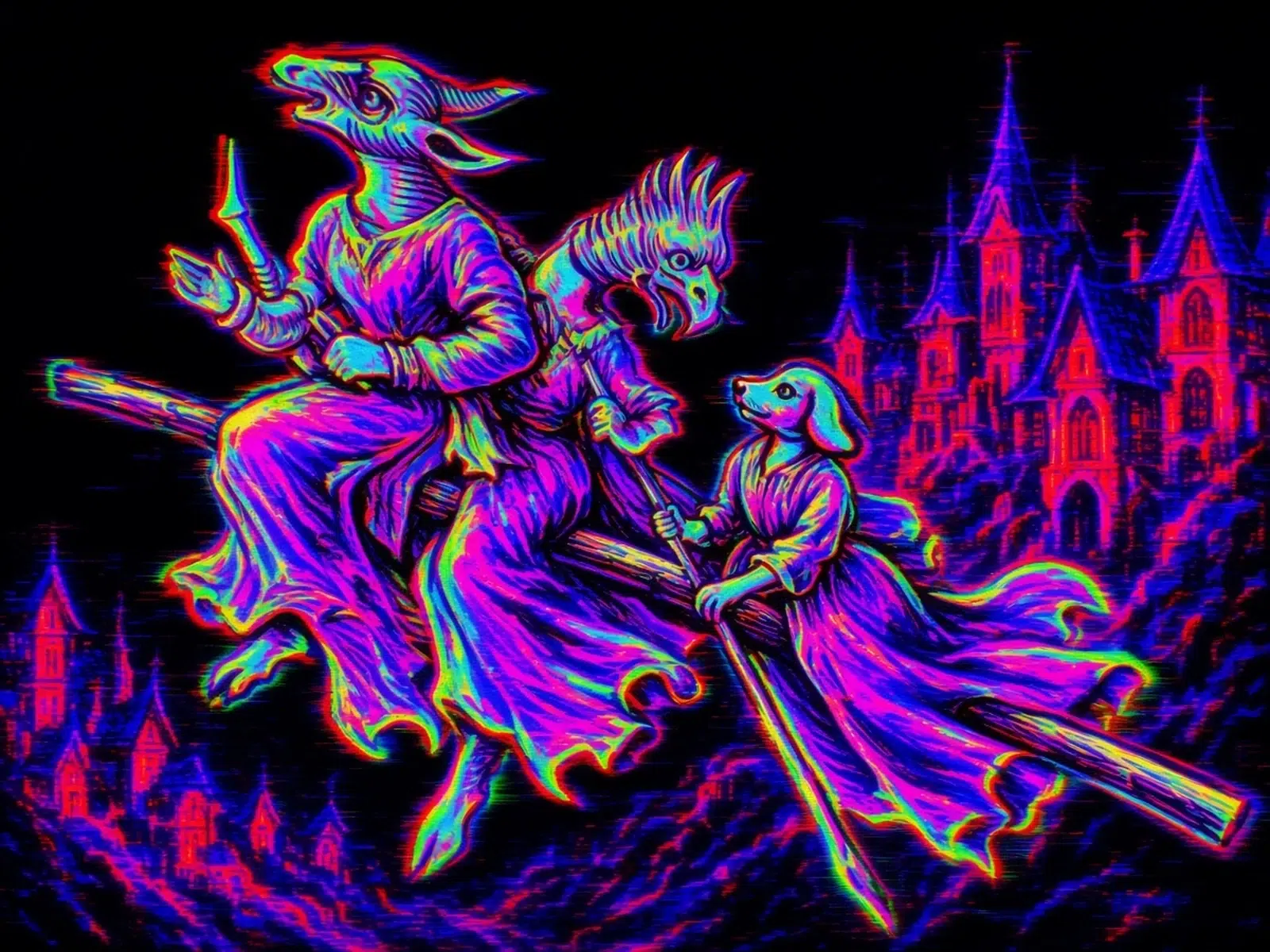
The way in was always the strangest part. The Canon Episcopi women rode on beasts. A woodcut in Ulrich Molitor’s witchcraft book (printed around 1489) shows three witches with the heads of a donkey, a rooster, and a dog, riding a forked stick through the air. Isobel Gowdie said she’d taken the form of a jackdaw, while others in her coven became cats and hares. In Friuli, the benandanti said their spirits left their bodies at night as small animals.
It’s the same pattern every time. The body stays put, and some other self goes out, an animal self or a night self or whatever you want to call it. The modern Sabbatic tradition even has a name for that piece of the lore. In a statement on its own publisher’s site, the Cultus Sabbati calls the Sabbat “the astral or dream convocation of magical ritualists’ souls, animal selves, and a vast array of spirits, faeries and otherworldly beings.”
If you’ve ever had a flying dream so real you woke up tired, you kind of get it, right?
If you want more on leaving the body behind, I went deep on that in Astral Projection Demons: Dark Entities Met Out of Body, and way back in Episode 2: Dreams.
6. Who Is the Horned One at the Witches’ Sabbat?
Every Sabbat needs a host, and in the lore he’s horned. Goya painted him twice. In Witches’ Sabbath (1797–1798), a huge he-goat sits under a quarter moon while bats wheel overhead. Decades later, in one of his Black Paintings (1821–1823), now in the Prado, he came back with The Great He-Goat, a dark goat-shape looming over a crowd of wide-eyed faces. Remember, the Basque meeting place itself was “the meadow of the he-goat.”
In 1921, Margaret Murray argued the accused witches were a surviving horned-god religion. Scholars call that the witch-cult hypothesis and mostly reject it, and the Bristol historian Ronald Hutton reads the pre-Christian bits of witch lore as legends, dreams, or trance experiences.
Witches today see a lot more in him. In Cornwall, Gemma Gary’s book of rites, The Devil’s Dozen, is described by its publisher as the work of a present-day initiate of the “Old Craft.” That description says the Old One embodies both “the ‘rend in the veil'” and the bridge between the material and spiritual worlds, and calls him the “psychopomp guide of souls, and sentinel of the threshold unto the mysteries of death and the Otherworld.”
Nigel Jackson goes darker. In Masks of Misrule: The Horned God & His Cult in Europe (Capall Bann, 1996), as quoted in Mat Auryn’s review, he writes that “when darkness covers the world and all are asleep in their beds,” the Horned One “summons forth the Wise to go out of themselves, riding on the turbulent storms and tempests over brake and thicket, ditch and dale to the realms beyond.” He’s also the one who “opens the Devil’s Road to the High Sabbat.” High Sabbat. Chumbley used those exact words too, but we’ll get there.
So the host of the Sabbat is also the doorman. Is he a demon, an old god, or the keeper of a border most of us never cross? For how the church built its devils, check out Demonology: Medieval Europe (Episode 103) and Demonology: The Renaissance (Ep 137).
7. Why Is the Sabbat an Upside-Down World?
Everything at the Sabbat runs backward. In his Compendium Maleficarum (1608), Francesco Maria Guazzo described attendants re-baptized in the Devil’s name and “dancing back to back forming a round.” Even Goya’s 1798 painting runs backward, according to its Wikipedia write-up. The goat holds out his left hoof instead of his right, and the quarter moon faces out of the canvas.
The mainstream herd reads all of that as propaganda. And sure, a lot of it was. But the modern Sabbatic Craft takes the inversion seriously as a key. The Cultus Sabbati says it uses demonological names and imagery “as part of a cipher to convey a gnosis of Luciferian self-liberation,” and it warns readers to “discern the use of veil upon veil.” Then comes this line, which I love. “One must be careful to interpret this; it is a test! Few pass beyond it.”
So maybe the upside-down world is the first sign you’ve crossed over. I mean, if the other side looked just like this one, how would you know you’d arrived?
8. The Benandanti: Night Battles Fought in Spirit
Okay, this one’s high strangeness. Not connected to the Sabbat, as far as I can prove. But they sure rhyme.
In the Friuli region of northeastern Italy during the 1500s and 1600s, there were people called the benandanti, the “good walkers.” They were said to be born with a caul over their heads. On Thursdays during the Ember Days, they said, their spirits left their sleeping bodies and went out to the fields to fight the malandanti, the evil witches, for the next season’s crops. The benandanti fought with stalks of fennel, the witches with sorghum stalks.
In 1575, a benandante named Paolo Gasparotto told a priest that on those Thursdays they “fought, played, leaped about, and rode various animals.” When the priest didn’t believe him, Gasparotto invited both him and the inquisitor to come along on the next journey. He refused to name any other members of the fraternity, because he’d be “badly beaten by the witches” if he did. Think about that for a second. He was more afraid of the witches out there than of the Inquisition in the room.
He shouldn’t have been. As the historian Carlo Ginzburg showed in The Night Battles (first published in Italian as I benandanti in 1966), the Inquisition slowly bent these spirit-battles into the shape of the Devil’s Sabbat. Ginzburg died this past June, at 87. What did those farmers actually see out there on Ember Day nights?
9. Isobel Gowdie, the Hollow Hills, and the Mountain of Venus
Back to Isobel. Her four confessions in 1662 hold 27 charms and chants, more than any other British witchcraft case, and according to her Wikipedia biography, they seem to have come out without violent torture, though historian Brian Levack suspects some was used. She described the Queen of Elphame’s home at Downie Hill, full of water bulls that scared her.
In The Visions of Isobel Gowdie (2010), historian Emma Wilby argued that Gowdie’s fairy material may hold “dark shamanic” elements.
And Isobel’s hill has company. The German legend of the Venusberg, the Mountain of Venus, follows an old folktale pattern where a mortal, seduced by a fairy queen, visits the otherworld, just like Scotland’s Thomas the Rhymer. Here’s the kicker. According to Wikipedia, the first time the name Venusberg shows up in German for the otherworld or fairyland is in Nider’s Formicarius, the same 1430s witch book from section two. I’m not saying the hill and the Sabbat are the same place. But they turn up in the same book.
Gowdie walked into a hill. So where did she go? And was hers the only door?
10. Doorways to the Sabbat: Blåkulla, the Brocken, and the Walnut of Benevento
Okay, so if the Sabbat’s a real realm, it has to have doors, right? Turns out people gave a few of them names. And addresses.
Blåkulla, the Meadow With No End
Mora, Sweden, August 1669. A royal commission sat down in front of about three thousand spectators and started questioning the village children, one at a time, kept apart from each other. It’s said they all told the same story.
They’d been carried at night to Blåkulla, the “blue hill.” They rode goats, fence posts, or spits through the air. The old English translation of the trial account describes it as “a delicate large Meadow, whereof you can see no end,” with a house behind “a Gate painted with divers colours.” Some children said a “white Angel” stood near the door, reminding them to keep God’s commandments.
Then there’s the detail that stopped me cold. The sleeping men the witches had ridden there “stood in the House by the Gate in a slumbering Posture, sleeping against the Wall.” Bodies asleep, parked by the door. Remember Salazar’s “in bed and at the Sabbat at the same time”?

The great Swedish witch panic of 1668 to 1676 ended in executions, and Mora’s were the first mass executions of it, resting on children’s testimony. I’ll leave that there. As for Blåkulla itself, it may have had an address. The Baltic island of Blå Jungfrun was called Blåkulla in the old days and rumored since medieval times to be where witches met. Swedish and Finnish kids still dress up as Easter witches every year to remember the flight to Blåkulla.
The Brocken on Walpurgis Night
Climb the Brocken on the right misty day and your own shadow can get thrown onto the fog in front of you, an effect so common here it’s named the Brocken spectre. It’s the highest peak in Germany’s Harz Mountains, 1,141 meters, and fog sits on it up to 300 days a year. Locals also call it the Blocksberg, and it’s been tangled up with witches and devils in legend pretty much forever.
The big night is Walpurgis Night, April 30, the eve of the feast of St. Walpurga, an 8th-century abbess whose help Christians called on against witchcraft. In parts of Europe they still light bonfires that night to keep witches away.
Johannes Praetorius recorded the German word Walpurgisnacht in 1668, the same year he published a book on the witches of the Blocksberg. Then in 1808, Goethe sent Faust up the mountain. “Now, to the Brocken, the witches ride.” Two rock formations on the summit, the Devil’s Pulpit and the Witches’ Altar, may have given him the idea.
Fun fact. During the Cold War, East Germany walled off the whole summit plateau with concrete, and the public couldn’t go up again until December 3, 1989. Even the witches needed a visa.
The Walnut Tree of Benevento
I’ll be honest, this one’s my favorite. “Send me to the walnut tree of Benevento, under the water and under the wind, under all bad weather.” Women accused of witchcraft in southern Italy kept repeating some version of that charm at their trials. In the legend it went with the flying ointment, and once they were airborne, the witches of Benevento became bodiless, spirits like the wind. Stormy nights were their favorite.
Their gathering place was a walnut tree on the bank of the Sabato river. Matteuccia da Todi, tried in 1428, said the meetings happened under it. Legend made it the same sacred tree that St. Barbatus chopped down and uprooted in the 600s, where Lombard warriors had once honored Wotan. Either the Devil restored it, people said, or the witches grew it back from seed. Witnesses called it tall, ever green, and of “a noxious nature.” And the local word for these witches, janara, may even come from Diana’s name.
In 1639, the city’s chief physician, Pietro Piperno, wrote a whole treatise to debunk the tree, De Nuce Maga Beneventana, and even drew a map with several possible walnut trees on it. Nobody ever settled where it stood. A tree nobody can pin to a map. Sound familiar?
11. Is the Witches’ Sabbat a Real Place? The Witch’s Double
This is the question that sent me back into the research. If the witch was in bed, was it only a dream? Practitioners of the Sabbatic current say no. In their telling, the dream is the vehicle, and the place on the other end is real.
The idea under that claim is older than the witch trials. The medievalist Claude Lecouteux wrote a whole book on it, Witches, Werewolves, and Fairies: Shapeshifters and Astral Doubles in the Middle Ages (Inner Traditions, 2003). His publisher sums up what he dug out of Western European legend as an almost forgotten religious idea, that every person has three souls, and one of them, the Double, can leave the physical body and journey wherever it chooses.
Read the old cases with that in mind and they snap into focus. The benandanti’s spirits went out while their bodies slept. Isobel had a charm for going out as a hare. And Salazar’s complaint about someone being in bed and at the Sabbat at once stops sounding like a contradiction. It sounds like a job description. The body stays home, and the double goes to work.
Ginzburg came at it from the archive side. In Ecstasies: Deciphering the Witches’ Sabbath (1989, in English 1990), he traced a path from the witch trials to a wide range of practices he read as evidence of a substrate of shamanic cults in Europe. And in shamanic lore, the spirit journey goes somewhere. The traveler meets someone there and comes home carrying something.
If Europe really had a buried layer of soul-travelers, wouldn’t all their roads lead to the same place?
12. Andrew Chumbley and the Sabbat as a Realm of Consciousness
Now we jump to modern England. Andrew D. Chumbley (1967–2004) was an English magician, poet, and artist, and the Magister of a closed magical group called the Cultus Sabbati. He called his tradition the Sabbatic Craft, a term he said “describes the way in which elements of witch-lore, Sabbath mythology and imagery were being employed in the cunning-craft tradition into which I was originally inducted.”
For Chumbley, the Sabbat was somewhere you could still go. In a 2002 interview with The Cauldron, he called willed dreaming essential for meeting the spiritual dimensions he named “the High Sabbat,” warning that the wrong habits can fixate perception in a way “that seals the soul in the body instead of enabling it to go forth at will.”
Go forth. That’s travel language. The Cultus Sabbati’s statement on the Xoanon site goes further, saying “the true location of the Sabbath is at the Crossroads of waking, sleeping and mundane dreaming, that is, in the state of True Dreaming.”
His grimoire The Azoëtia came out privately under his Xoanon imprint in 1992, and it’s absurdly hard to find. And the Cultus itself? According to its own statement, “those who ask for entry are refused. Initiation is by invitation only.” Creepy as hell, and kind of beautiful. Chumbley died on his 37th birthday in 2004, while working on a doctorate in the history of religion. I keep wondering what that dissertation would have said.
13. The Hidden Kingdom of Eld: Where Modern Witches Place the Sabbat
So where is it, then? The best map I found comes from a scholar and a practitioner working together. In 2024, Jeff Howard and artist Steve Patterson, who worked with Chumbley in the early 2000s as a member of the Cultus Sabbati, published a prize-winning paper in Praxis-Knowledge called “To Reveal the Hidden Kingdom of Eld”.
The title phrase comes from a charm in Chumbley’s Dragon-Book of Essex called “The Hallowing of the Kingdom of Qayin.” According to the authors, the charm promises to reveal an otherworld that sits just on the other side of the mundane, physical world and is bound up with it. They call it “the concealed, superimposed Otherworld of imaginal space.” Superimposed. Laid right over this world, like the second image on a double-exposed photo.
To pin down what kind of place that is, they borrow a term from the religious historian Henry Corbin, the mundus imaginalis. In their words, it’s “neither wholly physical nor wholly ethereal,” a liminal space between this world and the Otherworld, “real and imaginary, material and spiritual.” Both columns at once.
Chumbley’s own map has a crossroads at its center. The paper notes that in the Azoëtia, the crossroads joins “waking, dreaming, and sleeping” as the “Three Roads of Sentience,” and it’s also a meeting point of life and death. The Cultus describes the whole complex of Sabbat imagery as “the atemporal reality of our ritual.” Atemporal means outside of time. So in their telling, the Sabbat didn’t happen once in a Basque meadow in 1610. It’s always there, and the witch drops in.
Peter Grey says much the same from another corner. His publisher, Scarlet Imprint, says Apocalyptic Witchcraft (2013) “gives a compelling and profound account of the Sabbat and Wild Hunt as living experiences. These are the core of our ritual practice.” Dream magic is named as one path in. Living experiences. Superimposed. Atemporal. Honestly, nobody talks like that about a metaphor. You talk like that about somewhere you’ve been. So next time you jolt awake from a flying dream, where were you just now?
14. Who Kept the Sabbat Road Open?
Daniel A. Schulke succeeded Chumbley as Magister of the Cultus Sabbati. Michael Howard, longtime publisher of The Cauldron, called Chumbley “a man of the land, rural in both birth and character,” and he and Schulke co-edited Hands of Apostasy: Essays on Traditional Witchcraft (Three Hands Press, 2014).
Howard also wrote the foreword to Gemma Gary’s The Black Toad, a book on West Country Old Craft and its ties to “the spirit forces of the land, the Faerie.” So the dream outlived the dreamer, which fits a lore the Cultus says comes “from the timeless wellspring of dream.” Who’s dreaming it now?
15. The Witches’ Sabbat Across the Centuries
| Source | When | Where the Sabbat happens | How the witch gets there |
|---|---|---|---|
| Canon Episcopi (Regino of Prüm) | c. 906 | Night rides with Diana | In dreams (the church blamed the Devil) |
| Burchard of Worms, Decretum | c. 1012 | Night rides with “the witch Holda” | Riding beasts on fixed nights |
| Matteuccia da Todi’s trial | 1428 | The walnut tree of Benevento | Flight by night; in legend, bodiless as the wind |
| Nider, Formicarius | 1436–1438 | Secret gatherings; also the first German use of “Venusberg” for the otherworld | Flight called a delusion |
| Gasparotto, benandanti trial | 1575 | Fields at night on Ember Day Thursdays | Spirit leaves the sleeping body |
| Salazar’s report, Logroño trials | 1611 | Akelarre and the cave at Zugarramurdi | In bed and at the Sabbat at once (he doubted it) |
| Isobel Gowdie | 1662 | Downie Hill, the realm of the Queen of Elphame | Shape-shifting spirit journey |
| Praetorius, Brocken lore | 1668 | The Brocken (Blocksberg) on Walpurgis Night | Flight, in the legend |
| Mora trial, Sweden | 1669 | Blåkulla, “a delicate large Meadow, whereof you can see no end” | Carried through the air; sleeping bodies left by the gate |
| Cultus Sabbati / Chumbley | Modern | “The Crossroads of waking, sleeping and mundane dreaming” | True Dreaming |
| Patterson and Howard | 2024 | “The Hidden Kingdom of Eld,” laid over this world | Ritual, vision, and the land |
A quick checklist for spotting a Sabbat journey account
- The person’s body stays in bed, or is found asleep, while they “travel.”
- They go in an animal form, or ride an animal.
- The journey happens on fixed nights, like Ember Days or feast eves.
- They meet a ruler of the night, horned or otherwise, or a fairy queen.
- Normal rules flip upside down once they arrive.
- They name the place (a hill, a mountain, a meadow, a tree) and talk about it as somewhere real.
- They come back with knowledge, a charm, or a job to do.
So… Is the Witches’ Sabbat Real?
Here’s where I land. The witch hunters’ version, built in interrogation rooms, I’m happy to let go.
But the realm itself keeps showing up in places that had no reason to copy each other. A tenth-century church canon. A goddess riding the winter storms. Friulian farmers with fennel stalks, a Swedish meadow with no end, a walnut tree nobody could find, and a Scottish cottar’s wife chanting herself into a hare. Then an Essex poet puts the Sabbat at a crossroads between waking and sleep, and people from his own circle call it a hidden kingdom laid over this one.
The people who practice this current talk about it as a place, with a host, a crossroads, and a way in. They say your double already knows the road. And far too many people, across far too many centuries, describe the SAME road out of the body for me to shrug that off.
Maybe the Sabbat is a place you reach the way Isobel did, with your eyes closed. Sleep well tonight.
Frequently Asked Questions
What is the witches’ Sabbat?
The witches’ Sabbat is the night gathering where witches meet spirits, other witches, and a horned master. Witch hunters treated it as a physical crime, but folk visionaries and modern Sabbatic witches describe reaching it in spirit, through dream or trance.
Is the witches’ Sabbat a real place?
Within Sabbatic and traditional witchcraft, yes. Practitioners describe it as a real otherworld that the witch’s spirit or double reaches while the body sleeps. Writers close to the Cultus Sabbati place it at a crossroads of waking, sleeping, and dreaming, laid over our own world.
Is the witches’ Sabbat the same as the eight Wiccan sabbats?
No. The eight sabbats are modern pagan seasonal holidays on the Wheel of the Year. The witches’ Sabbat is the older legend of a nocturnal convocation, found in medieval church law, early modern trial records, and today’s Sabbatic Craft.
What is the Dreaming Sabbat?
The Dreaming Sabbat is the Sabbat reached in spirit while the body sleeps. Andrew Chumbley’s Cultus Sabbati places its true location at “the Crossroads of waking, sleeping and mundane dreaming,” a state it calls True Dreaming.
Where did witches say the Sabbat was held?
Named Sabbat places include Blåkulla in Sweden, the Brocken in Germany’s Harz Mountains, the walnut tree of Benevento in Italy, and the cave and meadow of Zugarramurdi in the Basque Country. In the lore they work less like addresses and more like doorways to the otherworld.
Keep Exploring the Weird
If this rabbit hole got you, try The Chapel Perilous, the History of the Goetia, and Halloween: The Night the Veil Thins (Ep 168). Want the lore that doesn’t fit in an article? Join the free newsletter for the strangest story on my mind each week.
And the question I get most is whether the Chroniclers Vault is worth five bucks. Here’s the honest answer. It starts at five bucks a month, it unlocks the full extended episodes, and it’s what keeps the show alive. Either way, thanks for reading.
Sources
- “Witches’ sabbath,” Encyclopaedia Britannica: https://www.britannica.com/topic/witches-sabbath
- Witches’ Sabbath, Wikipedia (Malleus wording, de Lancre’s usage, Guazzo 1608, torture and testimony, Ginzburg on out-of-body testimonies): https://en.wikipedia.org/wiki/Witches%27_Sabbath
- Canon Episcopi, Wikipedia (Regino of Prüm c. 906, Gratian c. 1140, Diana, dreams): https://en.wikipedia.org/wiki/Canon_Episcopi
- Formicarius, Wikipedia (Nider, 1436–1438): https://en.wikipedia.org/wiki/Formicarius
- Bailey, Michael D. “Nider, Johannes (ca. 1380–1438),” Encyclopedia of Witchcraft: The Western Tradition (2006), Iowa State repository: https://dr.lib.iastate.edu/server/api/core/bitstreams/3132c7a4-a62b-4109-b884-261bca682d33/content
- Utz Tremp, Kathrin. “Heresy” (on the Errores Gazariorum, Aosta Valley, before 1436/1438): https://atusyd.dk/sites/default/files/aktiviteter/utz-tremp_heresy_ew.pdf
- Kieckhefer, Richard. “Mythologies of Witchcraft in the Fifteenth Century,” Magic, Ritual, and Witchcraft (2006), Project MUSE: https://muse.jhu.edu/article/236419
- Pierre de Lancre, Wikipedia (Labourd 1609, Tableau 1612, love of dance, lost records): https://en.wikipedia.org/wiki/Pierre_de_Lancre
- Basque witch trials, Wikipedia (Logroño 1609–1614, auto-da-fé of 1 Nov 1610, Akelarre, Salazar’s 1611 visit near Zugarramurdi, the cave and Infernuko erreka, Salazar’s objections): https://en.wikipedia.org/wiki/Basque_witch_trials
- Benandanti, Wikipedia (caul, Ember Days, fennel and sorghum, Gasparotto 1575): https://en.wikipedia.org/wiki/Benandanti
- Carlo Ginzburg, Wikipedia (The Night Battles 1966/1983, Ecstasies, died 17 June 2026): https://en.wikipedia.org/wiki/Carlo_Ginzburg
- Isobel Gowdie, Wikipedia (Auldearn 1662, four confessions, hare charm, Queen of Elphame, Wilby, Levack, Goodare): https://en.wikipedia.org/wiki/Isobel_Gowdie
- Normand, Lawrence. Review of Emma Wilby, The Visions of Isobel Gowdie (Sussex Academic Press, 2010), Journal of Scottish Historical Studies 32 (2012): https://www.euppublishing.com/doi/10.3366/jshs.2012.0040
- Wild Hunt, Wikipedia (Hutton on the Wild Hunt and the Sabbat; Hutton, “The Wild Hunt and the Witches’ Sabbath,” Folklore 125, 2014): https://en.wikipedia.org/wiki/Wild_Hunt
- Witch-cult hypothesis, Wikipedia (Murray 1921 and 1931, Hutton, Magliocco): https://en.wikipedia.org/wiki/Witch-cult_hypothesis
- Witches’ Sabbath (Goya, 1798), Wikipedia (Museo Lázaro Galdiano, inverted hoof and moon): https://en.wikipedia.org/wiki/Witches%27_Sabbath_%28Goya,_1798%29
- Andrew D. Chumbley, Wikipedia (Sabbatic Craft quote, willed dreaming and the High Sabbat, Azoëtia 1992, Qutub 1995, Dragon-Book of Essex, Howard obituary, Schulke): https://en.wikipedia.org/wiki/Andrew_D._Chumbley
- “Cultus Sabbati: Provenance, Dream, and Magistry,” Xoanon: https://xoanon.co.uk/cultus-sabbati/
- Ward, Coby Michael. “Sabbatic Witchcraft: An Explanation,” Patheos (2016): https://www.patheos.com/blogs/poisonersapothecary/2016/08/29/sabbatic-witchcraft-an-explanation/
- Doyle White, Ethan. Review of Michael Howard and Daniel Schulke, eds., Hands of Apostasy (Three Hands Press, 2014): https://ethandoylewhite.blogspot.com/2014/10/a-halloween-review-michael-howard-and.html
- Patterson, Steve, and Jeff Howard. “To Reveal the Hidden Kingdom of Eld: Andrew Chumbley, the Cultus Sabbati, and Imaginal Space in Cornwall.” Praxis-Knowledge 1 (2024), RENSEP Tandem Paper Prize 2023, CC BY-NC 4.0. https://doi.org/10.61149/QNQT7324 and PDF: https://www.rensep.org/wp-content/uploads/2024/10/Praxis-Knowledge-1-1.pdf
- Lecouteux, Claude. Witches, Werewolves, and Fairies: Shapeshifters and Astral Doubles in the Middle Ages (Inner Traditions, 2003), publisher description: https://www.innertraditions.com/books/witches-werewolves-and-fairies
- Ecstasies: Deciphering the Witches’ Sabbath, Wikipedia (Ginzburg 1989, English 1990; Hutton’s assessment): https://en.wikipedia.org/wiki/Ecstasies_%28book%29
- Venusberg (mythology), Wikipedia (fairy-queen otherworld pattern, Thomas the Rhymer, first German mention in Nider’s Formicarius): https://en.wikipedia.org/wiki/Venusberg_%28mythology%29
- Gary, Gemma. The Devil’s Dozen: Thirteen Craft Rites of The Old One, expanded edition (Troy Books), publisher description: https://www.troybooks.co.uk/books/the-devils-dozen
- Gary, Gemma. The Black Toad: West Country Witchcraft and Magic, foreword by Michael Howard (Troy Books), publisher description: https://www.troybooks.co.uk/books/the-black-toad
- Grey, Peter. Apocalyptic Witchcraft (Scarlet Imprint, 2013), publisher description: https://scarletimprint.com/publications/p/apocalyptic-witchcraft
- Canon Episcopi in Burchard of Worms’ Decretum, Cologne Dom Hs. 119, c. 1020, Wikimedia Commons: https://commons.wikimedia.org/wiki/File:Canon_Episcopi_Hs119.jpg
- Goya, Witches’ Sabbath (The Great He-Goat), 1821–1823, Wikimedia Commons: https://commons.wikimedia.org/wiki/File:Francisco_de_Goya_y_Lucientes_-Witches%27_Sabbath%28The_Great_He-Goat%29.jpg
- Cameron, Katharine, Thomas the Rhymer illustration (1908), Wikimedia Commons: https://commons.wikimedia.org/wiki/File:Katherine_Cameron-Thomas_the_Rhymer.png
- Molitor woodcut, c. 1489, Wikimedia Commons: https://commons.wikimedia.org/wiki/File:Molitoris_Hexenflug.jpg
- Holda, Wikipedia (Burchard’s Decretum and strigam Holdam, the night-spirit women “out through closed doors,” Ginzburg on spirit-following goddesses, Grimm on Perchta and the Wild Hunt): https://en.wikipedia.org/wiki/Holda
- Perchta, Wikipedia (Twelve Days and Rauhnächte, Mogk’s “hidden or covered” etymology, the farmhand in the stove): https://en.wikipedia.org/wiki/Perchta
- Auryn, Mat. “Review: Call of the Horned Piper,” Patheos (2017): https://www.patheos.com/blogs/matauryn/2017/09/28/call-horned-piper/
- Auryn, Mat. “Review: Masks of Misrule,” Patheos (2017), quoting Nigel Jackson, Masks of Misrule: The Horned God & His Cult in Europe (Capall Bann, 1996): https://www.patheos.com/blogs/matauryn/2017/06/28/review-masks-misrule/
- Zugarramurdi, Wikipedia (Akerbeltz legend, “Cathedral of the Devil,” solstice fires in the caves): https://en.wikipedia.org/wiki/Zugarramurdi
- Blockula, Wikipedia (Blåkulla, the endless meadow, painted gate, sleeping men by the gate, white angel, Blå Jungfrun, Easter witches): https://en.wikipedia.org/wiki/Blockula
- Mora witch trial, Wikipedia (August 1669 commission, three thousand spectators, children questioned apart, first mass execution of the 1668–1676 hunt): https://en.wikipedia.org/wiki/Mora_witch_trial
- Brocken, Wikipedia (1,141 m, fog up to 300 days, Brocken spectre, Blocksberg, Goethe’s Faust 1808, Devil’s Pulpit and Witches’ Altar, summit sealed until 3 December 1989): https://en.wikipedia.org/wiki/Brocken
- Walpurgis Night, Wikipedia (30 April, St. Walpurga, bonfires against witches, Praetorius 1668): https://en.wikipedia.org/wiki/Walpurgis_Night
- Witches of Benevento, Wikipedia (the walnut charm, stormy-night flight, Matteuccia da Todi 1428, St. Barbatus legend, “noxious nature,” janara and Diana, Piperno 1639): https://en.wikipedia.org/wiki/Witches_of_Benevento
- Praetorius, Johannes, Blockes-Berges Verrichtung (Leipzig, 1668), Wikimedia Commons record: https://commons.wikimedia.org/wiki/File:Praetorius_Blocksberg.jpg
- Malmström, August, Odin’s Hunt, Wikimedia Commons: https://commons.wikimedia.org/wiki/File:Odin%27s_hunt_%28Malmstr%C3%B6m%29.jpg
- Le Breton, Louis, Blokula illustration, Dictionnaire infernal (1863), Wikimedia Commons: https://commons.wikimedia.org/wiki/File:Ill_dict_infernal_p0116-100_blokula.jpg
- Bestehorn, L. S., view of the Brocken (1732), Wikimedia Commons: https://commons.wikimedia.org/wiki/File:Brocken_L._S._Bestehorn.jpg

0 Comments