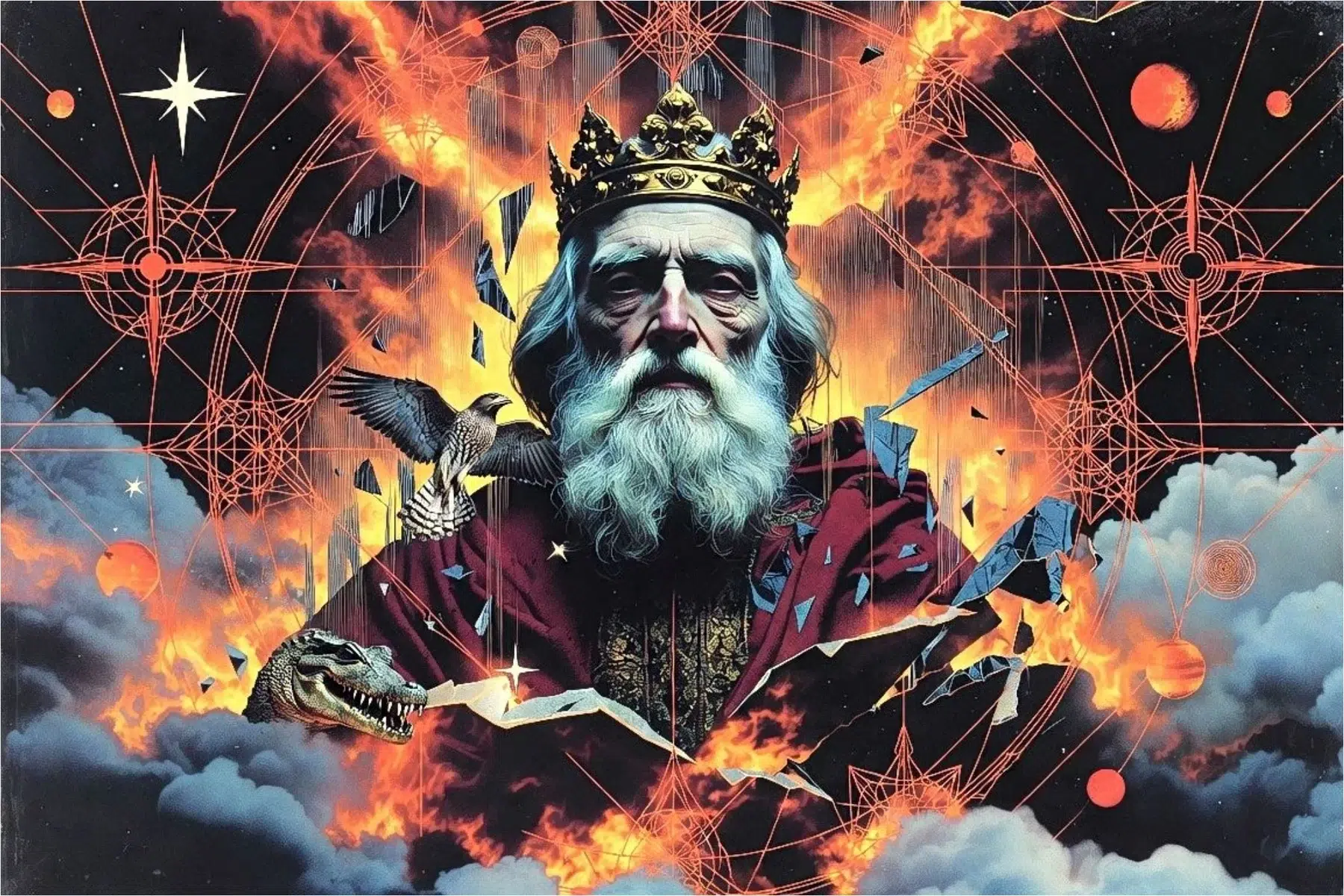
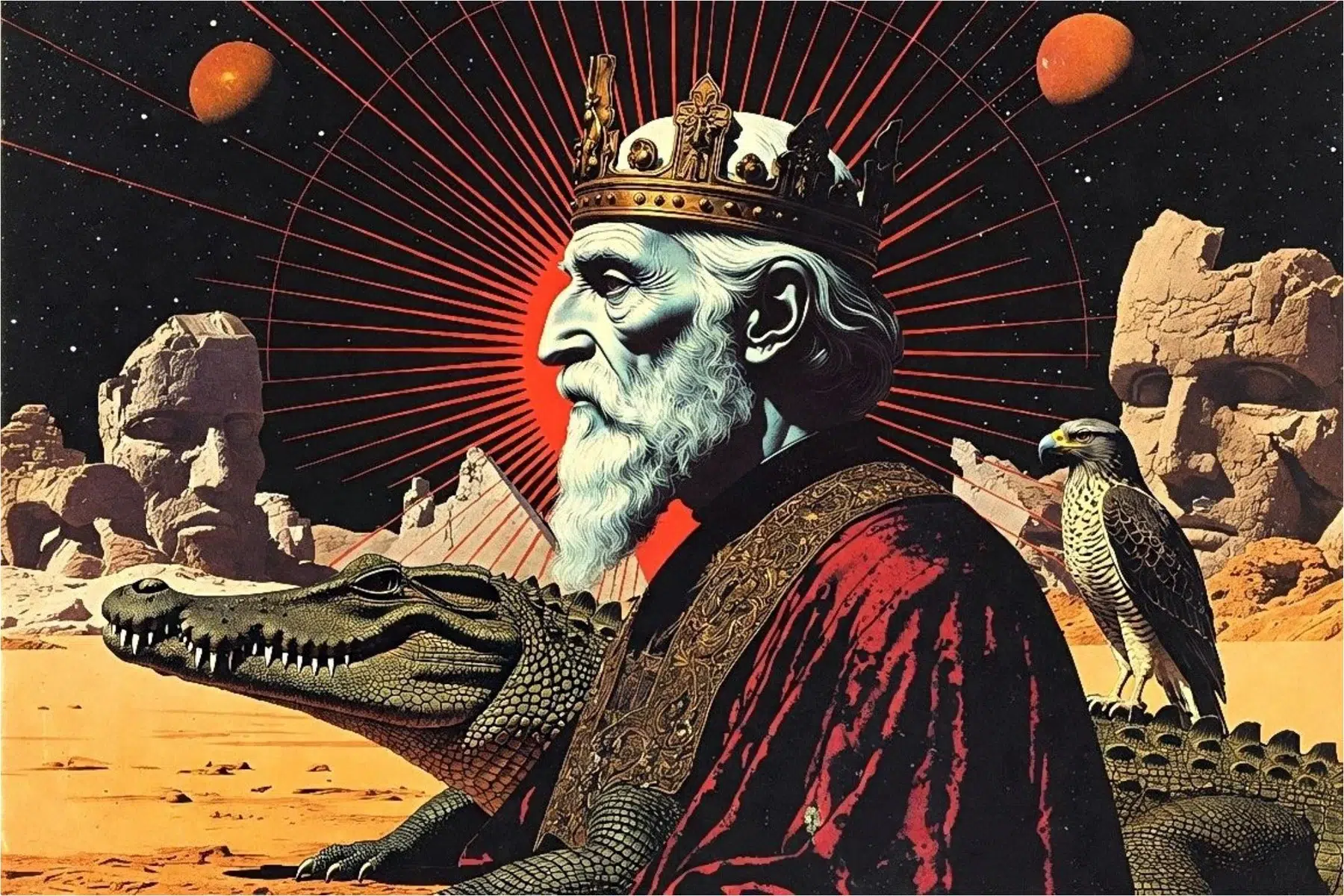
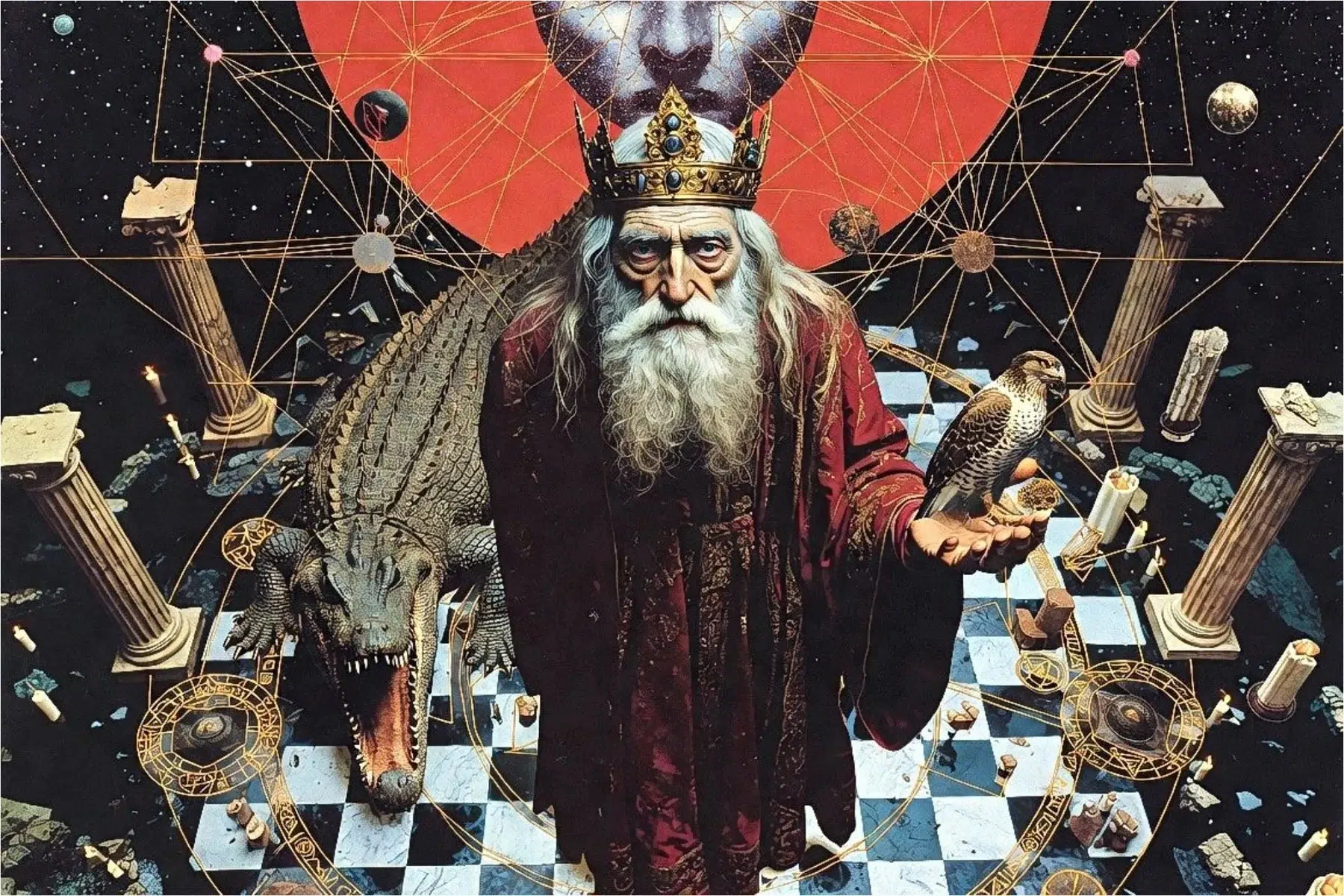
Agares comes up looking almost kind. A fair old man sitting a crocodile like it’s a horse, a goshawk parked on his fist. The old catalogs say he arrives mildly. I have never trusted a sentence that much in my life.
Because the rest of the entry is not mild at all. People who were standing still start running. The ones who already ran start coming back. Languages land in your head as if you’d always had them. And if that weren’t enough, this “mild” duke can strip a person of every dignity they have, spiritual or worldly, and the ground itself gets involved.
Agares is the second spirit in the Ars Goetia, the first book of the Lesser Key of Solomon. He’s a duke under the power of the east, with 31 legions under him, and the books have been copying his description for more than 400 years. If you read our History of the Goetia, you already know how a man trying to kill witchcraft accidentally printed Hell’s phone book. Agares is the second name in that book.
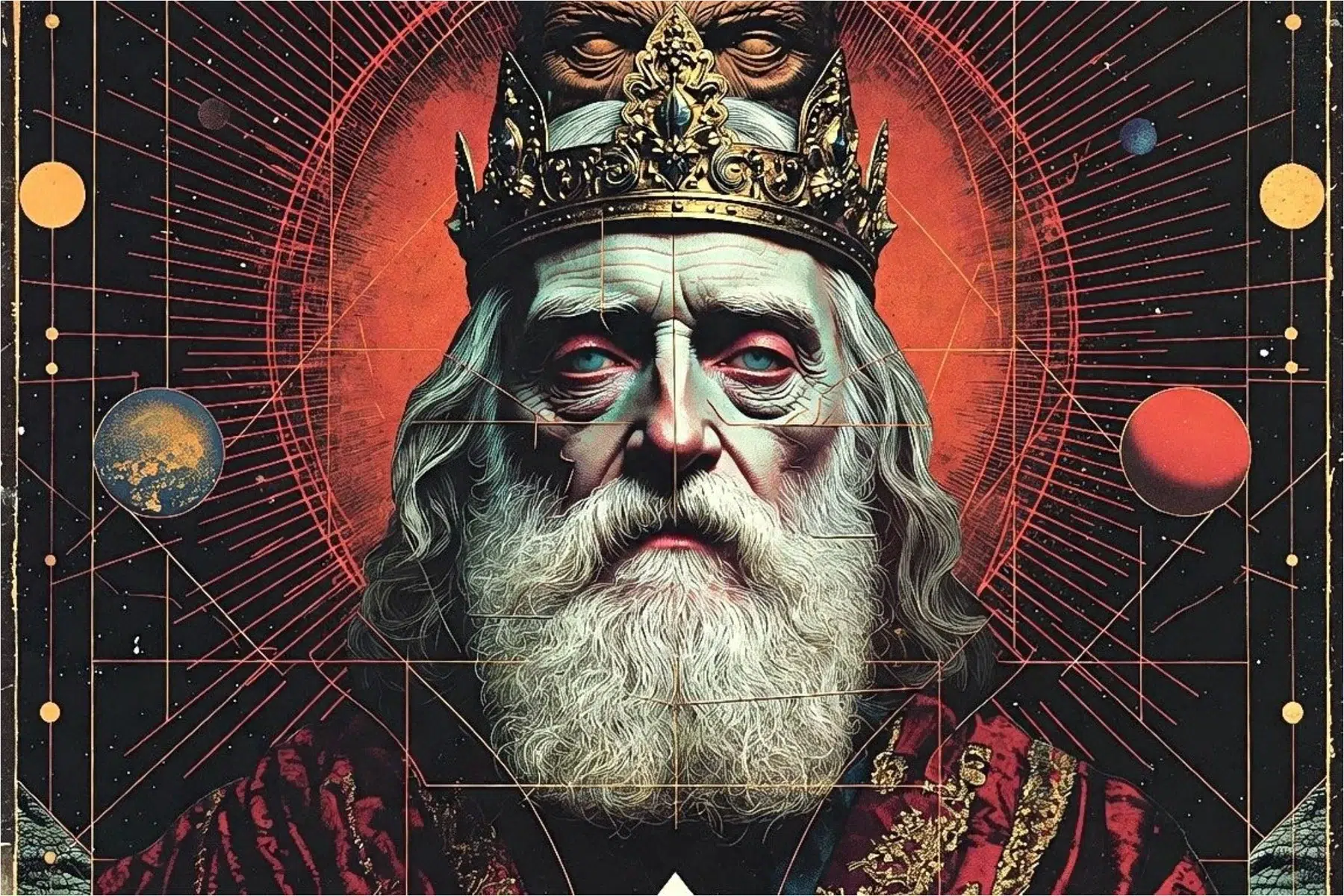
Agares at a Glance
- Number: 2 of 72
- Rank: Duke
- Direction: East, under King Oriens (as noted by Joseph H. Peterson from the Book of Oberon)
- Legions: 31 (the Livre des Esperitz, an earlier French catalog, is said to give him 36 and the simpler name Agarat)
- Appearance: A fair old man riding a crocodile, a goshawk on his fist, mild in manner
- Offices: Teaches all languages or tongues at once; fetches back runaways and makes the ones standing still run; overthrows dignities, supernatural and temporal; causes earthquakes (Weyer’s Latin is weirder, and we’ll get there)
- Former choir: The Order of Virtues, according to the grimoires themselves
- Metal: Copper, for a duke’s seal, according to the Lemegeton‘s metal list. The Agares entry never names a planet. In that same list, copper is the metal of Venus.
- Hours: Sunrise to noon, and only in clear weather. That’s the window the Lemegeton gives for binding any duke.
- Shem HaMephorash pairing (Rudd system): Angel #2, Jeliel (also spelled Jelial; Golden Dawn spelling Yelauiel). Seraphim, Leo 5–10°.
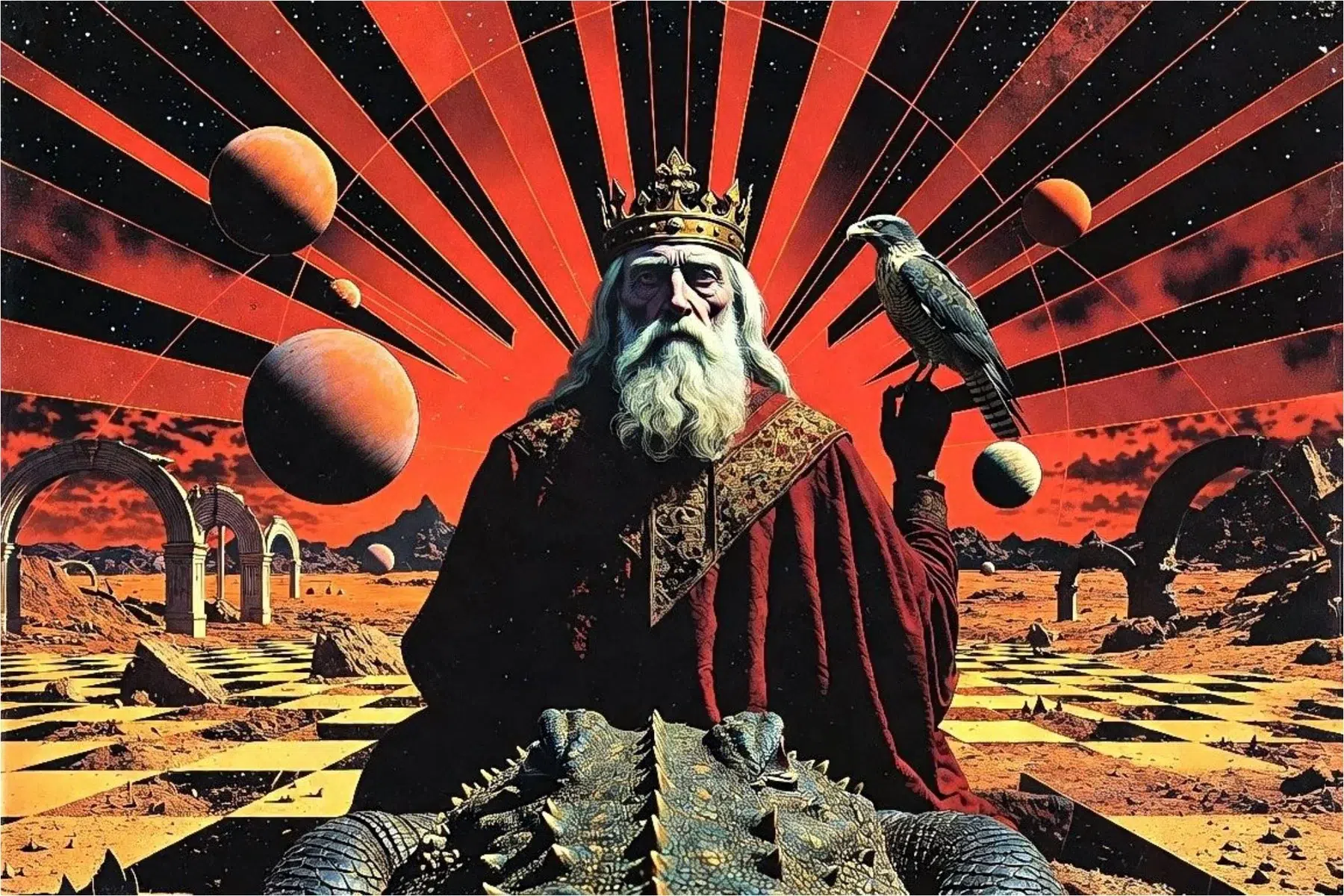
What the Grimoires Say
The version most people meet first is the 1904 edition, S. L. MacGregor Mathers‘s English of the Goetia, published by Aleister Crowley as The Book of the Goetia of Solomon the King. I checked it against the Sacred Texts transcription. This is the opening of the entry, word for word:
“The Second Spirit is a Duke called Agreas, or Agares. He is under the Power of the East, and cometh up in the form of an old fair Man, riding upon a Crocodile, carrying a Goshawk upon his fist, and yet mild in appearance.”
— S. L. MacGregor Mathers, trans., The Book of the Goetia of Solomon the King, ed. Aleister Crowley (1904)
Mathers is already giving you a second name, Agreas. We’ll come back to how many names this spirit has collected.
The manuscript behind that edition is older. Peterson’s transcription of British Library Sloane MS 3825, the Lemegeton copy he treats as his base text, is close to Mathers but a little rougher in the mouth, the way a 17th-century hand actually wrote it. Agares comes up “in the form of a fair Old man riding upon a Crocodill, very mildly, carrying a goshawke on his fist.” Same duke. Same east. Same 31 legions.
And both of those English catalogs are standing on a printed list from 1577. Johann Weyer, a Dutch physician who spent his career arguing that a lot of witchcraft cases were cruelty and delusion, still published a demon directory in De praestigiis daemonum called the Pseudomonarchia Daemonum. Reginald Scot put an English version of that list into The Discoverie of Witchcraft in 1584, and that’s the wording English readers lived with for decades. Weyer and Scot both call Agares the first duke under the power of the east, not “the second spirit,” because their numbering is a little different. The description is the same animal.
“hee teacheth presentlie all maner of toongs, he fetcheth backe all such as runne awaie, and maketh them runne that stand still”
— Reginald Scot, The Discoverie of Witchcraft (1584), rendering Johann Weyer, Pseudomonarchia Daemonum (1577)
I love that “presentlie.” Not after years of study. Presently. Now.
The Old Man on the Crocodile
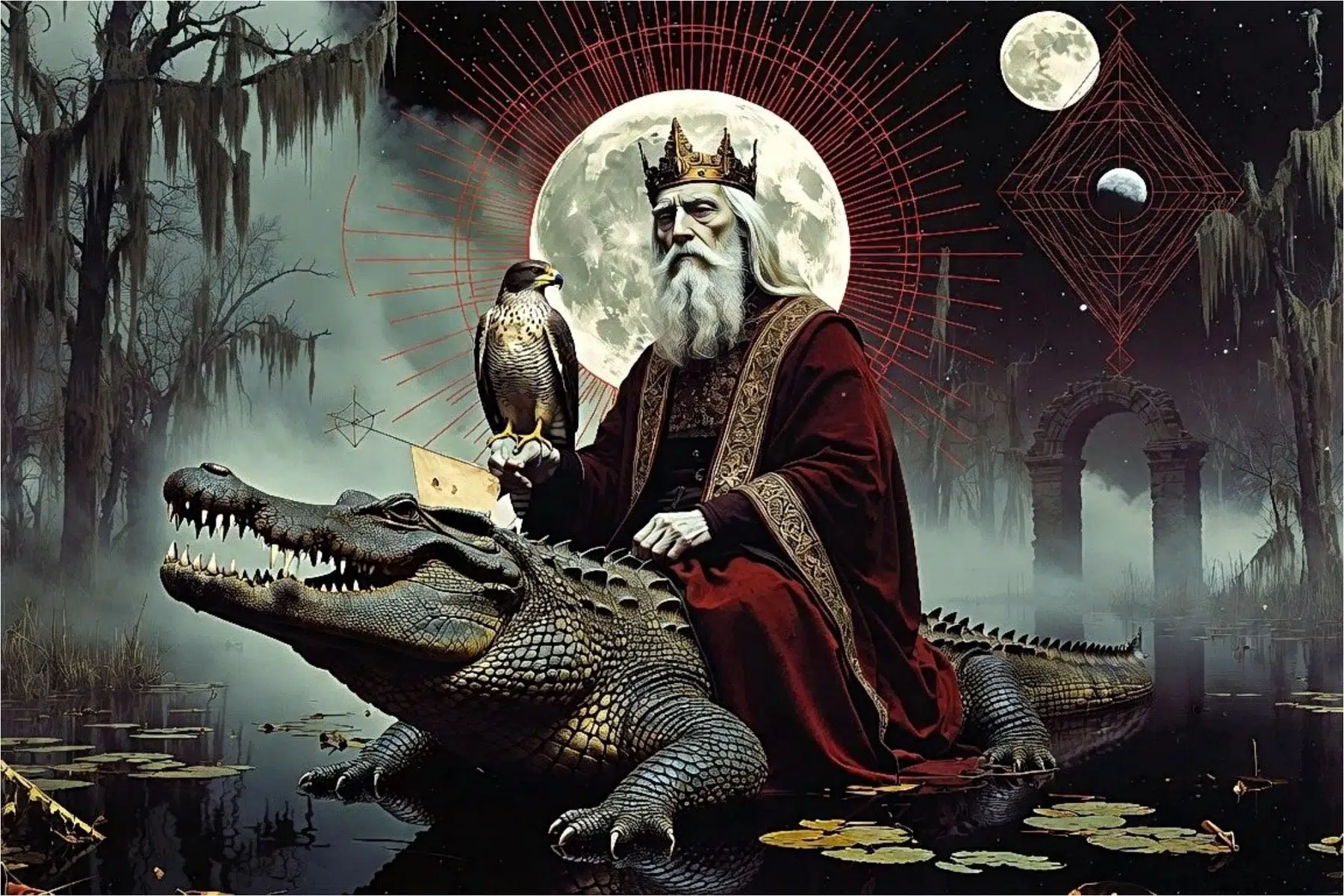
The crocodile is doing a lot of work in this picture. He’s riding a river predator like a mount, peacefully, and he looks like he should be someone’s grandfather. The goshawk on his fist is a hunting bird, the kind a nobleman would carry. So you’ve got rank, patience, and something that can kill you from the water, all in one image, and the text keeps insisting he comes up mildly.
I’m not going to pretend I know what every piece “means.” The catalogs don’t give a lecture on symbolism. They just tell you what you’ll see. Which, if you’ve ever sat with this kind of lore, is usually the scariest way to write it.
Then there are the offices, and this is where Agares stops being a weird illustration and starts being a problem you might actually want, or really not want.
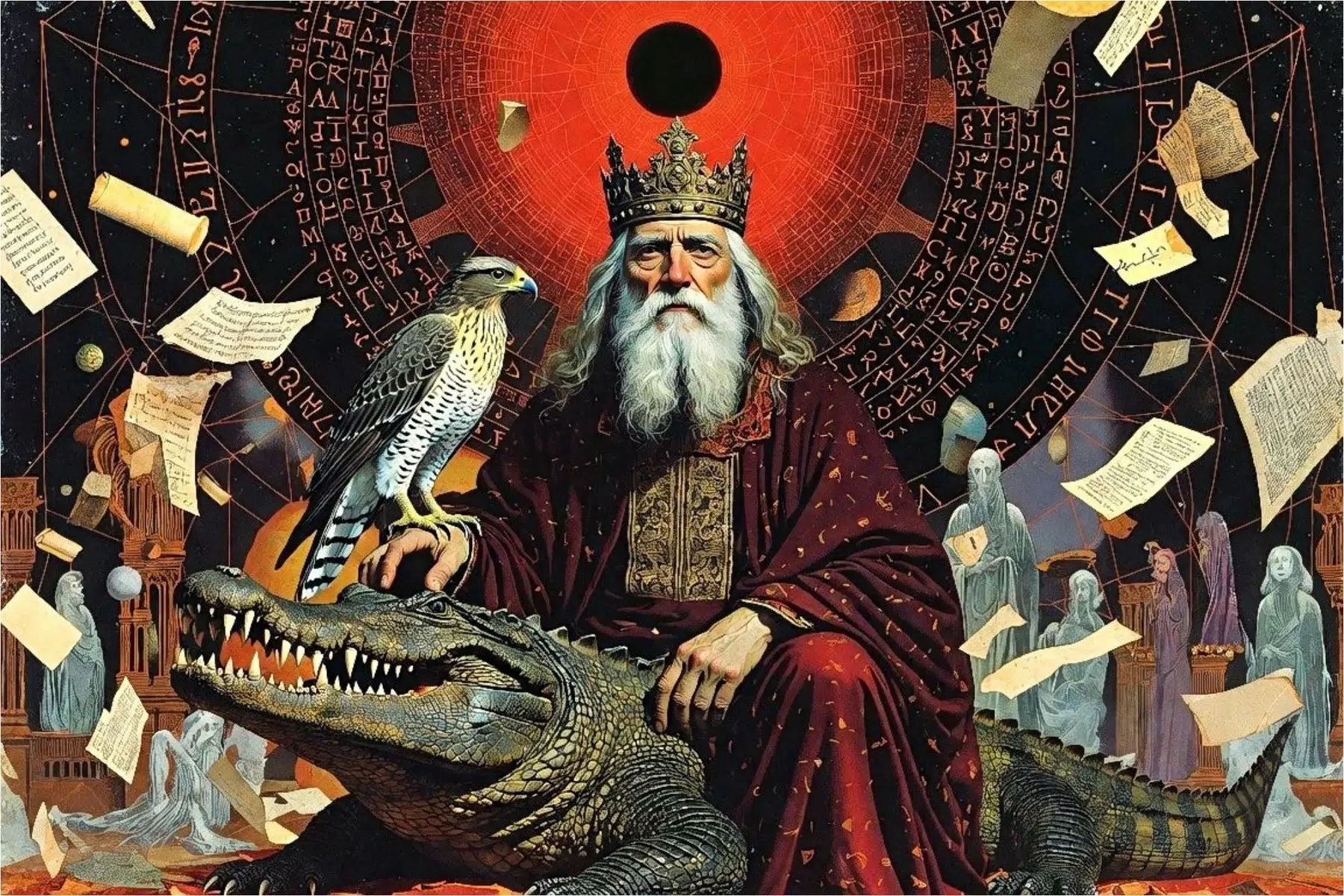
Languages first, because that’s the gift people still talk about. Not a tutor. Not a grammar book. The claim in the Goetia is that he can drop every tongue on you in the moment, which is a kind of high strangeness all by itself. If you’ve ever had a dream where you could suddenly read a page that should have been closed to you, you already know the flavor of that promise.
The runaway piece is stranger, and I think it’s the one that sits in the room after you close the book. He fetches back the people who fled. He also makes the people who were standing still start running. Call it a lost-friend charm if you want. The actual office is authority over whether a body stays or goes. In a 16th-century head, that could mean deserters, servants, a spouse who left in the night. In a modern head, you can hear how easily that office could get misused, and the old books do not give you a safety lecture.
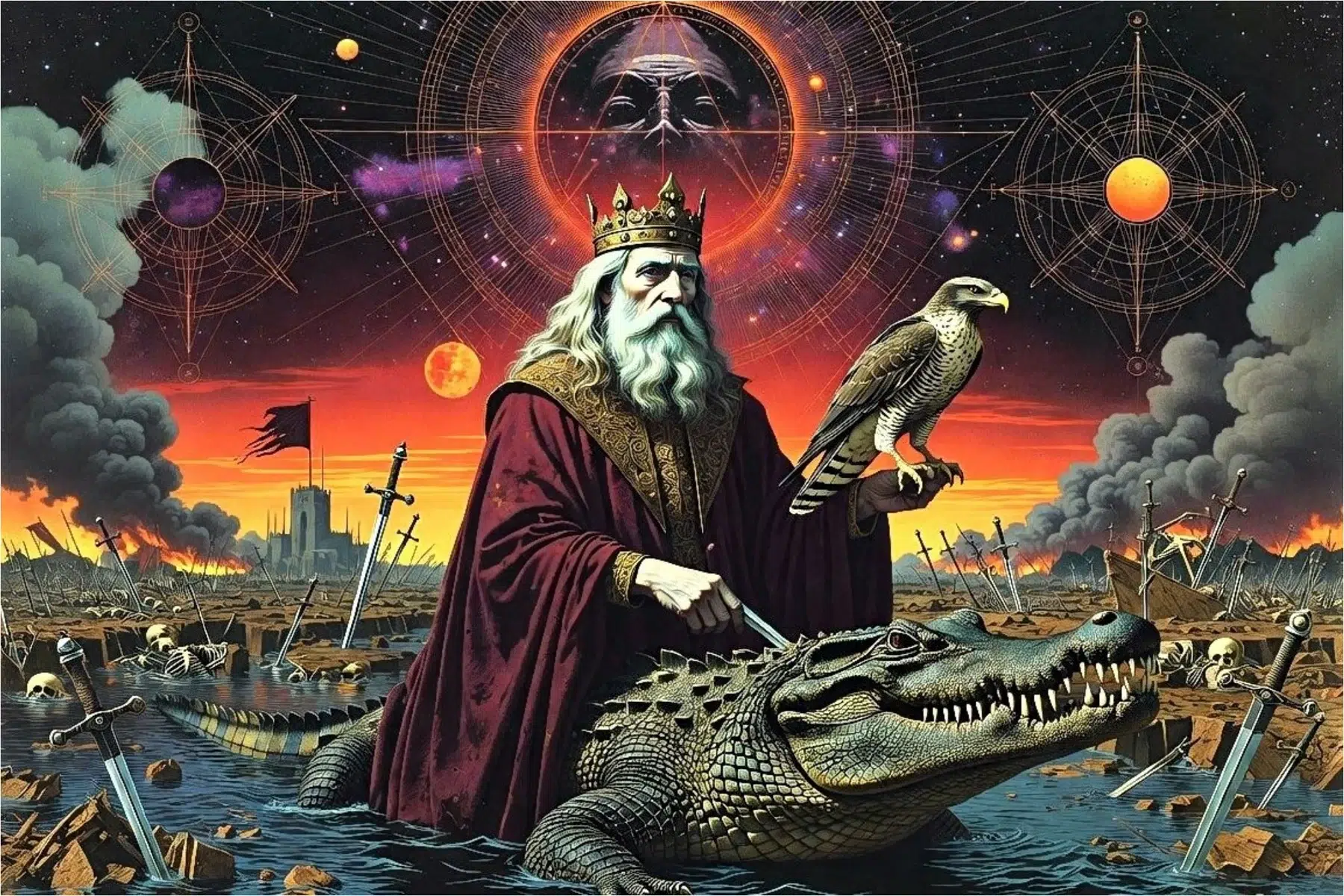
Destroying dignities is the one that sounds political until you notice the word “spiritual” is sitting right next to “temporal.” Titles, offices, the worldly kind of rank, sure. But also the other kind, the rank a spirit or a person holds in a hierarchy you can’t see. Mathers keeps both. Weyer’s Latin says he dismisses prelacies and dignities, praelaturas & dignitates dimittit. If the catalogs are right, Agares doesn’t just teach you to talk. He can take a name off a door.
And then the earth moves. Or, well, maybe it dances.
This is my one note for the (quote on quote) “experts” who like to tidy this stuff into a translation error and walk away. Scot’s English says Agares makes earthquakes. Weyer’s Latin, in the same slot, is tripudiare facit spiritus terræ. Peterson’s literal gloss is “makes spirits of the earth dance.” That’s not a smaller claim. That’s a different one, and it’s weirder. Maybe later English compilers heard the ground shaking and wrote “earthquakes.” Or, I mean, maybe both things are the same event described from two floors of the same house. I know which reading I can’t shake.
Older Roots (and What’s Still Theory)
Agares does not show up out of nowhere in 1904, and he doesn’t even start with Weyer. The name keeps shifting as you walk backward, which is pretty typical for this catalog.
Peterson’s notes on the Pseudomonarchia already catch the earlier spellings in English and Latin manuscripts: Agaros in Coxe 25 and in the SSM manuscript, Agaret in a Trinity College list, and Agaros again in the Folger Shakespeare Library’s Book of Oberon, where he’s listed second. So before “Agares” got frozen by print, people were already writing Agaros and Agaret like they were trying to catch the same sound.
Wikipedia’s Agares page, citing the historian Jean-Patrice Boudet, puts him still earlier in the French Livre des Esperitz, as Agarat. In that telling he’s described simply as an old man, and he’s given 36 legions instead of 31. I have not held that manuscript myself, so I’m marking that as Boudet’s account, not as something I counted with my own eyes.
The same Wikipedia summary, citing the 2011 Teitan Press edition of A Book of the Office of Spirits (John Porter via Frederick Hockley, ed. Colin D. Campbell), says the Liber Officiorum Spirituum places him as Agaros, second under Oriens, and describes him as an old man riding a cockatrice, with no hawk at all. A cockatrice is not a crocodile. It’s a different beast, the kind of hybrid that belongs in medieval bestiaries, a serpent with a killer stare. If that reading of the Office of Spirits is right, the mount changed on the way to Weyer, or two traditions sat down next to each other and we inherited the crocodile. That’s theory until someone puts the manuscript page in front of us, but it’s a pretty good one.
Wikipedia also notes a shorter form, Agarus, in The Grimoire of Pope Honorius, and a place for him among the subordinates of Lucifuge Rofocale in the Grand Grimoire, as A. E. Waite laid that hierarchy out. I mention those so the map is honest. I did not treat them as a second full biography.
What I will not do is invent a pagan god and staple Agares to him. Some spirits in this catalog have a pretty clear older life, Bael being the obvious one. Agares doesn’t come with that kind of trail, at least not one I could verify. The name may just be the name. That’s allowed.
The one older identity the grimoires themselves do claim is the choir. He “was of the order of Vertues.” That’s not my theory. That’s the text. In the old angelic hierarchy, the Virtues are the choir associated with miracles, with movement in nature, with the kind of power that makes the world behave strangely. A duke who teaches tongues, moves bodies against their will, and either shakes the ground or makes the spirits in it dance… you can see why a compiler would put him there. You can also see why the same compiler would say “was.” Past tense. A Virtue who isn’t standing in that choir anymore.
If you want a picture of how later Europe saw him, look up the 1863 Paris edition of Collin de Plancy‘s Dictionnaire Infernal. Louis Le Breton drew him as an old man on a crocodile with a hawk, and that engraving is the image that escaped the grimoires and started living on its own. The art in this post is doing a different job, and it should. The 1863 plate is the ancestor. These pictures are the current face.
The Seal
The Goetia doesn’t treat the seal like decoration. Mathers and the older Sloane 3825 text both close the entry on the same order. A lamen is a pendant or plate worn on your chest, and his seal is supposed to be hanging there before you ever call him.
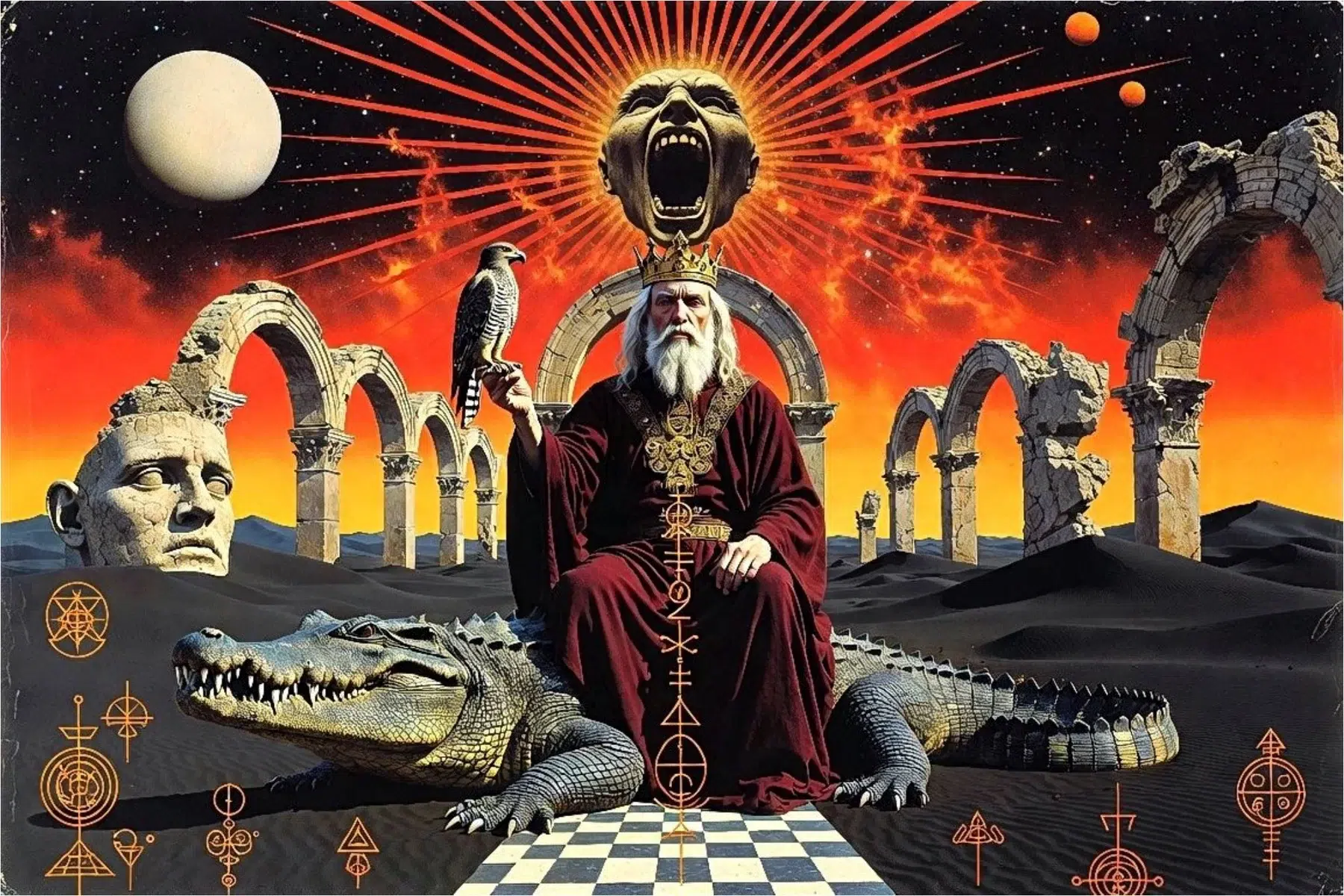
The Lemegeton also says the seals of the 72 are to be made in metals according to rank, and Peterson reads the duke slot as copper. That’s the practical instruction, as much as this book ever gets practical.
Modern Encounters and Practice
Start with the older ritual material, because it proves people were doing more than reading about him. Wikipedia, citing David Rankine’s edition of The Book of Treasure Spirits (material associated with Elias Ashmole and Sloane MS 3824), notes that Agares is named in invocations aimed at spirits that guard treasure, and that the same manuscript includes an “Experiment of Agares” for drawing him into a crystal. English magicians were writing an operation under his name, with a crystal, centuries before anybody typed his name into a forum. He was never just a list entry.
And people are still calling him. The language office is the one that shows up in the most down-to-earth way. In 2024, one Reddit user in r/DemonolatryPractices wrote a thank-you post after a language exam. Right before it, they’d done a ritual asking Agares to help with their essay. Normally they fight to make sentences in that language sound natural. That day they stopped second-guessing their word choices, and the whole thing came out smooth. No lightning bolt. Just a tongue that suddenly cooperated, which is exactly what the old books promised.
The runaway office has its believers too. In December 2024, another user in the same subreddit posted that Agares had kept their partner from moving abroad. Agares was the first spirit they’d ever worked with. After the ritual came the dreams and the synchronicities, crocodile imagery everywhere they looked. The partner had planned to leave within six months. A year and a half later, he was still there.
Then there’s what it actually feels like when he shows up. Answering a question in r/GalleryOfMagick in April 2026 about full evocation, a user named Aigle2Feu described summoning Agares and seeing him in a strange form, wearing a crown. They called the apparition “terribly real.” What stuck with them was the eyes, yellow and burning, seeming to search all the way down into them, and a deep, hoarse voice speaking inside their head. Agares gave off a force that brought chills and goosebumps, and they added that demonic energy in general can stand your hair on end and speed up your heart.
Not everyone gets him during the ritual itself. On the Become A Living God forum in 2022, a member who goes by caringang wrote up a ritual that seemed to do nothing at all. No voice, no image. Later, sliding toward sleep, they heard a woman scream their name from the middle of their own mind. Then a second voice, strong and from the diaphragm, like a middle-aged newscaster, said it again. When they asked who it was, they heard what sounded like thousands of wings, and felt wind run down the whole left side of their body. Before he left, Agares told them, “I’ll be around for a while.” They felt pressure in front of their left ear for the rest of the day.
My favorite is the slowest one. In a 2025 journal on the same forum, a practitioner called AvenaReys666 logged session after session with him. She kept smelling fresh soil in the air around her face. Waves of nausea came and went. In one trance she was standing in a swamp, stepped onto the crocodile beside him, and floated through murky green water while he pointed things out with a wooden cane, showing her how everything in that place talks to everything else. The next morning, childhood memories of her father came flooding back, and she cried. Her reading was that the runaway office covers lost memories too. Honestly, I can’t argue with her.
Today, people who work the Goetia still go to him for the offices the catalogs actually name: language, the return of someone who left, the collapse of a rank that shouldn’t have been there. Some work the full evocation with the circle and the triangle, the way the Lemegeton lays it out in our history piece. Some use later pathworking methods, which is a quieter way of approaching the same catalog, and quieter doesn’t automatically mean safer, or less real.
If you go looking on occult forums, you’ll find more heat around names like Paimon than around Agares. That doesn’t make him a lesser spirit. It might just mean fewer people are in a hurry to advertise that they asked a duke of the east to bring somebody back, or to take a dignity off a door. Fair enough.
Is Agares Dangerous?
Read his entry like a contract instead of a character sketch. Everything on it is about moving things that don’t want to move. People who left come back, people who stayed take off, rank gets stripped away in this world and the unseen one, and the ground itself either cracks or starts dancing. None of that is a small-scale power. A spirit whose whole job is upheaval isn’t a genie you rub for a parking spot.
The old books clearly treated him that way. They give dukes a binding window, mornings only and only in good weather, as if timing were part of the safety gear. And the whole Lemegeton setup assumes caution. The magician works from inside a protective circle, and the spirit is called into a triangle drawn outside it, so whatever arrives has a place to stand that isn’t yours. Nobody builds a fence like that around something they expect to be harmless.
The people who work with him now aren’t all telling love stories, either. One longtime practitioner, Voxx418, warned another user in r/DemonolatryPractices in 2024 that Agares “can bring contention, and anger,” and called that the root of his reputation for earthquakes. They say they’ve worked with Agares for decades, and that more than once an actual earthquake hit the town where they were doing the evocation. Their advice was to pick a different spirit when what you really need is to win people over.
Then there’s the backlash story. In 2023, a user named DarkRainFlames wrote a long post about getting his title wrong next to the sigil they’d drawn on their window sill. Their own tradition calls him King Agares, and they had written “Duke.” Not long after, their relationship fell apart. Through pendulum work they came to believe Agares had let it happen as a lesson about fully committing, not half-doing things. They were angry, and they forgave him eventually. They say he later told them he didn’t really care about the title. He’d just used it to frame a lesson they’d actually understand. Over on Become A Living God, in the caringang thread, a member called Wahnfried asked Agares for help landing a job, had a strange, menacing dream that night, and got a flat rejection the next day. Their takeaway was that “this stuff isn’t easy to undertake,” and they started rethinking how they work with spirits at all.
Here’s where I land. Most of the people who write about him describe a patient old man, calm and almost grandfatherly. I believe them. I also believe the practitioner who says the ground moved. Both can be true about a spirit whose offices are all about displacement. Agares seems to take you exactly at your word, and his gifts work by shifting something out of where it was. So if you ask him to bring somebody back, remember that a person with their own will is the thing being moved. If you ask him to knock down a rank, make sure it isn’t yours. The old protocol isn’t superstition to me. It’s the manual written by people who got the earthquake.
The Angel on the Other Side of the Seal
In the system associated with Dr. Thomas Rudd, each of the 72 Goetia spirits has a Shem HaMephorash angel assigned to it. The pairing is not a friendship. It’s a chain of command. As we put it in the Shem HaMephorash article:
“Demon on one side, the angel with authority over it on the other.”
— Cryptic Chronicles, “Shem HaMephorash Angels: The 72 Names Hidden in Three Red Sea Verses”
Agares’s counterpart is angel #2, Jeliel. Our live article uses that spelling in the body, “Angel 2, Jeliel, rules Agares.” The table in that same piece, and the Skinner and Rankine edition of The Goetia of Dr Rudd as cited on Wikipedia, also use Jelial. The Golden Dawn spelling is Yelauiel. The Hebrew root is ילי, and the full name is written יליאל. He’s listed among the Seraphim, in the Leo 5–10° slice, and Rudd assigns Psalm 22:19. The meaning given in the Mathers/Golden Dawn tradition is “Strength.”
That matters if you’re the kind of person who doesn’t like the idea of calling a Goetic duke with nothing standing on the other side of the seal. Rudd’s double seals were built for exactly that: the spirit on one face, the angel on the other. I am not going to turn this section into a ritual manual. I’m telling you the pairing is old, sourced, and already on this site.
And Jeliel, or Yeliel, is not a paper angel. In our Shem article we already covered a February 2026 writeup by Reddit user Brave-Movie-1028, who worked an eleven-day ritual with Yeliel for love, heard “this is coming,” met the person, froze, and later said, “there’s a killer instinct behind me now which I never had.” That’s the counterpart’s public trail, not Agares’s. I still think it’s worth keeping in the same frame. If the Rudd system is right, these two are not strangers.
Agares Demon FAQs
Who is the Agares demon in the Goetia?
Agares is the second of the 72 spirits in the Ars Goetia, a duke under the power of the east, said to command 31 legions. The main printed ancestors of his entry are Weyer’s Pseudomonarchia Daemonum (1577) and Scot’s 1584 English, then the 17th-century Lemegeton, then Mathers and Crowley in 1904.
What does Agares look like?
The standard description is an old man, fair to look at, riding a crocodile, carrying a goshawk on his fist, and mild in the way he arrives. Earlier lists may swap the crocodile for a cockatrice and drop the hawk. Collin de Plancy’s 1863 Dictionnaire Infernal made that crocodile image famous.
What can Agares do?
The catalogs say he teaches all languages immediately, fetches back runaways and makes the standing run, overthrows spiritual and temporal dignities, and either causes earthquakes or makes the spirits of the earth dance, depending on whether you follow Scot’s English or Weyer’s Latin. They also say he was of the Order of Virtues.
Is the Agares demon dangerous?
The grimoires give him powers built for upheaval: earthquakes, toppling spiritual and worldly rank, and moving people against their will. Some practitioners describe him as patient and calm, while others report anger, backlash, or real tremors around their work. Most agree he takes requests literally, so the old cautions about timing and protection still apply.
Which Shem HaMephorash angel is paired with Agares?
In the Rudd system, angel #2, Jeliel (also spelled Jelial or Yelauiel). That pairing is in The Goetia of Dr Rudd and in our Shem HaMephorash article.
Next and Previous
Previous: #1 Bael, already on the site.
Next: #3 Vassago is coming. The Goetia even says Vassago is “of the same nature as Agares,” which is a hell of a teaser to hang on the next door.
Counterpart: Agares’s angel, #2 Jeliel, is in our Shem HaMephorash Angels article until his own guide goes up.
This post is part of the Goetia Entity Guide.
If Agares is a Virtue who changed sides, and his angel is still standing on the other face of the seal, what do you think that partnership actually looks like when both of them show up?
Follow and Support
Follow on X: https://x.com/CrypticChrncles
Patreon: https://www.patreon.com/c/crypticchronicles
BUY MERCH: https://crypticchronicles.com/cryptic-chronicles/categories/shop/
👻 Explore spirit boxes, EMF detectors, haunted collectibles and Aztec death whistles at US Ghost Adventures, and support the show: https://tidd.ly/3UyP4yK
Affiliate disclosure: Cryptic Chronicles may earn a commission from qualifying purchases at no additional cost to you.
Sources
- S. L. MacGregor Mathers, trans., The Book of the Goetia of Solomon the King, ed. Aleister Crowley (Society for the Propagation of Religious Truth, 1904). Agares entry via the Sacred Texts transcription
- Joseph H. Peterson, transcription of Lemegeton Clavicula Salomonis, Sloane MS 3825, Esoteric Archives (Agares entry, metal list, and binding hours)
- Johann Weyer, Pseudomonarchia Daemonum (1577), Latin and Scot’s English, in Peterson’s edition
- Reginald Scot, The Discoverie of Witchcraft (London, 1584)
- “Agares,” Wikipedia, including citations to Jean-Patrice Boudet, “Les who’s who démonologiques de la Renaissance et leurs ancêtres médiévaux,” Médiévales 44 (2003); A Book of the Office of Spirits, ed. Colin D. Campbell (Teitan Press, 2011); and David Rankine, ed., The Book of Treasure Spirits (Avalonia, 2009)
- Tim Hacker, “Shem HaMephorash Angels: The 72 Names Hidden in Three Red Sea Verses”
- Stephen Skinner and David Rankine, eds., The Goetia of Dr Rudd (Golden Hoard, 2007), as cited on Wikipedia and in the Shem article’s table (Jelial / Agares)
- Tim Hacker, “The History of the Goetia”
- Tim Hacker, “Bael: The Goetia Demon”
- Jacques Collin de Plancy, Dictionnaire Infernal, 1863 edition, illustration by Louis Le Breton

0 Comments